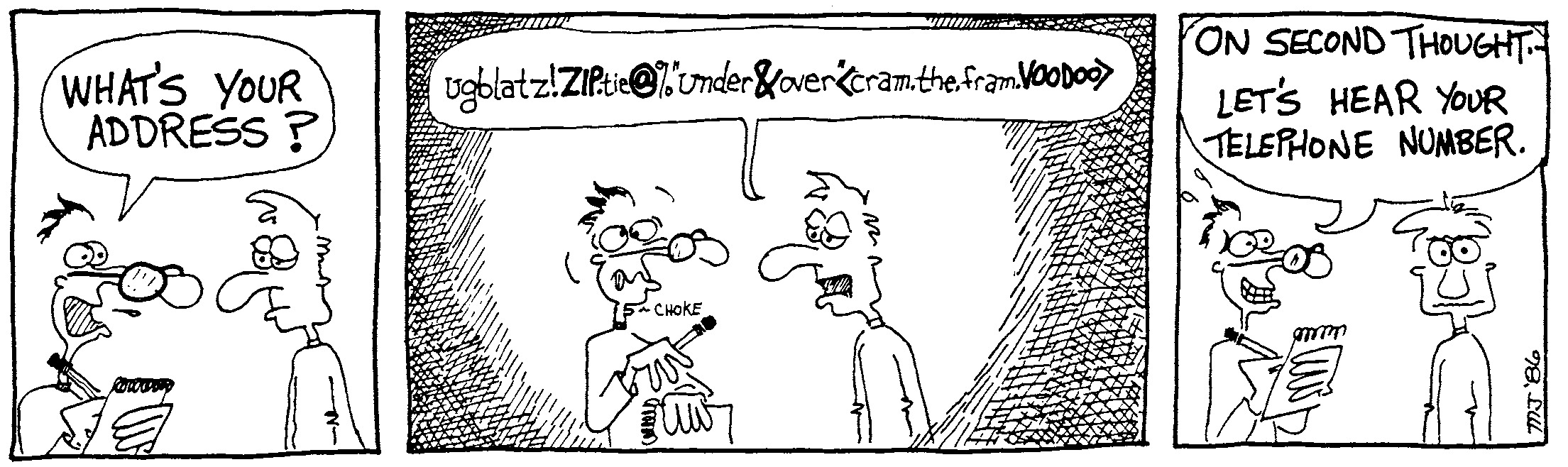
Mastering the Networks
by John Anderson
The desire to allow computers to talk to each other has given way to a multitude of networks each having their own protocol and characteristics. These diverse networks are all gatewayed to each other such that a user on any one of these networks can communicate with a user on another network. In a sense the networks themselves are networked together.
In this article, we will attempt to untangle the wires connecting these networks and examine the ARPANET, BITNET, CSNET, Mailnet, UUCP network, and their gateways.
The ARPANET is perhaps the most well known of all the networks. The ARPANET is funded by the Advance Research Projects Agency (Department of Defense) and exists to allow the various research institutions to share both resources and information. All types of machines running every imaginable operating system are on this network. Having an account on a machine which is an ARPANET node is the most desirable position to be in from a networking standpoint. This situation is advantageous because the ARPANET has gateways to all of the networks we will discuss. Because of this and some properties we will discuss later, the ARPANET has also been termed the "Internet."
Physically, ARPANET nodes are connected by dedicated data lines and use the TCP/IP protocol for communications. The TCP/IP protocol is one of the most popular and versatile networking protocols currently available. TCP/IP was made popular by the ARPANET and evolved on it. A node on the ARPANET can remotely login to, send mail to, and transfer files with any other node on the network directly. This is the only network which allows a user to remotely login to all of the nodes on the network.
The hacking possibilities for a user on this network are almost unlimited. The Network Information Center computer that is available to ARPANET users is the ultimate network resource. It provides abundant information about the ARPANET and the various gateway sites. A user on the ARPANET can contact NIC by using the command Telnet to open a connection with: sri-nic.arpa
The BITNET is similar to the ARPANET in that it also uses dedicated lines for communications. The similarities end there because instead of the TCP/IP protocol the BITNET uses the Remote Source Control System (RSCS) protocol. This network was originally composed of IBM mainframes and minicomputers due to its use of the RSCS protocol which is exclusively IBM's. Recently RSCS emulators have become available for machines running VMS and UNIX. Several non-IBM machines have joined the BITNET using these emulators and many shall follow. It is doubtful, however, that the BITNET will ever support all of the features that the ARPANET boasts since the RSCS protocol is very restrictive. The BITNET only supports electronic mail and file transfer between its nodes. It is not possible for one node to remotely login to another. Inquiries about the BITNET can be addressed to:
Educom BITNET Network Information Center P.O. Box 364 Princeton, NJ 08540 Phone: 609-734-1878 |
The CSNET or Phonenet is a network of university computer science departments and other research institutions. The CSNET is radically different from the networks mentioned above in that every node on the network is only connected to the relay node (csnet-relay). The connection to this central node is not via a dedicated line but via dial-up phone lines. Periodically (usually once a day) the csnet-relay will call each node on the network to see if there are any messages to be transferred. This type of network architecture gave the CSNET its second name, Phonenet. The CSNET only supports electronic mail and is not likely to ever support any other network functions if it does not change its method of networking. The CSNET is run by Bolt Beranek and Newman Inc. and can be contacted at the following address:
Bolt Beranek and Newman Inc. 10 Moulton Street Cambridge, MA 02238 Phone: 617-497-2777 |
A network similar to the CSNET is the Mailnet. Apparently this network only supports the transfer of mail. At this time the type of network structure and machines using this network are unknown to the author. However, it would not be unreasonable to assume that this network uses a structure similar to the CSNET's. Please address any additional information about Mailnet to this magazine.
Perhaps the largest and most loosely structured network is the UUCP network. This network has nodes in Canada, Japan, Europe, Australia, and many other countries. The UUCP network is composed exclusively of machines running the UNIX operating system. The network uses dial-up phone lines for the transmission of data and uses the UUCP protocol. UUCP (UNIX-to-UNIX Copy Program) is found on every system running UNIX and systems need only establish a connection with one system on the network to become a fully functioning node. The transfer of mail to any node on the network is supported. Remote logins and file transfers are only supported with your direct neighbors.
With so many different networks, a need for inter-network communications arose. Gateways are the bridges that link these networks together. Gateway sites are sites which reside on two or more networks. These gateways allow for the transfer of mail messages from one network to another. They do not allow remote login or file transfer. Almost every gateway site is a node on the ARPANET/Internet. Therefore if a user can send a message from his/her network to the ARPANET, it is possible to communicate with any other network which has a gateway site on the ARPANET. Below is a list of gateways to and from the ARPANET and the mailer syntax required:
Gateways to the ARPANET From ARPANET Gateway Site Mailer Syntax BITNET wiscvm.bitnet user%node.arpa@wiscvm.bitnet CSNET csnet-relay.csnet user%node.arpa@csnet-relay.csnet Mailnet harvard.mailnet user%node.arpa@harvard.mailnet UUCP seismo.uucp seismo!user%node.arpa Gateways from the ARPANET To ARPANET Gateway Site Mailer Syntax BITNET wiscvm.arpa user%node.bitnet@wiscvm.arpa CSNET csnet-relay.arpa user%node.csnet@csnet-relay.arpa Mailnet harvard.arpa user%node.mailnet@harvard.arpa UUCP seismo.arpa node!user.uucp@seismo.arpa |
Example #1
A user on the BITNET wishes to send a message to a user on the CSNET:
user%node.csnet%csnet-relay.arpa@wiscvm.bitnet |
(The @ is known as the separator and specifies the username at the node. An address can only have one @ in it. As the message gets closer to its destination, the @ and everything to the right of it will be chopped off. The % that is furthest to the right will then become an @. The % indicates additional directions.)
Example #2
A user on the UUCP network wishes to send mail to a Mailnet user:
seismo!user%node.mailnet%harvard.arpa |
(The UUCP network syntax is reversed. The ! appears on the left. In this example, seismo is the machine or gateway the user must go through. There can be more than one ! in a line. As the message progresses, the ! furthest to the left and everything to the left of it is chopped off. When the last ! is chopped off, the % on the right becomes an @. UUCP is not auto-routing, while the other networks are. This makes the ! feature necessary.)
By following the above examples, a user with a little knowledge of the network he/she resides on can communicate with any node on any network. It is quite possible that a user in Europe and a user in Australia could communicate with each other on a regular basis with a message delivery time of only two days. The uses for the above mail networks are limited only by one s imagination. These networks could be used to unite hackers all over the world at an almost negligible cost.