Build a Telephone Induction Coil
by 1000 Spiderwebs of Might
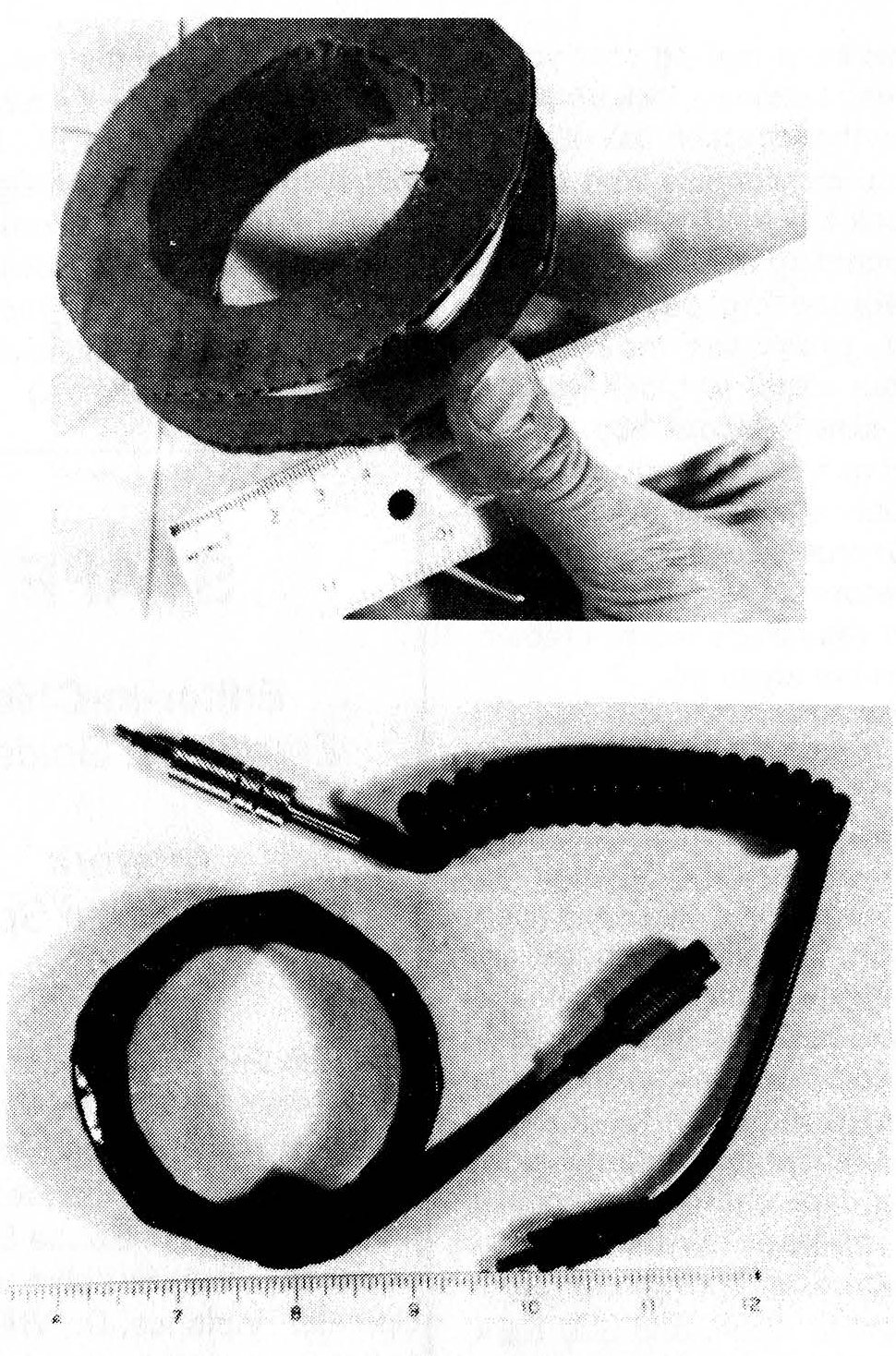
This multipurpose induction coil slips over the handset receiver of any payphone or standard desk phone and can be used in conjunction with a Walkman-type cassette unit for a variety of record and playback functions with excellent fidelity - at least to the extent that the telephone lines can carry frequency response-wise. You'll need a piece of brown corrugated cardboard from the side of a discarded box, some thin cardboard (like from a cereal box), a sharp hobby knife, electrician's tape, white glue or a hot glue gun (it'll speed construction a great deal) and 50 feet of #26 wire.
Begin by taping a single layer of cereal box type cardboard (about 1/2" wide) around the receiver side of the handset and secure it with a single wrap of tape. This is a spacer layer and is eventually discarded but insures the finished induction coil slides easily over the handset's receiver. Now wrap a single layer of 1/2" wide corrugated cardboard around this spacer layer and secure with a wrap of tape. Corrugated cardboard makes the best coil form because of its strength and rigidness.
Pull the corrugated cardboard ring off and discard the inner spacer ring (or save it if you are constructing more than one coil). Glue the corrugated cardboard ring to a 4' square piece of corrugated. After the glue sets, carefully cut out the inside of the ring with a sharp hobby knife to make a nice round hole that easily slides over the handset's receiver. Now glue another 4" square piece to the other side of the coil form and again cut out the inside of the ring.
Measure out about 50 feet of #26 wire and wind it around the completed corrugated coil core. Secure the two wire ends of the coil by twisting them together a few times. At this point you can either solder a short piece of shielded cable attached to an inline RCA phono jack or a longer cable terminated with a miniature stereo plug of the kind used in Walkman-type headphones. Connect the left and right channel inner conductors together for one connection to the coil and use the shielded braid for the other connection. If possible use a coil cord. They don't tangle as easily plus coil cords always have a cool hi-tech look to them.
Now carefully trim down the outside cardboard sides of the coil and wrap a long continuous overlapping spiral layer of electrician's tape around the remaining "doughnut" coil. Make sure the finished coil easily slides over the handset's receiver without being too loose or wobbly. Add another partial layer of tape if necessary to snug up the fit.
For the ultimate finishing touch the completed induction coil could be dipped in Plasti Dip instead of using the insulated tape. It dries to a smooth uniform rubberized coating. Plasti Dip is usually used to dip screwdriver, wrench, or other tool handles in order to prevent corrosion and provide a better grip.
Make a Red Box Tape
The easiest way to make one by yourself is to find two payphones side by side (like at a shopping mall, airport, or hotel lobby). Plug in your induction coil to the tape recorder's external mic input making sure you've installed fresh batteries.
Pick up phone #1, slide on the induction coil (it's best to cover the mouthpiece with a thick cloth to block any extraneous sounds), start the recording mode and initiate a call to neighboring payphone #2. Answer it, press the mouthpiece against your chest to block out any noise and slowly deposit about $5 or $6 worth of quarters into payphone #2. Hang up phone #2 after the last coin and all your change will come back via the coin return after a few seconds delay. Now you have a Red Box tape of quarter tones ready to go.
Plug the induction coil into the earphone output jack of your tape recorder. Play back the series of tones - you'll hear them clearly reproduced through the earpiece. Adjust the volume control for a nice and clear reproduction. Usually the control will be a notch or two short of full volume. Now make a test long-distance call to check out your new tape. Just don't let your batteries run down too low and you'll always get consistently good results.
The tape can even be copied over to another Walkman-type recorder using an appropriate patch cord. It's best to record and play back the copied tape on the same cassette recorder because exact tape speed is important to keep the pitch of beep tones identical. If you want to play music or a prerecorded spoken message over the phone the induction coil will produce superior fidelity compared to the carbon mic element in the handset. While music fidelity isn't great over the rather limited frequency range of phone lines it's still O.K. - much better than you're used to hearing and at times it's fun to be able to do it conveniently.
Since the induction coil couples all signals to the phone line via a magnetic field the fidelity is as good as possible and is only limited by the characteristics of the particular phone circuits.