The Australian Phone System
by Midnight Caller
In Australia there is one company which controls the nation's Public Switched Telephone Network (PSTN): The Overseas Telecommunications Corporation, which trades as Telecom Australia.
Telecom Australia is a federal government-owned statutory corporation responsible for providing telephone, data, and other communications services to the public. Put simply, Telecom have a monopoly on first home-phone installation and the core network (e.g., the copper wires, the optical fiber, the cellular network, etc.)
This all changed in late-1991 when Telecom was stripped of its monopoly and forced to compete in a duopoly arrangement with a second carrier until 1997 when the duopoly arrangement expires and it becomes free for all. The federal government will be issuing a second-carrier license which will allow full de-regulated competition for the first time in the provision of core network services. While the telecommunications industry has been de-regulated for quite some time (if you didn't like your Telecom phone, you could buy a cellular phone or pager from anyone), there has never been any competition on the initial connection service, or in the on-going provision of service.
When first offered, 31 different companies, mostly foreign, registered interest in applying for the license which carries a $3 billion (US$2.5 billion) license fee and includes three operational satellites (which no one wants), and three others being built (which no one wants either) by Hughes Aircraft Corporation.
There are now three consortiums left in the race: the BellSouth/Cable & Wireless consortium (C&W run the Mercury phone company in the United Kingdom), the Bell Atlantic/Ameritech consortium who recently bought the run-down hovel phone system in that rather odd country next to us, New Zealand, and a third-party which has remained anonymous, though rumor has it that the third consortium is led by Com Systems.
It is widely believed that BellSouth will get the license and Bell Atlantic will have to be content nursing sheep in New Zealand. As mentioned before, until 1997 there will be a duopoly, with the exception of a third nationwide cellular network to be licensed sometime next year or so.
The Network
The Telecom network consists largely of ARE-11 and Ericsson AXE-10 switching systems though older ARF and step-by-step exchanges still exist in some rural areas. The Ericsson AXE-10 exchanges are currently the most advanced exchanges available for use by the general public. At present some 70 percent of the Australian telephone network is fully computerized and this is expected to reach a full 100 percent by around 1994/95.
The AXE-10 offers all the facilities of what the more advanced Western Electric ESS systems offer such as Centrex facilities. One notable feature not offered by Telecom, though it can be made available on the AXE-10 exchanges, is ANI. Considering the problems U.S. phone companies have encountered in offering ANI services, Telecom has never made any comment on the facility, though BellSouth has said that it would be one of the new features it would introduce should it be successful in bidding for the second carrier license.
DTMF dialing is available as standard on the AXE-10 exchanges while those decrepit individuals unlucky enough to be on ARE-11 exchanges (like me) must apply for a DTMF service. It doesn't cost any extra, but it keeps a few failed bureaucrats in a job if you have to apply for it. The ARE-11 exchanges are far less advanced than the AXE-10s. They do not offer any of the Centrex or Easycall facilities (such as Call Waiting, Three-Way Calling, Call Diversion, ANI, etc.) that the AXE-10 offers.
The telecom network command center is located in Exhibition Street in the center of Melbourne with a fallback command center located in the Melbourne suburb of Windsor. Smaller network command centers are located in each state capital.
These two locations control all network management functions nationwide for all exchanges with the exception of the old step-by-step exchanges. They also control the nationwide data services and other special services such as AUSTPAC (X.25), Iterra (satellite), ISDN, DDN Flexnet (Digital Data Network), MobileNet (cellular), as well as a host of other services.
Being Telecom's home city, the central area of Melbourne is also the only city to be fully linked up with optical fiber at this time. Telecom is gradually overhauling its inter-city trunk lines with optical fiber (with the microwave network acting as a backup). Melbourne, Canberra, and Sydney are linked together by a 1000 km long stretch of fiber optic cable, with other links currently under way.
Payphones
There are five types of payphones in use around Australia. These are: The Phonecard payphone (the new standard payphone), CardPhone (for credit and debit cards), BluePhone, GoldPhone (being replaced by BluePhone), and the older rotary dial payphones which are progressively being phased out.
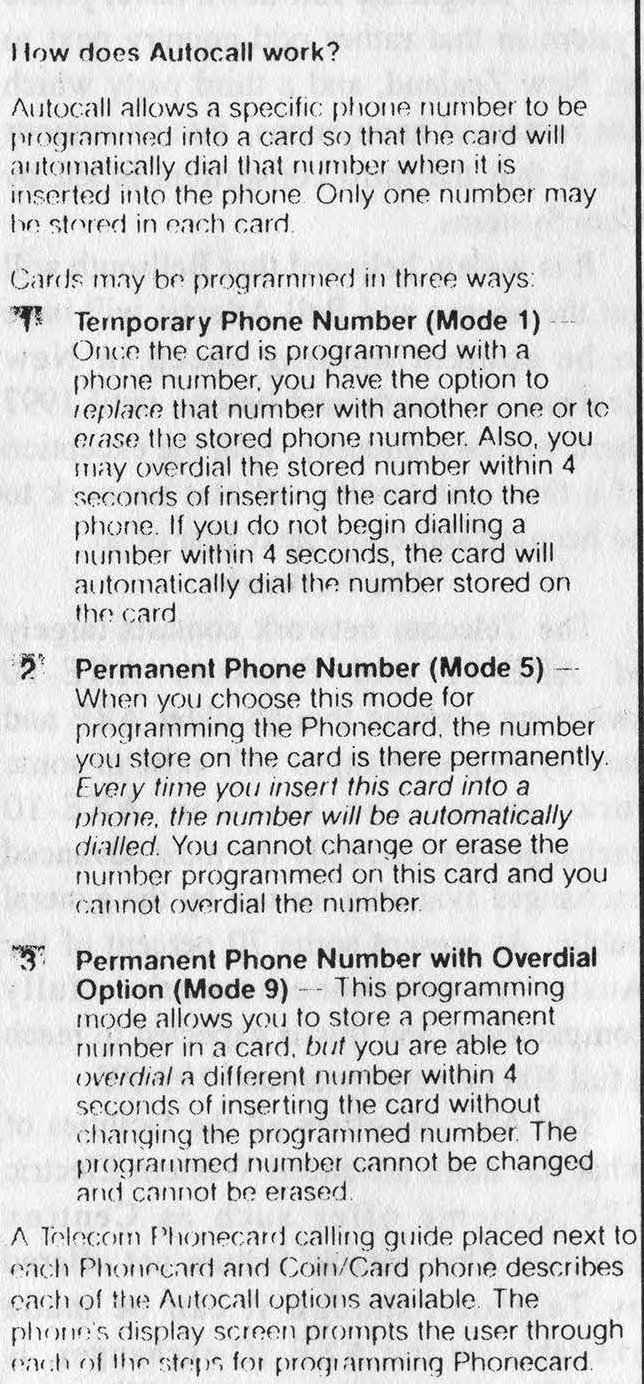
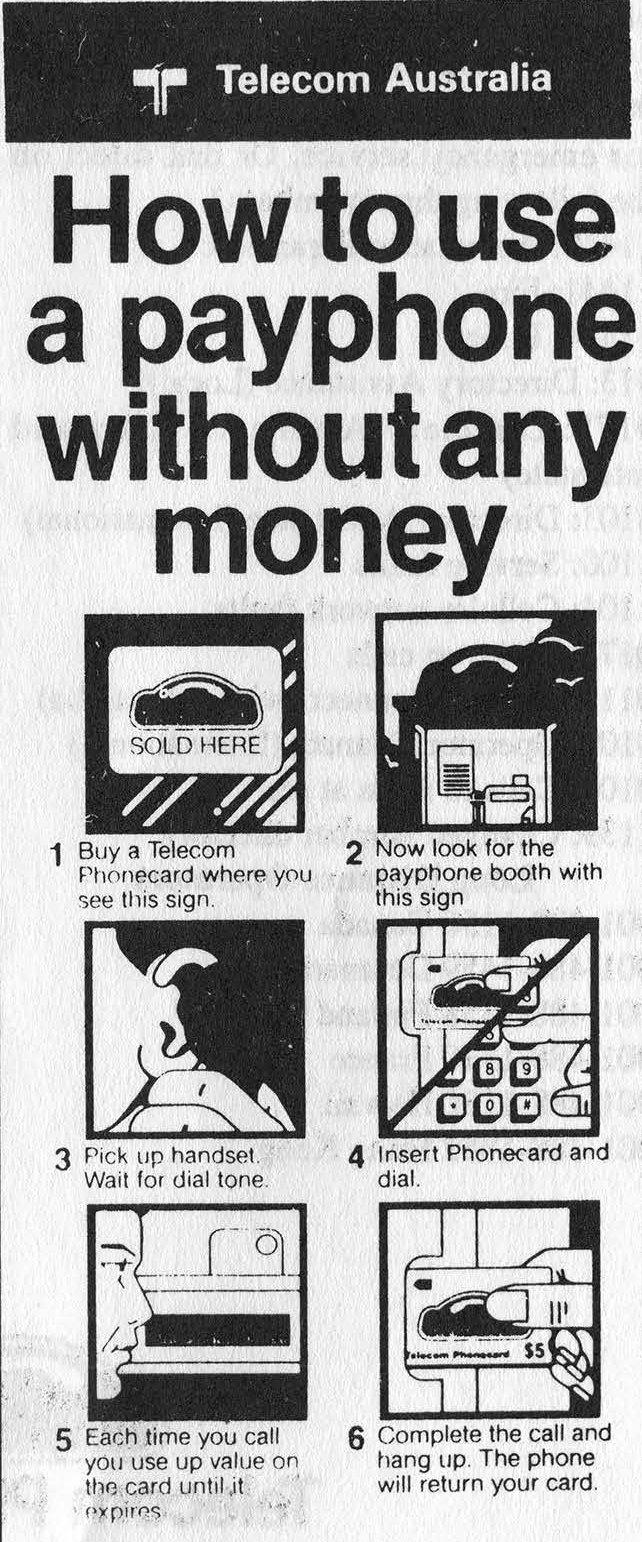
Phonecard Payphone: The new standard payphone in Australia is the new Telecom Phonecard Payphone. This phone uses either coins or pre-paid telephone cards similar to the cards that NTT (Japan) used to use in their payphones until the introduction of smartcard telephone cards. These payphones are usually located in places such as airports, hotels, and on the street.
Cardphone Payphone: These payphones only accepts credit or debit cards such as Amex, Visa, Mastercard, and debit cards issued by most of the banks. To place a call, a customer swipes their card through the card reader, then enters their PIN number. After this is verified, the caller dials the number they want and the call is charged back to their card. These phones are located in airports, tourist areas, hotels and some central city locations. They are generally not located in the street.
BluePhone Payphone: The BluePhone was so-called because it is blue - pretty imaginative. These accept coins only and are only located indoors. Most may be found in bars, groceries, supermarkets, restaurants, 7-Elevens, stores and hotels. These are never located on the street.
GoldPhone Payphone: Prior to the world's greatest marketing coup, the BluePhone, Telecom's crack advertising team christened the GoldPhone - it was gold. The GoldPhones are unimpressive indoor phones such as the BluePhones (See Spring 1990 for photo) and are gradually replaced by the BluePhones.
CrapPhone Payphone: So named because that is what it is. This has been the Telecom standard payphone for more than 10 years. While some have had push-button dialers installed, most still use rotary dial mechanisms. These payphones are easily distinguishable from their robust, but dull, metallic green appearance. The unit itself is made of two-inch thick steel. These phones may be found in streets but are being progressively replaced but the Phonecard payphone. By replacing coin-only payphones with card-accepting phones, Telecom hopes to reduce the level of vandalism affecting payphones.
Operator Numbers
0101 : Operator Connect (International) 0103 : Directory Assistance (International) 0108 : Calls to Ships at Sea 0173 : Wake-Up calls 0175 : Directory Assistance (Intra- and Inter-state) 1100 : Service Faults 1104 : Cellular nEtwork faults 1139 : Changed Number Directory 011 : Operator Connect (Within Australia) 013 : Directory Assistance (Local 000 : Emergency Operator Ask operator for emergency service. Or dial-direct on the following three numbers: 11440 : Ambulance / Paramedic 11441 : Fire 11444 : Police |
Long-Distance Operators
001-488-1150 : Canada 001-488-1459 : Denmark 001-488-1358 : Finland 001-488-1330 : France 001-488-1180 : Hawaii 001-488-1852 : Hong Kong 001-488-1620 : Indonesia 001-488-1390 : Italy 001-488-1810 : Japan 001-488-1820 : South Korea 001-488-1310 : Netherlands 001-488-1640 : New Zealand (TCNZ) 001-488-1650 : Singapore 001-488-1440 : U.K. (British Telecom) 001-488-1011 : U.S. (AT&T - USA Direct) 001-488-1100 : U.S. (MCI - Call USA) |
Other/Special Numbers
199 : Ring-Back 552-4111 : Telecom Line Identifier (gives you the number you are calling from if on ARE-11 or AXE-10 exchange) 01921 : AUSTPAC (X.25) 300 bps 01922 : AUSTPAC (X.25) 1200 bps 01923 : AUSTPAC (X.25) 1200/75 bps 01924 : AUSTPAC (X.25) 2400 bps 01925 : AUSTPAC (X.25) 4800 bps 01928 : AUSTPAC (X.25) 9600 bps 01955 : Discovery 1200/75 bps 01956 : Discovery 2400 bps 0193111 : Discovery 2400 bps |
Australian Capital City Area Codes
02 : Sydney, NSW 03 : Melbourne, VIC 06 : Canberra, ACT 07 : Brisbane, QLD 08 : Adelaide, SA 09 : Perth, WA 002 : Hobart, TAS 089 : Darwin, NT |
-+-+-+-+-+-+-+-+-+-+-+-+-+-+-+-+-+-+-+-+-+-+-+-+-+-+-+-+-+-+-+-+-+-+-+-+-+-+-+
        The Following was Taken From The 2600 Magazine of Spring 1992
                    Text typed by OMEGA / MEGA - Ind.
-+-+-+-+-+-+-+-+-+-+-+-+-+-+-+-+-+-+-+-+-+-+-+-+-+-+-+-+-+-+-+-+-+-+-+-+-+-+-+