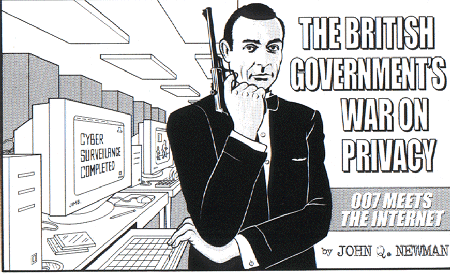
007 Meets the Internet
by John Q. Newman
The Internet poses a serious challenge to national governments that want to restrict what type of information and entertainment their citizens can see. By its very design, the Internet transcends national borders and content laws that most nations impose on television and radio broadcasters. Television and radio stations in Canada, for example, are required to carry a certain percentage of Canadian content programming. These programs must be carried, even if they have few or no patrons, and lose money, as part of the “national” duty of the station concerned.
The Internet flies in the face of such regulation. Internet users can visit any sites they wish, regardless of the nation the site is actually located in. An Internet activity that might be illegal in one jurisdiction may be quite legal in another. Internet users can gamble online, and view explicit erotica, frequently in defiance of local laws and regulations. The Internet also allows instantaneous and essentially anonymous correspondence with other Internet users via e-mail anywhere in the world.
The state of affairs has caused the government of the United Kingdom to enact a set of laws that will remove any vestiges of privacy from all Internet users located in the British Isles. These laws are collectively known as “big browser,” and they are truly Orwellian.
These laws allow the British government, without a warrant, or any other judicial process, to delve into the private web-grazing habits of the masses. Police agencies will be given broad new powers that will supercede the need to justify their snooping before a judge. The new laws will require that all UK-based Internet service providers link “black boxes” to their systems that have the capability of tracking the web browsing of each subscriber. Individuals can be forced, under penalty of fines and imprisonment, to reveal passwords for their e-mail accounts, and finally, these new powers will be backed up by a new, multimillion-dollar cyber-monitoring center located at MI-5, Britain's notorious secret police headquarters.
This is not a “what if” scenario. The cyber monitoring center has already been constructed, and the enabling legislation has already been passed. Unlike the United States, there is no way these new laws can be challenged on constitutional grounds, because in England, there is no constitution.
It is too late for anything to be done about the British situation, but we can learn some valuable lessons from this on our side of the Atlantic. The Internet in and of itself will not create or protect privacy. In fact, the reverse can happen. The same technology that allows everyone to access the Internet can also be very easily used to spy on the hapless individual. The recent controversy over the FBI e-mail interception program known as Carnivore is proof of this.
The Internet will become an indispensable part of daily life, for most people, in the manner that the telephone is now. Government agencies require warrants and other judicial process to tap telephones or open someone's mail. There should be no less protection for communication via the Internet.
The danger is that many of our privacy laws are inadequate to cope with 21st century technology, and court decisions have gutted many of the privacy protections we had before. We may want to believe that an American version of the “big browser” laws are unthinkable; but experience should tell us otherwise.
In America, privacy is not lost in quantum jumps, but in small, incremental steps. But in the end, the net result can be the same. No government agency would think of proposing laws as radical as big browser, at least not in one step. But in many ways, we have our own set of “big browser” laws already in force, just in different areas of our lives. Consider your credit report for example.
Most other industrial democracies do not allow almost anyone access to the credit histories of their citizens unless there is a valid reason for such access, such as the extension of credit. This is not the case in the United States. In the United States, complete strangers can purchase most parts of anyone's credit report for a few dollars, quite legally. How did this happen? A number of years ago, certain industry groups - credit bureaus, financial service firms, etc. - lobbied the Federal Trade Commission to remove the privacy protections from most parts of an individual's credit report. To make a long story short, the FTC sided with the moneyed interest, and the result is that your most personal identifying information - your Social Security number, for example, is now essentially a public record item available to anyone for less than $50.
Our privacy has also been removed from our driver and vehicle registration records. Most state motor vehicle departments have sold off en masse the entire database of drivers license and vehicle registration files for many decades. These two practices are not common in most other industrial democracies.
The challenge is to stay vigilant about our privacy rights, and to not agree to gut the few privacy protections we do have. People are often convinced to give up their privacy rights by being told that doing so will conquer a greater evil. The British government sold the “big browser” legislation to the public by fear mongering. The argument was essentially that British law enforcement would be helpless in the face of criminals who use the Internet to entice underage children into unspeakable acts, or execute crimes of extreme violence such as terrorism and drug smuggling. The Internet would give these pedophiles and terrorists a cloak of anonymity and allow them to run amuck with impunity.
Anyone who opposes the legislation, once the debate is framed in these terms, seems to be in a league with the devil, and once again, privacy loses. The ultimate challenge of democracy is simply that a few of the guilty go free so that the innocent are not wrongly convicted. A similar analogy applies to privacy rights in a democracy. Some will abuse the right of privacy to commit unspeakable acts, but a democracy must tolerate this to allow the vast majority of its people to enjoy the right of the “unexamined” life.