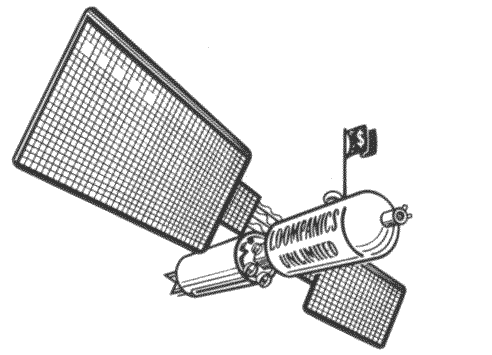
© 2000 by Bob Newland Artwork © 2000 by Nick Bougas
Organized Crime is directly paying a third or more of the 535 people sitting in the Congress of the United States. There is no other rational explanation for the kilotons of vice-producing laws we've had dumped on us since about the day my four-year-old granddaughter, Bridget, was conceived.
Claire Wolfe, whose essays have graced these pages, and whose Loompanics books could soon be banned and burned, said in the foreword to 101 Things to Do 'Til the Revolution, "America is at that awkward stage. It's too late to work within the system, but too early to shoot the bastards."
That there are 7,000 new federal laws in four years is reason enough to shoot the bastards. After you have prohibited stealing, beating people up arbitrarily, killing people, defrauding people, creating imminent danger through personal negligence or malice, kidnapping, rape, and littering, what's left? A few dozen laws to differentiate between various degrees of crime and to propose appropriate punishment? Maybe.
The crimes I just listed create victims. But what -- that doesn't fall into one of the above-listed categories -- can properly be called a crime? The creation of more "crimes" through legislation is the result of special-interest lobbying, and imposes economic regulation under the guise of moral indignation. Someone -- often many someones -- gets paid off every time a law is passed today. I'd say that's true of every single law passed during the entire 20th Century.
The first wholesale disaster caused by this congressional whoring was alcohol Prohibition. In 1918, the rate of alcohol consumption had been steadily declining since the Civil War. Crime was low. During the next 14 years of federal alcohol prohibition, alcohol consumption rose to the current level, where it's hung for 68 years. Murders rose from three per 100,000 population per year to ten per 100,000. The drive-by shooting was born. Millions of our parents and grandparents were criminals. Many suffered horribly because the whimsical gavel of justice landed on them instead of their neighbors.
When Prohibition ended in 1932, the murder rate dropped like a rock to the pre-Prohibition level. All crime dropped to near pre-Prohibition levels. The nation enjoyed this state of relative safety and security for the next 35 years, despite the little-publicized antics of ex-Prohibition Agent Harry Anslinger, who had, along with the Hearst paper empire and DuPont Plastics (nylon), managed to vilify hemp, "marijuana," as the Next Big Threat to Virginity and the American Family.
The Vietnam War's daily incursion into everyone's living room by 1968 changed everything. Domestic groups were bombing banks and draft boards. War veterans -- vets, fer Chrissakes! -- were protesting the Vietnam War. College students denied draft deferments by the adoption of the lottery system were being drafted, and were protesting. What could be causing this?
President Nixon asserted that the protests could not be rational. Therefore something was destroying rational thought. Marijuana! Yeah, that's it. Marijuana. National news magazines ran frequent stories about the upsurge in marijuana use. Anti-war protests centered around smoke-ins. Obviously, Anslinger had been right. Reefer was destroying our future, our very ability to send kids to places they never heard of to kill people they didn't know.
Thus was born the "War on Drugs." Anslinger had died, so Nixon chose G. Gordon Liddy to head a task force whose job it was to highlight the destruction caused by marijuana, LSD, mescaline, mushroom, banana peel and nutmeg ingestion.
The Bureau of Narcotics and Dangerous Drugs soon became the Drug Enforcement Agency. Congress began passing a still-never-ending series of federal laws, many to prohibit a yard-long list of psychotropic (mood-altering), most of which had proven medical value. Other laws prohibited knowing anyone who used any of these, or knowing of a place where such were used or traded, or having a relative who had been accused of doing or knowing, or having property which had been accused of doing or knowing.
By 1985, the Fourth Amendment had been erased. There simply was no longer any such thing as "unreasonable" search or seizure. Cops were claiming -- credibly, according to the courts -- that a bulge in the suspect's pocket, which the cop had spotted a block away, looked like marijuana, and, upon a search, sure 'nuff turned out to be marijuana. Mention was rarely made of the hundreds, thousands, of people who were searched because of bulges caused by Kleenex or gloves.
When folks in the South began complaining of such tactics, the cops began offering drivers the option of keeping some of their own money if they would refrain from complaining. Some police agencies used the seized money to send officers on ski vacations.
All this under the auspices of a queer doctrine which said that, while property can commit a crime, property is afforded no civil rights or due process.
Murder rose from 3 per 100,000 population, per year, in 1965, to over 10 per 100,000 now. Theft, muggings, and aggravated assault also rose dramatically during the 1968-2000 era. As the viciousness of the laws and their enforcement agents grew, so did use and crime centered around obtaining. The risk factor being the most significant cost of dealing, the price charged for taking the risk grew exponentially, and so did the profits to some of the most vicious people on earth. The "War on Drugs" has been most effective at being a government price-support device for dealers.
Strangely, surveys show that use (licit and illicit) grew steadily during the last 30 years. Surveys show that the age of first-use decreased steadily. Police corruption grew dramatically, centered more and more around. Latin American governments fell like dominoes as America imposed her zero-tolerance policies, along with Agent Orange, on them. Over 60,000 innocent people have died in Columbia alone since 1975, caught in the crossfire between the cop cartels and cartels.
Congress, never at a loss for a rational explanation after promulgating a disastrous failure, began asserting that it was the fact that people could converse with each other which was causing such destruction. "If we could just stop folks from passing on knowledge, we could win their hearts and minds."
In that noble spirit, U.S. Senators Orrin Hatch and Diane Feinstein are currently attempting to codify a prohibition on the passing on of common knowledge. Having, since the infamous days on which they were elected to Congress, consistently created danger for common folks by escalating the "war on medicines," and having consistently and systematically disarmed common folks to prevent them from defending themselves, Hatch and Feinstein marched in bravely with the Final Solution.
Called the Methamphetamine Anti-Proliferation Act of 1999, it is the single most onerous piece of legislation we have ever seen. An interviewer once asked Ayn Rand when we would know we have to resist physically, that it's time to "take to the streets." She answered that we'd know when the free presses are shut down.
As S. 486, this language was approved by the U.S. Senate on November 19, 1999. It will be heard by the House soon, as H.R. 2987. Perhaps, by the time you read this, it will be law.
Don't be misled by the "intent" or "knowing that such person intends to use" disclaimers. Federal prosecutors will state that anyone distributing such information had to "know" that the information would be used to violate federal law. They'll also say, in reply to First Amendment arguments, that distributing such information is analogous to yelling "Fire!" in a crowded theater. And the courts will probably agree. And it really makes no difference if the courts agree. As with all crimes, the punishment begins with the accusation, not with the conviction.
The ACLU and other groups have vowed to immediately mount a Supreme Court challenge upon passage of the law. While I have almost no faith in the Supremes to do the right thing, this law has a chance of being struck down. Will Hatch and Feinstein then say, "Sorry, I made a mistake."?
No, they will immediately begin drafting another time-wasting, money-wasting, life-destroying bill, to solidly maintain their stupid, evil, counter-productive anti-medicine credentials. These cretinous sub-human creatures have no shame, no conscience, and no principles beyond getting re-elected.
Loompanics -- along with hundreds of publishers, wholesalers, and retailers -- will have to withdraw a substantial portion of its titles if the Methamphetamine Anti-Proliferation Act survives the Supreme Court. Until it's challenged (and beaten) every publisher with finite finances will have to contort beyond the point of absurdity to avoid the chance of prosecution. High Times magazine will be finished. Movies and television will be able to depict neither someone rolling or even smoking a joint, nor refer to any part of the process of cooking crank.
News programs concerned with policy will have to entirely skirt the production process, including footage of growing hemp plants. Internet service providers, along with their clients, will face endless RICO "conspiracy" charges -- often for entirely innocent communications. The entire face of the Internet, along with all communication, will change dramatically. And that won't prevent prosecutions. Federal prosecutors will routinely bring charges -- and financial ruin -- to bear on arbitrarily-chosen victims simply to maintain the proper level of terror. Look to the IRS for lessons in maintaining control through terror.
How does this serve Organized Crime? As the level of misery in the United States explodes, more and more people will turn to sedatives and stimulants. Illegal upply will become THE growth industry of the early 21st century, along with, of course, incarceration.
It's as simple as this. If the Methamphetamine Anti-Proliferation Act is allowed to stand, then the First Amendment will have been erased. The free press will have been shut down. And we'll know. It's time.