 © 2003 by John Q. Newman Artwork © 2003 by Nick Bougas
© 2003 by John Q. Newman Artwork © 2003 by Nick Bougas
by John Q. Newman
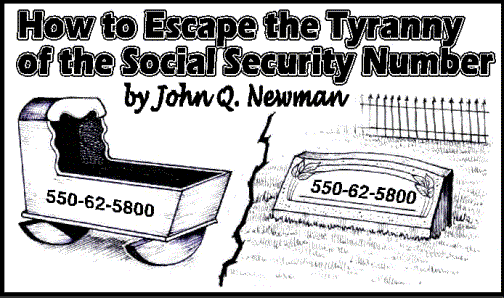
The Social Security number, or SSN is used everywhere in daily American life. It is virtually impossible to go about one's business without being asked for this number, over and over again. What will surprise most people is that this widespread use of Social Security numbers has no legal basis, and has led to this number becoming the defacto equivalent of a national identity card. The SSN was never intended to function as a personal identification number. Its widespread use as a personal identification number has in fact, led to the exponential growth of the crime of identity theft, which will strike over 750,000 this year.
What does a Social Security number actually identify? This is a key question, because it illuminates why this number was never intended to be used as a personal identifier. The Social Security number identifies a particular RETIREMENT ACCOUNT – NOT AN INDIVIDUAL. A good analog to this would be to consider your checking account or savings account number at your local bank. This number identifies a particular account – not you as an individual.
There was so much concern that Social Security numbers and cards would be turned into national identity documents when the system was created, that all Social Security cards bore a disclaimer on the bottom that said, “not for identification.” This disclaimer was on cards up until the early 1980s. Cards issued since that time have not carried that caveat. This fear of Social Security numbers being used as identity documents is also why the cards carry only a name on them, and no other identity data, such as birthdates or personal descriptions.
The initial purpose of the Social Security number was simply to identify the Social Security retirement account of the individual named. Employers would request this number from the new employee so payroll deductions for Social Security could be credited to the account. A natural outgrowth of this was that employers started to use the Social Security number as an employee number. That usage, however, is consistent with the purpose of the number. Soon, the numbers usage for non Social Security related purposes began to mushroom.
The government started the ball rolling. The various branches of the military started replacing the service number of each soldier with the Social Security number. All military identification cards now carry the Social Security number on the face as the identity number of the service member. The same is true for identity cards issued to military dependents – wives and children of service members. The federal civil service issued a regulation requiring all federal government agencies to begin using the Social Security number as the employee identification number. The Internal Revenue Service began to require it on all income tax returns, and started using it as a file identifier on all tax documents.
The States were not to be left out of the Social Security feeding frenzy. Most state motor vehicle departments started to request the number as part of the licensing process. Some states actually used the Social Security number as the drivers license number, others that did not use the Social Security number as the actual license number would display the number on the license.
Private sector businesses jumped on the bandwagon. Health insurance companies used it as the patient identity number on the cards carried by their insureds. Credit grantors began to require the number on credit applications, and the credit bureaus programmed their computers to use the number as a file identifier. Universities and schools used the number to identify student records. Soon, nearly everyone, from the library to the video rental store was using the number to identify individuals.
Why is this number so prized as an identifier, and why does that very fact make it totally unsuitable as a secure identifier?
In theory, each Social Security number should identify only one individual. In theory, people should only have one Social Security number, and no two people should be issued the same Social Security number. This is not actually true, there have been numerous cases of two people being assigned the same Social Security number, and people can get multiple Social Security numbers. To understand why each SSN should identify each person uniquely, we need to look at how the numbers are created and assigned.
The original goal of the SSN was to identify the separate retirement accounts of hundreds of millions of people. When the system was started in 1935, a numbering scheme had to be devised that would not allow the retirement accounts of people with identical names and even, in some cases, identical birthdates, from being confused. It also had to accommodate the growth in the population, from around 100 million then to nearly 300 million now.
A nine-digit system was proposed. The first three digits are called area numbers. This number would be assigned based on where the individual resided when he applied for a number. The middle two digits, known as group numbers, would be an indicator as to when the number was assigned. The last four digits are known as serial numbers. These numbers are issued sequentially.
The area numbers are assigned by state. The initial area numbers covered under the system were 001 to 595. A large population state, such as New York, will have more area numbers assigned to it than a smaller population state, such as Wyoming. As the population increased, additional area numbers in the 600 series were added. New York, for example, was initially assigned area numbers 050 to 134, and on the opposite end, Wyoming was only assigned one area number – 520.
The middle two numbers are group numbers. These numbers indicate when a particular Social Security Number was assigned, and can also be used to determine if a particular number has actually been assigned to the purported holder. Group numbers range from 01 to 99. Group numbers are not assigned in a straight increasing sequence. The first group numbers assigned are the odd groups under 10. These would be 01, 03, 05, 07, and 09. After these are assigned, the even groups between 10 and 99 are issued. Then, even groups less than 10 are assigned, and the last to be issued are the odd groups above 10. Frequently fraudulent or erroneous Social Security numbers are detected because even though the area numbers are valid, the group numbers have not yet been assigned.
The last four digits, the serial number, are simply issued sequentially as a particular area and group number combination are assigned. Consider Wyoming, for example. The first two Social Security numbers assigned in Wyoming were 520-01-0001 and 520-01-0002. The last Social Security number assigned to Wyoming will be 520-99-9999. What happens then? New area numbers will be assigned to this state, and the process starts all over again.
The ability to create hundreds of millions of number combinations is what allows each Social Security number to be unique to an individual. But it is also the Achilles' heel of the number. It is quite possible to simply make up Social Security numbers at random, and have created a number that is valid, and has been assigned to someone. This is because there is no check digit or check sum in the number. By following the rules given above and consulting Social Security number tables widely available in books and on the Internet, anyone can make up an SSN that is potentially valid, and has probably been issued to someone else.
Because most uses of the SSN are not authorized by law, the number itself is never verified by the Social Security Administration. In fact, in most cases, that would be illegal. Consider some of the following examples. Credit bureaus use the number to retrieve and create a credit history file. The SSN is the primary file identifier and creator. The credit bureau doesn't verify with the Social Security Administration that the person providing the number is the rightful owner. Credit bureaus, and banks, do use a computer program to verify that the number provided has been issued, and likely does belong to the applicant. Consider our previous example of Wyoming. The first SSN issued there was 520-01-0001. If a person used this number on a credit application now, it would be rejected, because this number would have been assigned in the 1930s.
Another indirect check on Social Security numbers is made via the Social Security Death Index. When the individual dies, if his relatives claim the Social Security Death Benefit – about $300, then the person's Social Security number is officially retired, and placed into the death index. The death index is public record, and can be consulted for free at numerous sites on the Internet. If a made up Social Security number has been the subject of a death claim, the credit bureaus and banks will reject it.
So, with a little knowledge, an imposter can make up an SSN, and start a credit history, open bank accounts, and use a bogus SSN for most needs. Only a few places actually verify the number, this can only happen where it is explicitly authorized by law. The issuance of a driver's license is a good example. Some states now verify the SSN online with the Social Security Administration when a person applies for a new or renewal license. The states that are doing so at the time of this writing are:
| Alabama | Idaho | Massachusetts | Nebraska | Ohio | Virginia |
| Arizona | Maine | Mississippi | Nevada | South Dakota | Washington |
| District of Columbia | Maryland | Missouri | New York | Tennessee | Wyoming |
Identity thieves can appropriate another person's identity by simply appropriating their SSN. Because of its wide usage on numerous documents, the SSN can be located quite easily. In most states, driver's records, for example, are public, and the information can be purchased for a small fee by anyone. Many states use the SSN as part of the voter registration file, these are public records. In many states, civil court filings – marriages, divorces, civil suits, etc., all have the SSN on them to identify the individual. What must always be remembered, especially in the case of private businesses, is that few or no laws in most states prohibit them from reselling your personal information to third parties. The end result of all of this is that your SSN has become a national identifier; with just this number, nearly all records about you can be located quickly.
Is there any way out of the tyranny of the Social Security number? The answer is yes, but the price of freedom may include accepting some inconveniences, and learning how to question those who ask for the number. The linchpin of this is to remember that most uses of the SSN have become customary, and are not explicitly authorized by or required by law. The net effect of this is that a private business does not have to give you services if you refuse to provide the number; on the other hand, most companies have procedures to still serve people who do not want to provide their Social Security number.
Consider universities. Most request the SSN to use as a student identification number for student ID cards and transcripts. Nearly all schools, however, will assign you a nine-digit number instead of the Social Security number for this purpose if you object. But the burden is on YOU to object. The staff will try to convince you why you should use the SSN – “it is more convenient, etc.” but if you stand your ground, they will assign you a different number.
This should be your policy with all askers, and you will find that about 75% of the time, accommodation can be made. But what about those situations where you must provide the number, and cannot get around it. Is there a solution? The good news is yes, and it comes from the government itself. There are two avenues that can be followed.
The U.S. Constitution recognizes the separation of Church and State. When dealing with government agencies, a religious objection to using the SSN will frequently be allowed as per official policy. One person receiving federal food stamp benefits said that he had a religious objection to the SSN. He was given a form to fill out, and received his benefits anyway. If you claim a religious objection, you need to sound credible about it. Do a little research about why certain Christian groups object to Social Security numbers as identification. Some quote Revelations, and say they believe that the SSN is the “mark of the beast,” that people will have to accept in order to buy or sell goods. This will frequently work with state agencies as well. Luckily, there is a number that can frequently be used in lieu of the Social Security number in many instances. Having this number, known as an individual taxpayer identification number, or ITIN for short, is an excellent alternative. It also buttresses the religious objection.
Just what is an ITIN? The second largest use of the SSN, after Social Security purposes, has to do with taxes or taxable benefits. In fact, most of the time, your SSN is referred to by the term of “taxpayer identification number.” This wordplay masks the fact that for most people this will be the SSN. But some people have obtained an ITIN, for use on their income tax returns, withholding statements, and even bank accounts.
An ITIN is a unique 9-digit number assigned by the Internal Revenue Service – not the Social Security Administration. This number can be used anyplace a “taxpayer identification number is required. Anyone can get an ITIN. Why were they created? Nearly eight million illegal immigrants are working in the USA. These people created massive headaches for the IRS at tax time because they would work under false Social Security numbers, usually numbers who belonged to other people. When the legitimate holders of these numbers would file their returns, they would get nasty letters from the IRS about unreported income, etc. On the other side of the equation, the IRS would send tax refunds to people who were not entitled to receive them.
The ITIN was a way to eliminate this problem. Anyone, legal or not, could get a number, and use it on their tax return. The IRS now disallows all deductions on a tax return filed with a false SSN. The only deduction a person filing with an ITIN cannot receive is the earned income tax credit – all other deductions are allowed.
How can you get an ITIN? ITIN's are issued by the IRS. They will try to talk American citizens out of getting one. If you go to the IRS and stand your ground, citing the religious belief, you will get the number. The application form is simple, and can be found at the IRS Website. The form is called a W-7.
The use of an ITIN in place of an SSN starts to break the stranglehold of the SSN. Many state motor vehicle departments will now accept this number in lieu of a Social Security number. Further protection of your privacy at motor vehicle departments is often possible. Many states will agree to omit either the SSN or ITIN from the license face, and if it is a state where these numbers are used as the license number, they will assign a different license number.
The ITIN can also be used with hardass businesses that absolutely insist on having the number or no go. Remember, these places do not actually verify the number with the Social Security Administration.
By following theses steps, you will reduce the circulation of your SS number dramatically. You can even file tax returns under the ITIN. Eventually you will have the satisfaction of knowing that your Social Security number is used for what it was intended – to identify your Social Security retirement account and very little else.