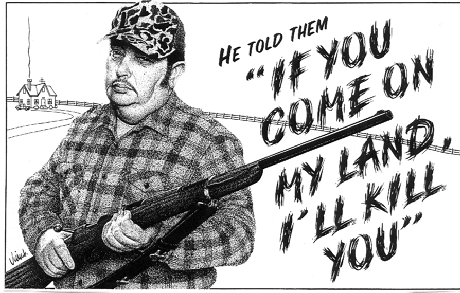
IF YOU COME ON MY LAND,
I"LL KILL YOU
by Vin Suprynowicz
He told them, “If you come on my land, I’ll kill you.”
They’d been hassling Carl Drega, retired carpenter, for years. He was cited for not finishing a tarpaper outbuilding on his property “soon enough.” He was cited for shifting rocks and fill to rebuild the shoreline of his property -- along the Connecticut River in upstate New Hampshire -- after it washed out in a flood. (Authorities claimed he didn’t have the proper permit. The state announced it would send in contractors to “put the shoreline back the way it was” -- precisely what Drega claimed he had done -- and bill Drega for the costs, however high.)
Drega tried to fight them in court, and to get the Boston Globe interested in his plight. But he was an unsophisticated man, and no one paid any attention to his rambling letters until that hot day in August 1998 when two local cops pulled him over in a supermarket parking lot for having “rust holes in the bed of his pickup.”
Then they started to pay attention.
Carl Drega shot and killed the two cops, drove downtown in one of the police cars, found the part-time judge who had backed many of the actions against him, and killed her too. Then, for good measure, he killed the editor of the local newspaper, who was foolish enough to try and tackle Drega while unarmed.
Carl Drega died later that day, in a shoot-out with police.
In San Leandro, California -- about 20 miles southeast of San Francisco -- the mostly Portuguese clientele of the 78-year-old Santos Linguisa factory had grown used to the kind of signs recently displayed outside the shop by proprietor Stuart Alexander, great-grandson of the factory’s founder.
“To all our great customers,” read the most prominent one last June, “the USDA is coming into our plant harassing my employees and me, making it impossible to make our great product. Gee, if all meat plants could be in business for 79 years without one complaint, the meat inspectors would not have jobs. Therefore, we are taking legal action against them.”
In fact, on June 22 of last year the facility had just reopened after being closed for alleged health violations, when two state and two federal food inspectors -- two men and two women, all between the ages of 30 and 50 -- decided to pay Mr. Alexander another visit, ABC News reports.
Alexander, 39, surrendered without incident or attempt to flee when located less than a block from his factory. Police had been led there by the sole surviving food inspector. Police had to break a window and climb inside the factory, where they found the other three inspectors on the floor, dead of multiple gunshot wounds.
Danny Gomes, a friend of Alexander’s who waited outside the police tape at the factory for news, told a reporter for the Daily Hayward Review that Alexander was upset because inspectors wanted him to raise the temperature of his meat while preparing sausage.
“He was a good man, but pressure, pressure -- everybody blows up under pressure,” said Michael Smith, another friend of Alexander’s.
In 1997, the California state Legislature had named San Leandro -- home of a locally famous annual sausage festival, the “Sausage Capital of California.”
For years, Garry Watson, 49, of little Bunker, Missouri (population 390) had been squabbling with town officials over the sewage line easement, which ran across his property to the adjoining, town-operated sewage lagoon.
Clarence Rosemann, whose family runs the local Handi Mart in the deeply wooded community 100 miles southwest of St. Louis, told reporters for the St. Louis Post-Dispatch that he and his son dug up sewer lines on Watson’s property about a year back, when Watson couldn’t get the city to consider fixing them. After Watson paid Rosemann to dig up the pipes, Rosemann found that the clog was, indeed, on the city’s right of way, as Watson had contended.
Later, the city demanded permission to go on Watson’s property to fix other sewer problems. Town residents say officials grew dissatisfied with their existing easement, and announced they were going to excavate a new sewer line across the landowner’s property. Capt. Chris Ricks of the Missouri State Highway Patrol reports Watson’s wife, Linda, was served with “easement right-of-way papers” on Wednesday evening, Sept. 6, 2000. His wife gave Watson the papers when he got home at 5 a.m. the next morning from his job at a car battery recycling plant northeast of Bunker. Watson -- described as “white, 5 feet 11 inches, weighing 200 pounds with gray hair and blue eyes,” reportedly went to bed for a short time, but arose about 7 a.m. when the city work crew arrived.
“He told them ‘If you come on my land, I’ll kill you,’” Bunker resident Gregg Tivnan told me this week. “When he came home in the morning, his wife gave him the papers. Then the three city workers showed up with a backhoe, plus a police officer. They’d sent along a cop in a cop car to guard the workers, because they were afraid there might be trouble. Watson had gone inside for a little while, but then he came out and pulled his SKS (semi-automatic rifle) out of his truck, steadied it against the truck, and he shot them.”
Killed in the Sept. 7 incident, from a range of about 85 yards, were Rocky B. Gordon, 34, a city maintenance man, and David Thompson, 44, an alderman who supervised public works. City maintenance worker Delmar Eugene Dunn, 51, remained in serious but stable condition at St. John’s Regional Health Center in Springfield the following weekend. Bunker police Officer Steve Stoops, who drove away from the scene after being shot, was treated and released from a hospital in Salem, Missouri, for a bullet wound to his arm and a graze to the neck.
Watson thereupon kissed his wife goodbye, took his rifle, and disappeared into the woods, where his body was found two days later -- dead of an apparently self-inflicted gunshot wound.
In the meantime, Garry Watson had gained a middle name, being thereafter referred to in all press accounts as Garry DeWayne Watson.
“Before this, nobody in town even knew he had a middle name, let alone what it was,” says Tivnan. “All of a sudden he had this middle name, like John Wilkes Booth or Lee Harvey Oswald.”
Following such incidents, the local papers are inevitably filled with well-meaning but mawkish boilerplate about the townsfolk “pulling together” and attempting to “heal” following the “tragedy.” There are endless expressions of frustration by those who pretend to have no idea how such a thing could happen, pretending to ask how such an otherwise peaceful member of the community could “just snap like that.”
In fact, the supposedly elusive explanation is right before our eyes. “He was pushed,” Clarence Rosemann told the big-city reporters from St. Louis.
Another area resident, who didn’t want to be identified, told the visiting newsmen, “Most people are understanding why Garry Watson was upset. They are wishing he didn’t do it, but they are understanding why he did it.”
You see, to most of the people who work in government and the media these days -- especially in our urban centers -- “private property” is a concept out of some 18th century history book. Oh, sure, “property owners” are allowed to live on their land, so long as they pay rent to the state in the form of “property taxes” -- just as they’re allowed to keep custody of their own children, until such time as the state decides to reclaim the custody it initially established in the maternity ward (where the infant was assigned a “voluntary” nine-digit federal ID number, with or without the parents’ permission) based on any number of pretexts, from “medical neglect” (parental refusal to expose the child to the federally acknowledged risk of death or brain damage from required pertussis shots) to “mandatory public education.”
But an actual “right” to be left alone on our land to do whatever we please -- always providing we don’t actually endanger the lives or health of our neighbors?
Heavens! If we allowed that, how would we enforce all our wonderful new “environmental protection” laws, or the “zoning codes,” or the laws against growing hemp or tobacco or distilling whisky without a license, or any of the endless parade of other malum prohibitum decrees which have multiplied like swarms of flying ants in this nation over the past 87 years?
There is no “mystery” about why Carl Drega and Stuart Alexander and Garry Watson did what they did.
What does it mean to say we have any “rights” or “freedoms” at all, if we cannot peacefully enjoy that property which we buy with the fruits of our labors? In his 1985 book Takings, University of Chicago Law Professor Richard Epstein wrote that “Private property gives the right to exclude others without the need for any justification.
“Indeed, it is the ability to act at will and without need for justification within some domain which is the essence of freedom, be it of speech or of property.”
“Unfortunately,” replies James Bovard, author of the book Freedom in Chains: The Rise of the State and the Demise of the Citizen, “federal law enforcement agents and prosecutors are making private property much less private. In 1984 the Supreme Court ruled in Oliver vs. United States -- a case involving Kentucky law enforcement agents who ignored several ‘No Trespassing’ signs, climbed over a fence, tramped a mile and a half onto a person’s land and found marijuana plants -- that ‘open fields do not provide the setting for those intimate activities that the (Fourth) Amendment is intended to shelter from government interference or surveillance’ (466 U.S. 170, 179 [1984].) ...
“The core of the ‘open fields’ decision,” Bovard wrote in the September, 2000 edition of Ideas on Liberty, published by the Foundation for Economic Education in Irvington-on-Hudson, N.Y., “is that the government cannot wrongfully invade a person’s land, because government agents have a right to go wherever they damn well please. ...And for those areas that are sufficiently fenced in, the Supreme Court had blessed low-level helicopter flights to search for any illicit plants on the ground. (Florida vs. Riley, 488 U.S. 445 [1989].)
“The Supreme Court decision, which has been cited in over 600 subsequent federal and state court decisions, nullified hundreds of years of common-law precedents limiting the power of government agents. The ruling was a green light for warrantless raids by federal immigration agents; in 1997 the New York Times reported cases of upstate New York farmers’ complaining that ‘immigration agents... barged into packing sheds like gang busters, handcuffing all workers who might be Hispanic and asking questions later. ...’ In a raid outside Elba, N.Y., at least one INS agent opened fire on fleeing farm workers. Many harvests subsequently rotted in the fields because of the shortage of farm workers. ...
“Police also possess the right to destroy property they search. Santa Clara, Calif., police served search and arrest warrants by firing smoke grenades, tear-gas canisters, and flash grenades into a rental home; not surprisingly, the house caught fire and burned down. When the homeowner sued for damages, a federal court rejected the plea, declaring that the police force ‘only ... carelessly conducted its routine and regular duty of pursuing criminals and obtaining evidence of criminal activity. The damage resulted from a single, isolated incidence of alleged negligence.’ (Patel vs. U.S., 823 F. Supp. 696. 698 [1993].)”
Renters fare even worse. “Park Forest, Ill. in 1994 enacted an ordinance that authorizes warrantless searches of every single-family rental home by a city inspector or police officer,” Mr. Bovard continues, “who are authorized to invade rental units ‘at all reasonable times.’ No limit was placed on the power of the inspectors to search through people’s homes, and tenants were prohibited from denying entry to government agents. Federal Judge Joan Gottschall struck down the searches as unconstitutional in February 1998, but her decision will have little or no effect on the numerous other localities that authorize similar invasions of privacy.”
We are now involved in a war in this nation, a last-ditch struggle in which the other side contends only the king’s men are allowed to use force or the threat of force, and that any uppity peasant finally rendered so desperate as to employ the same kind of armed force routinely employed by our oppressors must surely be a “lone madman” who “snapped for no reason.”
No, we should not and do not endorse or approve the individual choices of Carl Drega, or Stuart Alexander, or Garry Watson. It would not be right to actively encourage anyone else to pick up a gun and shoot the next government agent who barges his or her way onto private property.
But we are obliged to honor their memories and the personal courage it takes to fight and die for a principle, even as we lament both their desperate, misguided actions ... and the systematic erosion of our liberties which gave them rise.
“Just because one government agent has a piece of paper that’s signed by another government agent, does that mean there’s no more right to private property?” asks my friend Gregg Tivnan.
“If statists fear popular resistance,” replies Jim Bovard, “perhaps government should violate fewer rights.”
There remain in America -- especially in rural America, where many have now made their final retreat, backs to the wall in hopes of no more than being allowed to “peacefully enjoy” life, liberty, and the pursuit of happiness -- millions of Americans for whom “private property” is not some dried and dusty phrase out of a long-discarded history book, at all.
To many Americans, “property rights” remain something worth fighting -- and dying -- for.
Want to find out how many? Keep pushing.
Vin Suprynowicz is assistant editorial page editor of the Las Vegas Review-Journal, and editor of Financial Privacy Report (subscribe by calling Lance at 612-895-8757.) His book, Send in the Waco Killers: Essays on the Freedom Movement, 1993-1998, is available by dialing 1-800-244-2224; or via web site http://www.thespiritof76.com/wacokillers.html; and from Loompanics.
“The whole aim of practical politics is to keep the populace alarmed -- and thus clamorous to be led to safety -- by menacing it with an endless series of hobgoblins, all of them imaginary.” -- H.L. Mencken