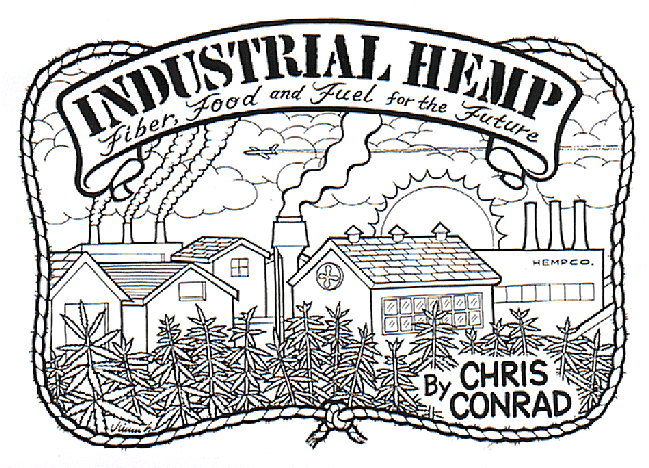
Ten years ago, barely anyone had heard the word "hemp" except in reference to some vague memory of rope. Today congress and the corporate news media discuss the plant, and a fledgling industry has emerged into a world of opportunity amid crisis. Tomorrow holds the promise of a healthy global economy prosperity based in part upon more environmentally sound technologies and sustainable hemp agriculture.
Still, there has been plenty of tangible progress and good reason for optimism. The Hemp Industry Association (HIA) is a trade group consisting of more than 300 member businesses. Three states, Hawaii, North Dakota and Minnesota adopted legislation in 1999 to research "and to cultivate" industrial hemp. Several other States are considering similar bills this year, including South Dakota and Maryland, which in April approved a four-year pilot project in hemp. Natural Business magazine ran an article in 1999 predicting that hemp sales will reach $600 million sometime in the year 2001.
But before we get too far ahead of ourselves, let's briefly go back a few millennia to get up to date. In case you are uncertain, yes; hemp is the English word for Cannabis Sativa, the same plant family as marijuana. Marijuana comes only from the mature female flowers of certain strains of Cannabis that have medicinal effects or can make people high. Cannabis has medicinal effects or can make people high. Cannabis plants valued and used for their seed and fiber that are incapable of producing usable marijuana are generally referred to as "industrial hemp."
About 10,000 years ago, well after the last ice ages had receded, humans first put seed into soil, introducing agriculture and permanent settlements that led to civilization as we know it today. Or, in the words of the Book of Genesis, "Behold, every green herb bearing seed after its kind; to you I have given it for meat."
Foremost among those seeds were those of Cannabis Sativa L. Hemp seed was used not only for "meat," meaning as a food item to be consumed, but also to make soaps, ointments and lubricants. But it was the bark fiber that left its enduring marks on clay pottery and the beginning of the manufacturing industry of the planet. Artifacts from coastal China and ancient Mesopotamia, the "Cradle of Civilization," connecting Europe, Asia and Africa verify this link. They mark the beginning of a long and noble relationship. Humans and hemp went together nearly everywhere.
Hemp grew to be one of the world's largest and most widespread industries. Its fiber was used to make nets to catch fish and fowls and tame horses. It was used to make rope and clothing. Hemp was used to make the world's first paper, and the sails and rigging of great ships that conquered the oceans and brought Columbus to America. Many colonial Americans were subsidized or even required by law to grow specified amounts of hemp for the government. The founders of the United States were essentially a group of hemp farmers and businessmen who teamed up with smugglers and tax resistors in the name of liberty and justice for all. The government they founded subsidized production of about a million acres of hemp during World War II.
Things got sticky with the rise of the mechanized timber, cotton and petrochemical industries of the 19th Century. The invested “Robber Barons” bought government favors to dominate the economy. Then came the rise of Prohibitionism in the 20th Century. This one-two sucker punch led to the passage of the Marijuana Tax Act of 1937, which suppressed industrial hemp, medical Cannabis and social use of marijuana all under the cruel hoax of a revenue tax.
Hemp all but disappeared, and industrial technology moved ahead without it. The Department of Agriculture warned of dire social and environmental consequences, and global deforestation and pollution escalated at unprecedented levels. The family farm declined as a way of life in America.
In 1969 the U.S. Supreme Court ruled that Cannabis prohibition was unconstitutional. So Congress passed the Controlled Substance Act to perpetrate a new fraud. The CSA authorizes the DEA (Drug Enforcement Administration) to define “marihuana” and regulate drugs based on scientific criteria of specific hazards that they pose to the user and to society. Without doing a single study, the agency arbitrarily combined and labeled all forms of Cannabis as dangerous to health and of no value to society, placing it in Schedule 1. For thirty years, this lie has been a cornerstone of federal law.
Hemp was tossed out of the frying pan and into the fire. Ironically, for all its virtues, hemp lacks the single characteristic for which it is vilified and outlawed. Industrial hemp is an ecofriendly raw material that can be used in thousands of products, but it can't make people high.
Meanwhile, tetrahydrocannabinol, or THC, the chemical compound in marijuana that actually does make people “high,” has been synthesized and placed in Schedule 3. In other words, the non-drug varieties of cannabis used for paper, textile and foods are all banned, while a pharmaceutical company legally synthesize and markets the only psychoactive drug the plant contains.
The Drug War has a total national budget of about $40 billion in state and local moneys allocated to it. Depending on whose statistics you accept, anywhere from a third to two thirds of that amount $14 to $27 billion, is spent on marijuana enforcement. Then there are another few billion spent on prisons to house pot smokers and another few billion to test hair and body fluids and drive pot smokers out of the work place.
The porkbarrel politics of prohibition have made many people and corporations rich, without having to show any results for all the tax money they spend. Drug use is up, drug production is up, police budgeters are up, and every year their budgets go up even more.
Meanwhile industrial hemp is said to have a $100 billion economic potential with the capacity to build housing for the homeless, create jobs for the unemployed, and provide fuel and food for the hungry people of the world. However, none of this makes any money for the prison lobby, piss testers or narcotics enforcement agencies. So federal law was modified in 1994 to place harsher penalties on marijuana and to provide the death penalty for growing one-fifth of an acre of fiber hemp.
The Clinton approach is to let future generations pay the price, both economic and social: just don't let anyone say Bill was soft on drugs.
For a 1-year subscription (6 issues) to Heads Magazine send $17.77 (U.S.) in the form of money order, check or cash to:
PO Box 287
White Plains, NY 10605