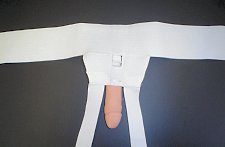
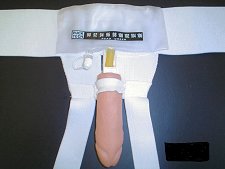
Behold! The Whizzinator!
Left: “Outside” view. Right: “Inside” view.
Thank Eris for the free market!
The Pee Police
by Gia Cosindas
by Gia Cosindas
Article © 2003 by Gia Cosindas
Recently one of our employees moved to another state and in the process of acquiring another job, came up against the dreaded “pee test.” Actually, he wasn't worried. Being something of a health nut, he figured he would pass with flying colors. However, when the test results came back a few days later, he was astonished to discover he'd failed, testing positive for opiates. His request for a retest or to be given a more accurate blood test was denied. Unfortunately, there is a one strike and you're out policy at most companies, including the one with whom he'd almost found work.
This is a scenario that plays out again and again. People who haven't had contact with illicit drugs for years or perhaps ever, submit urine to be tested and are astonished when the results come back showing they have tested positive for THC, opiates, amphetamines, or something else.
One airline attendant decided to fight after being fired when her random drug test came back positive. But, after hearing her story of 16 months without a job, house in foreclosure, $22,000 in attorney fees and the case still in litigation, most people would just find another job rather than fight.
How exactly does this testing process work? Is it as accurate as its proponents would have us believe and what options are available to hapless individuals caught in the drug-testing loop?
False positives are always talked about when the subject of drug testing via pee tests comes up, but like our former employee, or any others who consider themselves “clean,” they think they don't have anything to worry about. Companies that sell and administer drug tests maintain that false positives are unusual, if they will admit they occur at all. Reputable labs however, do concede that false positives can happen if follow-up testing isn't done and frequently it isn't.
Nevertheless, a lot of people, particularly those running companies that administer drug tests to employees and would-be employees, believe them to be accurate. According to other sources though, the percentage of false positives may run as high as 70%.
This may be in large part because smaller to mid-sized employers aren't willing to spend even more money for additional testing when the initial screening test comes up positive. Here's the scenario. An employer or company buys a number of on-site screening tests from the testing facility and lab at a cost of around $10 a test if bought in bulk. After that purchase, the testing facility doesn't hear from them again. The employer has his “drug test” and gives job applicants the screening test. From this, although this first “test” is only a “screening,” the would-be employer determines that the 'positives' mean their applicant is using drugs and that is the end of that person's prospects for a job with that company. The initial screening doesn't take into consideration the nearly 300 substances that can cause a false positive, but since it would require additional testing and money to find out exactly what caused the positive, it is just easier and less expensive for the employer to go on to the next applicant.
While the exact substance that caused a “false” positive can be proven in a lab, not all labs are reputable. Some cases of false positives occur in the labs themselves. These can include careless handling of urine specimens, improper procedure, accidents, human error, and dirty equipment. There are also those labs that have such strict operating procedures they won't even test specimens that are the wrong color, temperature, or specific gravity. Those tests are simply declared positive and tossed out. Depending on the lab, the numbers of discarded tests can be as high as 25%. And the employer does have to send the specimen to the lab and pay them to do the testing. Smaller employers simply cannot afford the overhead involved in additional testing
Drug testing programs are not cheap. The Feds estimate it at about $100 per employee. While some of the websites advertise tests at $1.75 per test, they are primarily a plastic cup with a temperature strip and a dipstick. Another manufacturer advertises on-site drug tests for $11.50, but again, those are actually screenings and don't give a true analysis. How many employers actually ante up the extra money for a lab to analyze the results of a positive and have additional testing done? The Fortune 500 companies have the cost of additional testing factored in to the cost per test. For smaller companies though, this can run another $20 or so per test and more than one test may be called for. And once again we see the War on Drugs stimulating the economy in ways we never dreamed.
Our ex co-worker believes it was his penchant for poppy seed muffins that led to his downfall in regard to the false positive on his drug test. The OHS website, which actively promotes and sells drug tests has this to say about false positives: “Most of the popular stories about 'things' that trigger a 'positive' drug-test result are based on misconceptions. These 'things' normally either: Don't show up at all (e.g., 'second hand' marijuana smoke does NOT trigger a false positive); Are not detected at a sufficient level to produce a false positive (e.g., a normal amount of ingested poppy seeds will NOT trigger a false positive for 'opiates'; Are easily distinguishable as 'false' in the laboratory.” Of course, that's if the specimen even gets to the lab.
Erowid.com, cites a Discovery Channel Mythbuster show where two people who tested negative for opiates on their initial drug test, then ate poppy seed encrusted pastries. One ate 3 poppy seed bagels, the other poppy seed cake. Not an out of the ordinary amount in either case, but within 30 minutes of ingesting the seeds, both tested positive for opiates and continued to test positive for 16 hours.
Almost every site on the Internet selling additives, supplements, or equipment with which to pass a piss test has a long list of substances and/or medical conditions that can cause false positives.
Almost every site on the Internet selling additives, supplements, or equipment with which to pass a piss test has a long list of substances and/or medical conditions that can cause false positives. Medical or dental treatments that involve anything ending in caine can cause a false positive. A partial listing of common over the counter products that can cause false positive results are: Poppy seeds, Emprin, Tylenol, anything with codeine, Alka Seltzer, diet aids, asthma medications, sleeping pills, amoxicyllin or any other antibiotic, tonic water, migraine-specific medications, Vicks inhalers, sinus caplets, Afrin, allergy preparations, Bronkaid, Primatine, Advil, Sinex, Pamprin, Ibuprofen, Excedrin, Aleve, Midol 200, Drixoral Cold and Flu, Nyquil, anti-anxiety medications, and a variety of eye drops and nearly three hundred other commonly used substances are the stuff false positives are made of and the list goes on and on.
So what about the additives that supposedly will allow you to test “clean”? Some are added to the urine, some you drink yourself. There's bleach, Drano, eye drops (these you would add to the urine), vitamins, goldenseal, and a plethora of other wonder drinks that promise to help you pass or your money back. Some, but not all of these companies actually do pay up. The majority of folks who fail aren't going to bother to try to get their money back and it's a crapshoot for the rest of them. Caveat emptor.
Drugtestinformation.com's website says that the best way to prepare for a drug test and detoxify is to drink a lot of water and sweat a lot. Since toxins (drug residues) are stored in fatty tissues, how fat the person is, their metabolic rate, and how long and how much of this substance they've been putting into their body directly relates to how quickly it can be sweated out. They recommend organic cranberry juice as a diuretic and say to forget the $40 herbs and tea formulations.
The person who suspects he or she might not pass the test could have an advantage over the person who thinks they are clean and have nothing to fear. Those folks who are recreational users have usually done some research prior to the test, have looked into other options, and are aware of the false positives that can occur, as well as the probability of true positives that might come of their own test. Their precautions might give them a step up on the person who thinks they are clean because they don't use any drugs. That's a big “might” because it is only the initial screening that might be fooled with additives and then, only if the employer is again too concerned with money to invest more money in tests, even the “on-site” tests that will show additives in the urine specimen.
A reputable lab can find if the urine has additives in it, or has additives and still tests positive too, or in some cases if the pee has been substituted. But you have to wonder if more tests get through than the labs want to admit. Why else would the government have recently decided to increase the testing? The spin we're being given is that it's "to increase the deterrent value of drug testing," whatever government doublespeak that is! Maybe, but there seems to be a leaning toward more expensive hair, saliva, and sweat testing. For the employers who do the testing, this will mean more money out of their pockets. More ways in which the War on Drugs is pouring dollars into the economy.
All bodies are different and process toxins at different rates so there is no hard and fast one-size-fits-all rule for how long traces of a substance can be found in your body. The generally agreed on time frame seems to be that marijuana stays in a person's body for up to five days after a single use. For someone who uses recreationally three to five times a week, traces will be found for up to 12 days. With daily use, traces will be found for a month or more. Cocaine or other opiates will leave traces for 2-3 days, but all of this depends on one's metabolism, and more especially on the amount of body fat they carry, which is where toxins (read drug traces) are stored.
The first proactive move in making an effort to pass the test is to eliminate recreational usage of your drug of choice for as long as possible prior to submitting a urine sample. And then, find a way to sweat via exercise or sauna, and keep pushing the cranberry juice. That helps only if you aren't a heavy user. Having a low percentage of body fat would help too. As far as eliminating the 300 or so other substances that can cause a positive reading, good luck. Hard core pot smokers may decide to skip the additives or diuretics altogether and go to a prosthesis and synthetic pee package.
The Urinator© and theWhizzinator© are prothesis packages that arrive at your door complete with heat packets and a small vial of synthetic urine with which to pass the pee test.
The Urinator© and the Whizzinator© are prosthesis packages that arrive at your door complete with heat packets and a small vial of synthetic urine with which to pass the pee test. The units, which consist of a bladder and hose are supposed to mimic real urinating. The basic model is just metal tubing, while the deluxe models have the metal tubing coming through a realistic-looking penis in a variety of flesh tones, in case you are watched while submitting the specimen; and they might work in most situations. However, (gosh, what do we call those guys who monitor pee tests – pee proctors?) one pee proctor heard a sound like a clink on the side of the cup and busted a guy who was using one of these units, probably the basic unit. Another guy was busted because that particular pee proctor made him drop his pants to pee in the specimen cup. (What, no fly allowed?) It's one thing to fool someone with a realistic approximation of a penis coming out of a fly. It's something else to expose the props that make it work, i.e. the pouches of pee taped to your leg and tubing with clamps and the like. A set-up like this will set you back about $160 with shipping. The down side is that they do make a click sound when you open the valve to release the flow and if the pee proctor wants you to start and stop the flow (Honest, I'm not making this up.) to prove you're using the real thing, you're out of luck.
The ACLU refers to the drug testing industry's promotion of these tests using “unsubstantiated claims and phantom research as “junk science.”
The ACLU refers to the drug testing industry's promotion of these tests using “unsubstantiated claims and phantom research” as “junk science.” It was, however, brilliant marketing and the business world in their ever-present quest for a blacker bottom line embraced it wholeheartedly. In the ACLU's 27-page report entitled Drug Testing: A Bad Investment, the extent to which the tweaking of facts was used to present a false picture is revealed.
According to the ACLU article, back in the1980's drug testing promoters claimed that drug users cost businesses $33 billion each year in lost productivity. Today the figure they use for lost productivity is more like $100 billion. What the drug testers don't tell you is how they arrived at these figures. The original $33 billion estimate came about through the use of data from the 1984 National Household Drug Use Survey by the Research Triangle Institute. RTI issued a report that compared the annual income of households containing someone who had ever used marijuana on a regular basis to that of the income of households with no history of marijuana usage. The difference between the annual incomes of the two groups was the $33 billion in lost productivity. The raising of that figure to $100 billion was “to control for the estimated cost of inflation.”
The hidden parts of these findings are that other drug use measures from the one's surveyed that didn't give RTI any useful data, i.e. data that could be used to promote the value of drug testing were ignored. For instance, that there was no difference in the annual incomes of households with and without current marijuana users in them wasn't factored in to the report. The same findings held true in households where illicit drugs other than marijuana were used. There was absolutely no difference in incomes between users and non-users. Had RTI chosen to use all the findings in their report, “lost productivity” due to drugs would have been zero. But those findings wouldn't sell drug tests, therefore they were ignored.
None of the reasons given by the drug testing companies and the federal government have ever proved to be true under close examination.
None of the reasons given by the drug testing companies and the federal government have ever proved to be true under close examination. Many law-abiding business people have bought into urine testing because for some reason they trust the federal government to tell the truth and not give them a snow job. They don't question what they are told. Even though they might personally find the concept invasive and repugnant, they test their employees and job applicants for drug use, even though that use occurs on the employee's time, not that of the business for which he works.
So let's take a look at the average recreational pot smoker. This person isn't going to go to work “high” any more than the person who drinks alcohol recreationally is going to go to work drunk. Neither one of them should be operating machinery while under the influence, but should they be fired for what they do in their off time? Has the federal government succeeded in conscripting unsuspecting companies as unknowing dupes, henchmen really, for the federal government's War on Drugs? Here we have supposedly patriotic citizens, business owners, doing the government's enforcing of the war on drugs through economic blackmail via loss of the ability to work, blindly casting aside all thought to the fact that they are violating constitutional freedoms at the same time.
Let's hope that some of these “nice” folks who somehow think that drug testing is going to make the country more productive and safe do some homework of their own and figure it out. It's all about the money. The War on Drugs is a cash cow and this is just one more aspect of it.
An insightful employee at one lab suggested that companies not interested in policing their employees' own time activities, i.e. those employers who are only interested in knowing their employees aren't impaired while on the job, would be more likely to use saliva tests, which still require additional lab testing if they come up positive. But at least these only test for drug activity over the past several hours and won't punish an employee who enjoyed himself at a party over the weekend.
Obviously, saliva tests are also far less invasive of personal privacy. Having someone look over your dental work isn't quite as demeaning as having your personal plumbing scrutinized while you're forced to perform a very private act in front of a stranger. It isn't like the guy standing next to you at the public urinal. You know you're being watched.
Now the government wants to increase the testing. This writer looked at one of the sites promoting the “only laboratory with FDA-Cleared Hair Test!” Because it showed investing opportunities, it was easy to see who had the controlling interest in the company. Lo and behold, a former CEO of an electric company. Any questions?
This is a scenario that plays out again and again. People who haven't had contact with illicit drugs for years or perhaps ever, submit urine to be tested and are astonished when the results come back showing they have tested positive for THC, opiates, amphetamines, or something else.
One airline attendant decided to fight after being fired when her random drug test came back positive. But, after hearing her story of 16 months without a job, house in foreclosure, $22,000 in attorney fees and the case still in litigation, most people would just find another job rather than fight.
How exactly does this testing process work? Is it as accurate as its proponents would have us believe and what options are available to hapless individuals caught in the drug-testing loop?
False positives are always talked about when the subject of drug testing via pee tests comes up, but like our former employee, or any others who consider themselves “clean,” they think they don't have anything to worry about. Companies that sell and administer drug tests maintain that false positives are unusual, if they will admit they occur at all. Reputable labs however, do concede that false positives can happen if follow-up testing isn't done and frequently it isn't.
Nevertheless, a lot of people, particularly those running companies that administer drug tests to employees and would-be employees, believe them to be accurate. According to other sources though, the percentage of false positives may run as high as 70%.
This may be in large part because smaller to mid-sized employers aren't willing to spend even more money for additional testing when the initial screening test comes up positive. Here's the scenario. An employer or company buys a number of on-site screening tests from the testing facility and lab at a cost of around $10 a test if bought in bulk. After that purchase, the testing facility doesn't hear from them again. The employer has his “drug test” and gives job applicants the screening test. From this, although this first “test” is only a “screening,” the would-be employer determines that the 'positives' mean their applicant is using drugs and that is the end of that person's prospects for a job with that company. The initial screening doesn't take into consideration the nearly 300 substances that can cause a false positive, but since it would require additional testing and money to find out exactly what caused the positive, it is just easier and less expensive for the employer to go on to the next applicant.
While the exact substance that caused a “false” positive can be proven in a lab, not all labs are reputable. Some cases of false positives occur in the labs themselves. These can include careless handling of urine specimens, improper procedure, accidents, human error, and dirty equipment. There are also those labs that have such strict operating procedures they won't even test specimens that are the wrong color, temperature, or specific gravity. Those tests are simply declared positive and tossed out. Depending on the lab, the numbers of discarded tests can be as high as 25%. And the employer does have to send the specimen to the lab and pay them to do the testing. Smaller employers simply cannot afford the overhead involved in additional testing
Drug testing programs are not cheap. The Feds estimate it at about $100 per employee. While some of the websites advertise tests at $1.75 per test, they are primarily a plastic cup with a temperature strip and a dipstick. Another manufacturer advertises on-site drug tests for $11.50, but again, those are actually screenings and don't give a true analysis. How many employers actually ante up the extra money for a lab to analyze the results of a positive and have additional testing done? The Fortune 500 companies have the cost of additional testing factored in to the cost per test. For smaller companies though, this can run another $20 or so per test and more than one test may be called for. And once again we see the War on Drugs stimulating the economy in ways we never dreamed.
Our ex co-worker believes it was his penchant for poppy seed muffins that led to his downfall in regard to the false positive on his drug test. The OHS website, which actively promotes and sells drug tests has this to say about false positives: “Most of the popular stories about 'things' that trigger a 'positive' drug-test result are based on misconceptions. These 'things' normally either: Don't show up at all (e.g., 'second hand' marijuana smoke does NOT trigger a false positive); Are not detected at a sufficient level to produce a false positive (e.g., a normal amount of ingested poppy seeds will NOT trigger a false positive for 'opiates'; Are easily distinguishable as 'false' in the laboratory.” Of course, that's if the specimen even gets to the lab.
Erowid.com, cites a Discovery Channel Mythbuster show where two people who tested negative for opiates on their initial drug test, then ate poppy seed encrusted pastries. One ate 3 poppy seed bagels, the other poppy seed cake. Not an out of the ordinary amount in either case, but within 30 minutes of ingesting the seeds, both tested positive for opiates and continued to test positive for 16 hours.
So what about the additives that supposedly will allow you to test “clean”? Some are added to the urine, some you drink yourself. There's bleach, Drano, eye drops (these you would add to the urine), vitamins, goldenseal, and a plethora of other wonder drinks that promise to help you pass or your money back. Some, but not all of these companies actually do pay up. The majority of folks who fail aren't going to bother to try to get their money back and it's a crapshoot for the rest of them. Caveat emptor.
Drugtestinformation.com's website says that the best way to prepare for a drug test and detoxify is to drink a lot of water and sweat a lot. Since toxins (drug residues) are stored in fatty tissues, how fat the person is, their metabolic rate, and how long and how much of this substance they've been putting into their body directly relates to how quickly it can be sweated out. They recommend organic cranberry juice as a diuretic and say to forget the $40 herbs and tea formulations.
The person who suspects he or she might not pass the test could have an advantage over the person who thinks they are clean and have nothing to fear. Those folks who are recreational users have usually done some research prior to the test, have looked into other options, and are aware of the false positives that can occur, as well as the probability of true positives that might come of their own test. Their precautions might give them a step up on the person who thinks they are clean because they don't use any drugs. That's a big “might” because it is only the initial screening that might be fooled with additives and then, only if the employer is again too concerned with money to invest more money in tests, even the “on-site” tests that will show additives in the urine specimen.
A reputable lab can find if the urine has additives in it, or has additives and still tests positive too, or in some cases if the pee has been substituted. But you have to wonder if more tests get through than the labs want to admit. Why else would the government have recently decided to increase the testing? The spin we're being given is that it's "to increase the deterrent value of drug testing," whatever government doublespeak that is! Maybe, but there seems to be a leaning toward more expensive hair, saliva, and sweat testing. For the employers who do the testing, this will mean more money out of their pockets. More ways in which the War on Drugs is pouring dollars into the economy.
All bodies are different and process toxins at different rates so there is no hard and fast one-size-fits-all rule for how long traces of a substance can be found in your body. The generally agreed on time frame seems to be that marijuana stays in a person's body for up to five days after a single use. For someone who uses recreationally three to five times a week, traces will be found for up to 12 days. With daily use, traces will be found for a month or more. Cocaine or other opiates will leave traces for 2-3 days, but all of this depends on one's metabolism, and more especially on the amount of body fat they carry, which is where toxins (read drug traces) are stored.
The first proactive move in making an effort to pass the test is to eliminate recreational usage of your drug of choice for as long as possible prior to submitting a urine sample. And then, find a way to sweat via exercise or sauna, and keep pushing the cranberry juice. That helps only if you aren't a heavy user. Having a low percentage of body fat would help too. As far as eliminating the 300 or so other substances that can cause a positive reading, good luck. Hard core pot smokers may decide to skip the additives or diuretics altogether and go to a prosthesis and synthetic pee package.
According to the ACLU article, back in the1980's drug testing promoters claimed that drug users cost businesses $33 billion each year in lost productivity. Today the figure they use for lost productivity is more like $100 billion. What the drug testers don't tell you is how they arrived at these figures. The original $33 billion estimate came about through the use of data from the 1984 National Household Drug Use Survey by the Research Triangle Institute. RTI issued a report that compared the annual income of households containing someone who had ever used marijuana on a regular basis to that of the income of households with no history of marijuana usage. The difference between the annual incomes of the two groups was the $33 billion in lost productivity. The raising of that figure to $100 billion was “to control for the estimated cost of inflation.”
The hidden parts of these findings are that other drug use measures from the one's surveyed that didn't give RTI any useful data, i.e. data that could be used to promote the value of drug testing were ignored. For instance, that there was no difference in the annual incomes of households with and without current marijuana users in them wasn't factored in to the report. The same findings held true in households where illicit drugs other than marijuana were used. There was absolutely no difference in incomes between users and non-users. Had RTI chosen to use all the findings in their report, “lost productivity” due to drugs would have been zero. But those findings wouldn't sell drug tests, therefore they were ignored.
So let's take a look at the average recreational pot smoker. This person isn't going to go to work “high” any more than the person who drinks alcohol recreationally is going to go to work drunk. Neither one of them should be operating machinery while under the influence, but should they be fired for what they do in their off time? Has the federal government succeeded in conscripting unsuspecting companies as unknowing dupes, henchmen really, for the federal government's War on Drugs? Here we have supposedly patriotic citizens, business owners, doing the government's enforcing of the war on drugs through economic blackmail via loss of the ability to work, blindly casting aside all thought to the fact that they are violating constitutional freedoms at the same time.
Let's hope that some of these “nice” folks who somehow think that drug testing is going to make the country more productive and safe do some homework of their own and figure it out. It's all about the money. The War on Drugs is a cash cow and this is just one more aspect of it.
An insightful employee at one lab suggested that companies not interested in policing their employees' own time activities, i.e. those employers who are only interested in knowing their employees aren't impaired while on the job, would be more likely to use saliva tests, which still require additional lab testing if they come up positive. But at least these only test for drug activity over the past several hours and won't punish an employee who enjoyed himself at a party over the weekend.
Obviously, saliva tests are also far less invasive of personal privacy. Having someone look over your dental work isn't quite as demeaning as having your personal plumbing scrutinized while you're forced to perform a very private act in front of a stranger. It isn't like the guy standing next to you at the public urinal. You know you're being watched.
Now the government wants to increase the testing. This writer looked at one of the sites promoting the “only laboratory with FDA-Cleared Hair Test!” Because it showed investing opportunities, it was easy to see who had the controlling interest in the company. Lo and behold, a former CEO of an electric company. Any questions?
Sources
Philadelphia Inquirer, 12/04/03, Man Charged with Defrauding Drug Test
The Globe and Mail, 10/09/03, Whizzinator gets Texas men in trouble
Loompanics Unlimited l
2004 Spring Supplement
LOOMPANICS UNLIMITED Online Catalog
The Globe and Mail, 10/09/03, Whizzinator gets Texas men in trouble