by Trent Sands
Someone writing to a correspondent at this address may have no idea that it is the equivalent of a post office box. Many small businesses that in reality operate out of someone's back room or kitchen table use a prestigious address of a mail receiving service located in a commercial building. These services are also indispensable to those seeking to establish a new identity. A mail receiving service address allows separation to be created between the name and address of the real person and that of the new individual being created.
Private mailboxes can also be used to fabricate a work history where none existed. A spurious company can be created at the mailing address, and company letterhead created.
Useful items such as employment reference letters and similar documents can now be generated. A private mail receiving service can also be used as an address of record by an individual to qualify for benefits that are only available to people who live in a certain area.
Private mail services have also been used to commit crime, and most of the time this is some type of fraud. The most common type of private mail fraud is when a scam is run. The mail drop is used as the “company” address of a business that is a scam that takes customers' money and never delivers anything. The second largest type of fraud worked through mail drops is "Identity Theft". In this scheme, the names and credit histories of honest people are appropriated by the criminals, who apply for credit cards and loans, but have the address of record as that of the mail drop. The fraudulently issued credit cards and account statements are sent to the mail drop address. The real person never knows until he receives telephone calls months later asking him why the bills are not being paid.
The postal service has issued new regulations that owners and clients of private mail drops must now follow. These revised orders were issued in response to an increasing amount of fraud being carried out by mail drop clients. But another agenda was also on the table at the post office. The postal service has never really approved of private mailbox services. The post office attitude is that, if someone wants a postal box, they should rent it from the postal service, not a private outfit. The post office loses millions of dollars a year in box rental fees to private box operators, and would like to get some of this money back.
The impact of the new regulations is first evident in the official paperwork that must be completed by all patrons of private mail services. The form is officially known as PS-1583, application for delivery of mail through agent. In postal parlance, the “agent” is the owner of the mail receiving service. This form requires the applicant to supply two forms of identification, one of which must have a photograph. The identification provided can be subjected to verification, and the postal services operator may make a photocopy of the identification documents.
The postal service also reserves the right to verify that the customer actually lives at the address given on the form PS-1583. This can be done by addressing mail to this address and verifying with the postal carrier on the route that the individual actually resides there.
The worst thing about this form is that, although its completion is technically voluntary, failure to do so will result in your mail being returned to sender. Second, the information on this form can be disclosed to law enforcement agencies, and to a host of other agencies without your knowledge or consent. Finally, even though completion of the form is voluntary, you can be prosecuted if you fill it out with false information.
This is not the end of Big Brother's new interest in private mailboxes. It will be illegal for users of private mailboxes to use the terms “suite,” “apartment,” “unit,” or other similar designations to identify the individual box. The only acceptable designation will be PMB, which stands for private mailbox, or the # symbol. The post office will conduct an advertising campaign to educate the public that these symbols indicate someone is using a private mailbox. At some date, a toll free telephone number will also be established that will tell the caller if the address given is that of a private mailbox outfit.
Are there any alternatives to the post office's new interest in where and how you receive your mail? The answer is yes, but for how long, is anyone's guess. One alternative is to use a secretarial or office space rental service instead. These businesses charge much more than a traditional private mailbox service to receive your mail, however, because mail receiving and forwarding is only an incidental part of their business, they are not required by law to comply with the postal service directives.
A second alternative is the so-called “ghost” address. A ghost address simply means you arrange to have your mail forwarded from a real street address to where you wish to receive it. The catch is, that you do not actually live, or have ever lived at the address from which the mail is redirected. This is simple to do. One simply locates a large multi-unit apartment complex in the place you wish to use as an address of record. Large apartment complexes have a constant, ongoing turn over of tenants, and hence forwarding of mail. Another mail forwarding order will not arouse the suspicions of the mail carrier assigned to the route. Simply pick a unit number, and file a change of address card. In a few days, all mail addressed to you at that address would be forwarded to your new location.
Ultimate mail privacy can be achieved by using the ghost address technique with forwarding to a secretarial service. For now, following these two steps can still keep Big Brother out of your mail.
The Post Office Assault on Private Mail Box Operators:
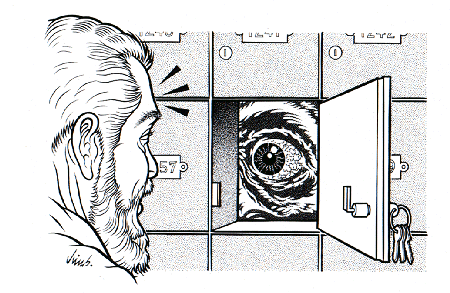
The use of a private mail receiving service, formally known in post office jargon as a commercial mail receiving agency, has been one very effective method for individuals to enhance their privacy at low cost. Private mailboxes are used by many types of individuals, from movie stars, to homeless people, to owners of home-based businesses. The operators of these establishments allow customers to use the business street address as their own, and typically, a box is provided for the customer's mail. This box will frequently be identified by a # sign, or the term “suite,” “apartment,” or “unit.”
A New Assault on Privacy