 © 2003 by Vin Suprynowicz Artwork © 2003 by Jim Blanchard
© 2003 by Vin Suprynowicz Artwork © 2003 by Jim Blanchard
“The jury has the power to bring a verdict in the teeth of both law and fact,” agreed U.S. Supreme Court Justice Oliver Wendell Holmes, in 1920.
“The jury has an unreviewable and irreversible power ...to acquit in disregard of the instructions on the law given by the trial judge,” confirmed the Washington, DC, Circuit Court of Appeals in the 1972 Vietnam war resister case U.S. vs. Dougherty, indicating this is hardly some dusty and forgotten 19th century notion.
“The pages of history shine upon instances of the jury's exercise of its prerogative to disregard instructions of the judge; for example, acquittals under the Fugitive Slave Law,” the Dougherty court continued.
And we all know, of course, that juries are supposed to be randomly selected, not stacked with those who will agree in advance to convict.
Yet in January 2003, in San Francisco, California, U.S. District Judge Charles Breyer was being anything but “random” as he carefully interviewed and sorted through 80 prospective jurors before settling on 12 – mostly out-of-towners – who appeared most likely to bring the conviction he sought against Oakland's self-styled “pot guru,” 58-year-old Ed Rosenthal.
After a two-week trial, that jury unanimously convicted Rosenthal, a world-renowned marijuana advocate, after finding as a matter of fact that he'd been growing more than 100 pot plants, conspired to cultivate marijuana, and maintained an Oakland warehouse for a growing operation. “He was painted as a major drug manufacturer,” The AP reports, “and put on little defense.”
And why did Rosenthal and his attorneys present so little defense? Because “Throughout the trial in U.S. District Court in San Francisco, (Judge) Breyer had refused all efforts by the defense to disclose to the jury that Rosenthal was growing marijuana as an 'officer' for the City of Oakland's medical marijuana program, authorized under California's Proposition 215, passed by the voters in 1996,” points out syndicated columnist Alexander Cockburn.
“Throughout the two-week trial, Rosenthal's defense team had repeatedly tried to call witnesses to testify that Rosenthal was growing medical marijuana ...acting as an agent of the City of Oakland's medical marijuana program,” confirms AP legal affairs writer David Kravets. “The judge denied those requests. The 9th U.S. Circuit Court of Appeals sided with the judge twice during mid-trial appeals.”
In other words – and as usual these days – the federal courts worked to conceal as much of the truth of the case as they saw fit, to make sure the jury made only a finding of fact, without being given any chance to decide whether the federal law was being appropriately applied in Rosenthal's case.
“Within hours of finding ...Rosenthal guilty on three felony counts of conspiracy and marijuana cultivation,” columnist Cockburn relates, “a sobbing juror was overheard saying she and others jurors had been terrified that U.S. District Judge Charles Breyer would throw them in prison if they had found Rosenthal innocent, although she herself had had a strong disposition to do so.”
(This is not an absurd concern. Colorado Juror Laura Kriho was charged with the felony of “jury tampering” when she voted to acquit a drug defendant in a jury room in Gilpin County, Colorado in 1996.) Juries already have, and have always had – the power to (in the words of Justice Oliver Wendell Holmes) “bring a verdict in the teeth of both law and fact,” to decline to enforce laws as evil and inhumane as the Fugitive Slave Act as the 1850s?
Today's authorities have something akin to a conniption fit. FIJA activist and former Arizona Libertarian Party chairman Rick Tompkins recalls, “We got a FIJA bill through one house of the Arizona Legislature, about 10 years back.” (The bill would have simply required that judges inform jurors of their pre-existing power to judge the law as well as the facts of the case.)
“And that was all the further it got. They rolled out the heavy guns, at that point,” Rick recalls. “The lawyers and prosecutors started going on the air, predicting this would encourage jurors to set murderers loose on the streets, all kinds of nonsense. A judge of the state Supreme Court actually wrote a letter to the editor, opposing the bill. Needless to say, you can't get enough air time to systematically rebut that kind of last-minute campaign, since we didn't have millions of dollars behind us. The bill died.”
All they were suggesting, Larry Dodge explains, was that an accused person be allowed to tell a judge or jury, “I did the acts of which I am accused. However, I think there is no good reason to punish me. Here's why…”
In August of 2002, the South Dakota Secretary of State published a voter guide which contained an argument against Question A. That argument asserted: “Amendment A would allow juries to be arbitrary, unreasonable, vindictive, mean spirited, ignorant, and unpatriotic. A jury could ignore treason. It could impose a trivial fine for murder.”
Leaving aside the irony implicit when any defender of the status quo complains that “a jury could be ignorant” (given the efforts they exert to make sure juries like that in Ed Rosenthal's pot case are kept in abject ignorance) – leaving aside the fact no one can remember the last time anyone was tried for treason in South Dakota – it simply is not true that a South Dakota jury could “impose a trivial fine for murder.”
“Juries don't impose sentences (except to decide between the options for life without parole or lethal injection in capital cases, hardly a 'trivial fine') in South Dakota, period,” pointed out South Dakota jury rights activist Bob Newland.
Newland sued the secretary of state in an attempt to prevent distribution of the “voter guide” with the lie included. His lawsuit was simply ignored. He also filed an ethics complaint with the Bar Association against the author of the statement. Given that the author, Bob Frieberg, was at the time serving as General Counsel to the state bar, “I probably don't need to explain how far that went,” Newland told me.
“We were outgunned and outmaneuvered,” Newland concluded. Question A went down to a humiliating 78%-22% defeat. (I covered the story at length in the January, 2003 edition of my monthly newsletter, “Privacy Alert,” in a piece headlined “Bury the Fully Informed Jury at Wounded Knee.”)
“Press coverage was brutally one sided,” Larry Dodge told supporters in a thank-you letter after the defeat, “with opinion editors reciting accusations made by our opponents without any regard for truth, editors refusing to run news releases we sent them, and the head of the AP going out of his way to use loaded words to describe the effort (e.g., 'Amendment A would enable jurors to ignore the law,' even after we explained to him in detail how jurors would have to consider, evaluate, and deliberate on the law like never before.)
“The opponents, almost all of them lawyers, were able to get a string of outright lies printed in the official Ballot Question Pamphlet as though they were true, and none of the efforts we made to get retractions, or to stop distribution of the pamphlet, made any headway.
“But most of all, I think the failure to succeed reflects a fear of freedom and responsibility on the part of the electorate, or perhaps should I say, a preference for mutual coercion and security over liberty and justice. It is not a new observation, but it's a sad one,” Dodge continued. “It is probably why those who value individual liberty, and say so, almost never get elected to anything.
“Viewed from that angle, the 22 percent 'yes' vote on Amendment A looks relatively encouraging: it's much higher than the vote percentage achieved by any Libertarian candidate this year, even in the handful of two-way races where Libertarians ran. It also means that 68,000 people either saw the light or at least noticed the glow represented by Amendment A on the South Dakota ballot.
“One out of four or five may not be great, but it 'ain't bad', either, viewed as a direct vote on the issues of liberty and justice. ...
“Others of you have contacted me and asked me what I will be doing next, so I'll tell you: Honey and I are going to explore a few places with possible expatriation in mind, as the USA seems destined to outdo even Nazi Germany as a totalitarian nation. Personal privacy has become almost extinct, as has banking privacy. Gun control has almost wiped out the 2nd Amendment.
“'Railroad' routes have been built around almost all forms of due process, from protection against double jeopardy and self-incrimination to trial by jury. The idea of states' rights is a distant memory, to the point where federal law, law enforcement, and financing have now displaced state law and law enforcement in every state, and extend to ever more types of crime.
“All I can say is that before the vise which is squeezing liberty to death tightens any further, we're going to look around. Specifically, before the Department of Homeland Security requires us all to get a retina scan before we can use the toilet, and before most urban places in the USA become targets for terrorists, we're going to take a freedom safari. ...”
Within months, the Dodges had bought land in Panama. They're now building a bed-and-breakfast inn where they hope to welcome other American expats.
Back in Oakland, speaking after the verdicts were read, Ed Rosenthal said, “I was not afforded a jury of my peers. They had to bring in 80 people to come up with 12 who would agree to set aside their beliefs on this issue. Even so, they would have acquitted me if they had been permitted to hear my story. But I did not get the chance in this trial to defend myself and explain my actions. ...
“Had the jury known about the city's attempts to give immunity to their people, including me, it would have acquitted me today. The other victims of today's decision are patients – people who are extremely ill or dying and who are soothed by medicinal marijuana – because I am only one of many people that they are trying to put in jail for helping sick people, as allowed under our laws.”
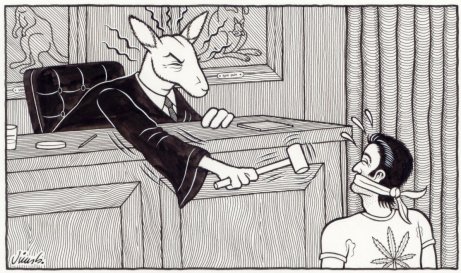
Defendant Rosenthal called Breyer's courtroom a “kangaroo court.”
It was.
And every prospective juror must remember that, when next it comes time for us to render a verdict in any “criminal” case with no obvious human victim.
For jurors now have little choice but to presume the prosecutor and the judge in any given case are conspiring to conceal vital and relevant facts, and that the defense attorneys have been threatened with jail should they so much as try to tell us what the case is really all about.
What other choice have men like U.S. District Judge Charles Breyer left us?
For jury rights, even if men as ruthless and evil as U.S. District Judge Charles Breyer fail to realize it, are the little jiggling weight atop the pressure cooker of public outrage at this ongoing, systematic stripping away of the rights of voters, of the states, and of our medical liberty.
Continue to tie down that weight, and what lies in store for such tyrants could well prove a whole lot worse than being “overruled.”