by Claire Wolfe
What's going on here? Have all these people gone paranoid crazy? Well, yes and no. They're all responding – rationally, they believe – to government whose paranoia takes increasingly brutal forms.
They fear they might be “detained” or “disappeared.” They fear that gorilla-like regulators may destroy their businesses. They fear they might fall under investigation by federal agencies whose “investigators” too often arrive at 4:00 a.m. with fully automatic German MP5s, black face masks, and no patience for silly arguments about the Bill of Rights.
In this post-Patriot Act era, there's genuine reason to fear. Some forms of self-censorship are simply sensible self-preservation tactics, thanks to Draconian new laws and vicious, often arbitrary prosecutions.
But in rushing to censor themselves – no, let's be honest, in rushing to censor ourselves even before government censors us – we too often play right into the iron fists of the anti-free-speech thugs we claim to oppose. On our own, we do their willful work for them – and worse.
The groundwork for silence is laid
This self-censorship actually began before the 9/11 attacks and before the infamous Patriot Act. One major culprit was a 1997 law, sponsored by Sen. Dianne Feinstein (D-CA) and her frequent co-conspirator Sen. Orrin Hatch (R-UT), that makes it illegal for anyone to publish information about explosives if they have reason to believe the information might be used by anyone who had any intent to commit “a federal crime of violence.”The infamous Hit Man lawsuit against Paladin Press had already established the precedent that merely selling a book to a stranger implied that (disclaimers to the contrary) the publisher was responsible for a book buyer's actions. Other lawsuits around the country repeatedly reaffirm the same message: Third parties can be held responsible for actions by complete strangers – actions they neither encouraged nor knew about.
This combo of one-two body blows, law and lawsuit, caused Paladin Press to pull more than 70 titles from its catalog in the late 1990s. Loompanics pulled three. It seemed like the only way to remain in business and out of prison.
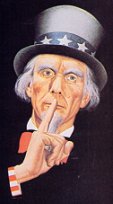
“Silence is health.”
So the climate for self-censorship already existed when the next set of one-two body blows – the 9/11 attacks followed a month later by the Patriot Act – struck America.
Self-censorship starts to become the norm
The first manifestations of post-9/11 self-censorship were innocuous enough.
Clear Channel Communications (the corporate owner of more than 1,100 U.S. radio stations) created a list of some 150 songs its stations were temporarily not allowed to play.
With the world reeling, even the dumbest radio jock would probably not have played “Hit Me with Your Best Shot,” “Jet Airliner,” “Another One Bites the Dust,” or “Shot Down in Flames.” Even Jerry Lee Lewis' “Great Balls of Fire” seemed tasteless in that moment.
But Clear Channel's list also contained an assortment of strange choices. Corporate stations were not to air Simon & Garfunkel's “Bridge over Troubled Waters,” John Lennon's “Imagine,” Louis Armstrong's “What a Wonderful World,” or even Mitch Ryder and the Detroit Wheels' “Devil with the Blue Dress.” Even without the bizarre no-play selection, many people found the very existence of such a list ominous.
Unfortunately, Clear Channel's no-play list was only the harmless-looking tip of a very cold, very scary, very deep iceberg of self-censorship.
Clear Channel stations can once again play Ricky Nelson's “Travelin' Man,” Neil Diamond's “America,” The Bangles' “Walk Like an Egyptian,” and Nine Inch Nails' “Head Like a Hole.” But businesses are increasingly likely to keep pertinent information out of public sight and hearing – as when the Voice of America (supposedly editorially independent, though government funded) obeyed a State Department edict and quit conducting interviews with officials of any country accused of sponsoring terrorism – thus ensuring that the VOA's audience would hear only the party line on international issues.
And worse, we've reached a point where we often choose to censor our own speech not because we must, but simply out of fear that someone, somewhere, will consider us terrorists, and bring the ugly consequences of their fear and hatred upon our heads.
“Silence is health.”
Obedience to government is the root of cowardice
Libertarians like to point out that the word “censorship” applies only when a government orders someone not to publish, air, or speak of certain matters. A private decision by an individual or a corporation therefore isn't censorship.
Overt government censorship by law or edict is rare today. It happens occasionally, as in July 2004 when the U.S. Justice Department ordered libraries around the nation to pull from their shelves and destroy certain documents explaining federal asset forfeiture procedures. Among the documents ordered destroyed were copies of CAFRA – the Civil Asset Forfeiture Reform Act of 2000 – which limits the government's powers to seize property.
But most contemporary censorship is more subtle. Government has learned that it doesn't have to order; it can merely dangle an amorphous threat. It doesn't have to forbid; it can simply fine. You can publish all the information about explosives you wish; you can just never be absolutely certain prosecutors won't swoop down claiming you “knew” readers would misuse the information. Howard Stern is free to say all the vulgar words he wants on the radio – as long as his employer is willing to pay repeated half-million dollar FCC fines. This is the modern face of government censorship.
If publishers make decisions about content based on their fear of government or their desire for a cozy, subsidized relationship with government, this, too, is a form of censorship.
When science editors decreed at the January 2003 meeting of the National Academy of Sciences that some research should never be published, they said they feared that scientific information might be used “by terrorists for malevolent purposes.” This sounds reasonable until you consider that openness is the soul of science. Information sharing is the engine that drives inquiry. It is the reality checking system that enables mistakes or frauds to be uncovered and corrected. Scientists often make their most important discoveries by following up on the published work of others. A scientific result that's “dangerous” in one sense might lead another scientist to read it and produce a cure for a disease or a discovery of a life-enhancing technology. To refuse to publish otherwise beneficial information simply because some unknown party might misuse it is not only an outrage, it's dangerous to both science and civilization.
The editors weren't merely acting out of patriotism or professional caution. They openly declared, “Self-governance is an alternative to government review of forthcoming journal articles.”
In other words, on the excuse of avoiding state control, they imposed upon themselves the very thing they feared from government.
“Silence is health.”
And what about we ordinary people who wear masks of conformity in public places? Government also encourages us to believe that our “silence is health.”
Take the case of Marc Schultz, a bookstore employee in Atlanta. One summer day in 2003, two FBI agents showed up at his work place. What, they demanded to know, had he been reading the previous Saturday while waiting for his latte at Caribou Coffee?
Schultz was stunned. He had no idea. “Some left-wing editorial,” he vaguely recalled. The agents were polite, but they pressed him. With his consent, they searched his car, looking for the incriminating piece of paper. They found nothing. Only much later did Schultz – who is Jewish, dark, bearded, and vaguely Middle Eastern looking – realize what he'd been reading that morning: “Weapons of Mass Stupidity,” Hal Crowther's scathing critique of Fox News.
The title was enough to cause a coffee house patron to follow Schultz outside, record information on his vehicle, and report Schultz's act of “terrorism” to the FBI.1
That'll teach you not to read “dangerous” literature in public, Mr. Schultz. And even if Marc Schultz has the guts to continue viewing critical literature, how many other Americans now hide their reading matter and their opinions solely out of fear of citizen spying and frivolous investigation?
“Silence is health.”
If anything, the climate of fear has gotten worse since 2003. The spies are no less ignorant. But they're now enrolled in fatly funded government programs.
You've heard about TIPS, the system under which the Department of Homeland Security intended to create a U.S. Stasi, with millions of utility workers, mail carriers, truckers, and repairmen delegated to spy on the rest of us. Americans were outraged. The cancellation of TIPS was announced with great fanfare and relief. But – in what has become an all-too typical tactic – DHS merely replaced its One Big Stasi with programs called Highway Watch, River Watch, Port Watch, Transit Watch, etc.
Time Magazine reported on Highway Watch – a program that handed a nearly $20 million taxpayer-funded boon to the American Trucking Associations for 2004 alone. Highway Watch training instructs thousands of Junior G-Men to call a secret number any time they spot someone taking a picture of a bridge or handling an awkward backpack. Time observed:
“Silence is health.” But even that won't help you if you're the wrong color or dressed in the wrong clothing.
Sadly, government not only tolerates ignorant bigotry among its trained spies, it promulgates some shocking bigotry of its own.
For example: The state of Pennsylvania created a terrorism-education website (www.pa-aware.org/index.asp). Its profile of “domestic terrorists” is so broad it potentially includes most non-mainstream political activists, both left and right. A section called “What to report” doesn't say a word about what activities are ominous enough to relay to law enforcement and what should not. It focuses solely on training people to make quick observations of license plate numbers, hair color, and other details.
The Pennsylvania site does mention in passing that only crimes – not anti-government statements or religious beliefs – should be reported. But before you breathe a sigh of relief consider: Pennsylvania defines “terrorist” crimes so broadly that those crimes include ... believe it or not – grafitti. Anti-terrorism volunteers are also encouraged to report their fellow citizens for drawing maps, taking pictures, valuing privacy, buying propane bottles, buying weapons, and purchasing ammunition (no amount or kind specified).3 There is absolutely no guidance on how to distinguish innocent privacy, innocent propane, or innocent ammunition from “terrorist” privacy, “terrorist” propane, or “terrorist” ammunition.
“Silence is health.” But silence isn't enough if you also happen to be a gun owner, an artist, a photographer, or be thought too stand-offish by your neighbors.
Which is the right response to such pervasive and pernicious bigotry? To fight it? Or to give in to it? Believe it or not, some self-proclaimed freedom lovers not only choose to do the latter; they promote hysteria, and hysteria-driven silence, in others.
Freedom lovers' surrender
Take for example, the strange case of the website Liberty Post. When “Goldi-Lox” (screen name of the moderator) pulled all mention of Loompanics from a discussion thread on Liberty Post, (http://libertypost.org/cgi-bin/readart.cgi?ArtNum=59896) she asserted:
I've check (sic) the [Loompanics] site, and the list of available books. Some of them easily fall into that area that the new Patriot Act would cover. I'm not going to put Neil at risk, as his name is listed as [Liberty Post's] “webmaster”, and I don't want to be at risk either. Apparently, linking to or promoting these types of sites, can cause jail time.
Goldi-Lox based her decision, and her terror, on the case of Sherman Austin, owner and webmaster of RaisetheFist.com. Austin, a 20-year-old anarchist activist, served a year in federal prison on a plea bargain for violating the same 1997 Feinstein-Hatch sponsored law that prompted Loompanics and Paladin to pull books from their catalogs.
Austin had given server space to an Internet tract called the Reclaim Guide, which includes instructions on improvising explosives. Those instructions were mirrored for months on the website of Carnegie-Mellon University without the university or the faculty member who posted them, David S. Touretzky, getting into legal trouble.4
But Austin also openly advocated violence as a political tactic, which Touretzky did not. Austin wasn't persecuted for hosting the Reclaim Guide. He was prosecuted for advocating violence, with the Reclaim Guide used as part of the prosecution's evidence.
Loompanics president Mike Hoy said of Liberty Post's fear-driven self-censorship:
Without question, we sometimes need to practice self-censorship to protect ourselves against real threats and unacceptable risks. By retreating now, we survive to fight harder against tyranny tomorrow.
But when we self-censor our own innocent opinions, actions, and reading matter merely out of vague fears – because somewhere a fool may be snooping, because somewhere a bigot may be lurking, because someday our increasingly tyrannical government might pass an edict against what we think or read – we do ourselves and our culture an injustice.
People who furthermore spread irrational fear – encouraging others not to seek information, not to read controversial books, not to express honest opinions, are twenty-first century quislings. They do the enemy's work for him.
A nation that tells itself “silence is health” becomes a nation where few dare criticize leaders or challenge brutal, unjust policies. So injustice and brutality prevail.
A silent nation is a nation of serfs, not citizens. A nation of useful cowards. A nation ripe for more tyranny. A nation of people waving the flag of freedom while pre-emptively surrendering freedom itself.
“Silence is health,” indeed. It is the health of tyrants.