by Mr. Unzip
It was the early 80s. Inflation was high and I was struggling to make ends meet. I was living in a small mobile home, doing my laundry at the local laundromat once a week, sometimes more often if the kids threw up or used too many diapers.
The airhead bimbo at work with the nice ass had just gotten the promotion that I had worked hard for. I pulled overtime, worked the night shift, filled in on other people’s sick calls, and worked two out of three weekends and all the holidays.
It just wasn’t fair! But then, everybody kept telling me that life rarely is fair. I had always been told by my parents to work hard and do a good job and I would go places. What was a frustrated genius to do?
I had always prided myself on my ability to think my way out of any situation. That was the thought that haunted me as I loaded up the car and headed for the laundromat. Before I would come home, I would formulate an idea, a discovery that would restore fairness to the playing field of life. It would restore the faith in my ability to use the meat between my ears that God had gifted me with.
This article is the result of research sparked by that idea at the laundromat. And although it was years ago, and the economy and technology have changed, surprisingly this hasn’t. Not yet anyway! Brace yourself for the aha experience of “WHY DIDN’T I THINK OF THAT?”
The idea I came up with at the laundromat was to photocopy dollar bills and feed them to the dollar bill changer. If you have ever been to a laundromat you have probably seen them. When you run out of quarters to feed the washers and dryers, you put a dollar bill in the changer and it dispenses four quarters for you.
It is pretty easy for a human to tell that photocopied money is just that, fake. But what about the dollar-bill changer? Could it be fooled? After all, it is only a machine. It can’t think. It only does what it is programmed to do. It recognizes a dollar bill and exchanges it for four quarters.
During the next week, I made several photocopies of a dollar bill. Some I copied only on one side, some I duplexed, or copied both sides. Then I tested them the next weekend and made seventeen dollars.
Technology is our friend. One machine, the photocopier, was able to fool the other machine, the dollar-bill changer. Each machine did what it was programmed to do. And I, as a thinking human being, was empowered to be able to “make money” whenever I needed it!
Is it counterfeiting? I wasn’t passing them at a store or gas station so it didn’t feel like it.
Counterfeiting is defined in the dictionary as: to try to deceive by pretense, to make an imitation of something else of value with intent to deceive, forgery. So it is counterfeiting. Low-tech counterfeiting. Counterfeiting on demand when money is needed.
It is illegal to copy full-size U.S. currency of any denomination, according to the Secret Service. Even a newspaper ad must use a smaller or larger size, or use only part of the bill for effect. So the feds understand the problem. They just don’t want you to understand the problem.
Of course, technology has changed a lot since then. Color copiers were the first innovation. The Canon models were so good at reproducing money that each one sold had to have the owner register with the FBI. Some people used them to counterfeit, of course, and they got caught and received a lot of attention.
Then with the aid of a computer and a color flatbed scanner, people could make exact copies of money. This was much better than the color copiers, as the colors were exact, not just real close. And people are using this technique still to this day. Some get caught; the smart ones don’t.
Then, with the aid of a computer and a computer-aided drafting program, also known as CAD, some students made excellent copies of money and got caught. They were turned in by the janitor. But they were good replicas and passed well.
It was these advanced technologies that led the Treasury to redesign currency with a host of things to thwart counterfeiters. The portraits of the presidents are larger and off-center. This makes room for a watermark which can be seen on the other half of the bill when it is held up to the light. They have embedded polymer security threads that glow in different colors when exposed to an ultraviolet light.
In 1999, $180 million in counterfeit bills were reported. These were all from high-tech counterfeiters. Yet with all these security measures, it is still possible to use low-tech counterfeiting. The new bills were designed to be recognized by the old bill changers. That way nobody had to retrofit their machines. How nice.
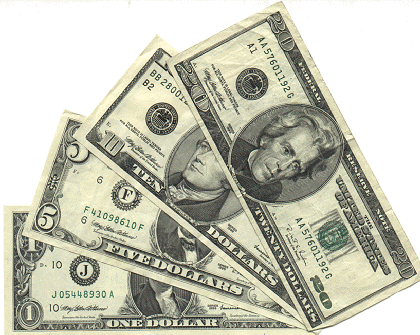
Okay, so you probably want to know which bills to copy. The answer is one- and five-dollar bills. High-tech counterfeiters favor $100 and $20 bills. That is because of the high value in a small amount of printing effort. Also the $20 bill is the second most common U.S. bill in circulation.
We will avoid them in low-tech counterfeiting. The one- and five-dollar bills have too short of a shelf life. That is, they wear out from use within eighteen months or so. There are no plans to change the one-dollar bill at all. And the new design of the five-dollar bill was built to be recognized by the current bill changers already in use.
However, some of the old bill changers do not recognize them, and are so posted.
Regular counterfeiters would find it too much work to make it worth their time to print one- and five-dollar bills.
So what do you do if you find a machine that only takes the old bills? Use copies of old money, of course. Where do you get the old five-dollar bills in good condition? You would be hard pressed to find any in change you get, but look anyway.
Assuming that you don’t find any old five-dollar bills that are in good condition, and let me stress that they must be in good condition to get a passable copy, what do you do then? You can get them from any coin shop. They will be as crisp as the day they were printed. You should buy at least three of them and use them as your masters from which all your copies will be generated.
I was able to find one- and five-dollar bills dated as far back as 1935 for as little as $1.25 for the one dollar bill, and $5.75 for a five-dollar bill. These were in good condition, but not “crisp.”
Old paper money had different colored seals than recent paper money. The bills from the thirties (1935) had a red seal. The bills from the fifties (1957) had a blue seal. Recent bills have a green seal. I found it made no difference to the bill changers what color the seal was. Copies of old money were easily exchanged for coins from the bill changers.
At the coin shop, just tell them you are a paper money collector, and you are looking for recent “crisp” ones and fives. I paid eight dollars for a recent “crisp” five-dollar bill.
You can ask your friends and relatives to check their change and keep a lookout for any crisp older ones and fives they get in their change. Some people put away crisp bills when a child is born, to be given to them when they’ve grown.
At the time of this writing, about 70% of all fives in circulation are the older style. Get them while you can.
I also experimented with a beat up bill and an ironing board. I sprayed the bill with water and ironed it. All the wrinkles came out. Unfortunately, everywhere that a crease had been, the picture, and integrity of the bill, was still damaged, and it made an unusable copy.
Okay, now you know how it works, and which denominations to copy. Now you probably want to know where to spend it. You already know that I started at a laundromat. Some of the bill changers only take one-dollar bills, others will take five-dollar bills, and some will take both. It gives a new meaning to money laundering!
Or you could hit up the pop machines. Most of the modern pop machines have a bill changer of one sort or another built right in. Insert your copy and select your soda. You get a pop and change back. Some pop machines will let you flip the change lever and get your four quarters without having to buy a pop. You will have to test for yourself to see what works on the particular machines in your area.
Then there are the candy and snack machines. They’re everywhere pop machines are, and most of the modern ones have a bill changer built into them. This is like money for nothing and your chips are free!
Some cigarette machines have a bill changer in them. The cigarette companies have burned us for years, so why not burn them back?
Self-service car washes are equipped with bill changers, usually for one- and five-dollar bills. This is one way you can exchange your copies for change and make a clean get away!
The Postal Service has come out with new stamp vending machines that accept paper money. With the rising cost of postage, they deserve a good licking.
If you live in a state that has video gambling or gaming machines, some of them are equipped to accept $20 bills. This is the only instance where using copies of $20 bills are suggested. (Special note: Some of the video gambling machines in Vegas will take anything from a one-dollar bill to a one-hundred-dollar bill. You could try them if you want to, but I don’t advise it. The casinos there have lots of cameras, and if they catch you cheating them, you might not need a lawyer, if you know what I mean.)
Also, any other vending machines that you know of that I have failed to mention should be checked out. If it has a bill changer on it, try it.
If you are going to go through with this and make it work a high percentage of the time, you should know certain tips. These will help the counterfeit bill to be accepted by the machines a higher percentage of the time, and help you to get away with it.
You don’t want to put any of your fingerprints on the paper you are copying the money on. Not before, during, or after.
If they are worn long enough, the rubber will actually take your fingerprints, and transfer them to the glove itself.
This is because the rubber is one of the things that defies the law of expansion and contraction. Water expands when it gets cold, and rubber shrinks when it gets hot. That is one reason why they use it for making condoms.
Vinyl gloves are better, but I don’t recommend them either. They can smear the toner ink on the fake money.
You can get glove liners from any medical supply company. Nurses use them to build a barrier between their skin and latex gloves. If humans come into contact with latex too often, they become allergic to it.
The cotton glove liners are thin, inexpensive, and allow free movement of your fingers. Just tell the clerk at the medical supply company that you have an allergy to latex, and they will not question you buying glove liners.
These can be awkward to work with though.
This goes for the money you intend to copy, and the copies you make. Go to the bank and get new crisp one- and five-dollar bills to use. Money that has been used too much does not copy well. Wrinkles and creases show up as lines on the copy, and the bill changer may not accept it.
If you have ever used a bill changer, you know that it won’t take a beat up bill. So with the money you intend to copy, and the counterfeit copies, keep these things in mind:
This can be done by taking a piece of heavy black construction paper, and using an Exacto knife or razor knife, measure and cut holes to the exact size of the money you intend to copy. You can get three bills per sheet. One template is all you need.
When the template is complete, you should be able to lay it on the photocopier, and insert a bill exactly into each of the holes. This has several advantages. First, it allows you to copy one side of the bills, then flip them over and copy the other side in the exact same place without any part of the counterfeit bill being off center from the other side.
Second, it allows you to cut precisely along the edges of the photocopied bills. The black paper gives a border that you can easily see. If you copy the bills without it, seeing where the edge of the bill is can be difficult.
Some bill changers are equipped to read only one side of the bill, usually the face side. This is good because you don’t have to duplex, or copy both sides of the bill.
If the bill changer reads both sides of the bill, it can still be fooled, but it is a lot more difficult. You will need to test machines you intend to use to redeem your copies with, to see if they will accept one-sided copies. I suggest that whenever possible, use only one-sided readers for redemption.
Duplexing. If you decide to copy both sides of the bill, it is best to use a copier that is designed for duplexing. That way, after you copy one side of the bill, you simply turn it over and copy the other side. If you placed the bill’s edges in the same place, it should come out perfect.
Some copiers will copy the other side on the other end of the paper. You can compensate by moving the bill to the other edge when copying the second side. It might require some testing on your part to get it to come out exactly right. That is one reason that you may choose to use a template.
You may find it quicker, I know I did, to shoot a hundred copies of one side, then reload the paper back into the copier and copy the other side. Again, this takes some testing because not all copiers are the same. Make sure everything is matching up. If it isn’t, you have placed the paper back into the copier wrong. Take it out and turn it around, not over, and try again.
Use only crisp, new unfolded and wrinkle-free bills for the best reproductions. Each time you copy a copy, it degrades the image, and the bill changer will not take a degraded copy.
Once your copies are made, you will have to cut them just the right size. If they are the wrong size, the bill changers will not accept them. There are three basic ways to cut your copied bills.
Regular black-and white-copiers are in use all over the place. They have become one of the most used pieces of office equipment today. And after today, the only one that can pay for itself in a matter of minutes.
Some fax machines are also equipped to be used as a copier. The costs are only a few hundred dollars for either a simple copier or a fax copier.
You could easily purchase one, and use it in the privacy of your own home. That way, you could make your counterfeit copies without anyone looking over your shoulder. You, of course, pay the cost of everything. Paper, toner, repairs.
Or you could choose to go to a quick copy center like Kinkos. They have real nice machines, and if you go to a 24-hour copy center at night, you will be undisturbed. If you are quick about it, you should be there only a few minutes.
At such a copy center, it is not uncommon for them to give you an autotron and let you make your own copies. An autotron is an electronic key and counter. It will allow the copier to work. Without it, you can push every button and the copier will not work.
The autotron has a row of numbers like the odometer in your car. Like the odometer keeping track of how many miles you drive, the autotron keeps track of how many copies you make. The clerk will only charge you for the copies you make, and they let you do the copying. IF they insist on making the copies for you, go somewhere else.
The drawback of using a copy center is that it costs you money to make your counterfeit bills. The best way is to use a copier at work. Almost every workplace today has at least one, and often more. If you can work late, or on weekends where you can have access undisturbed, that would be excellent.
I used an IBM at work on the weekend when I did my counterfeiting. I was able to copy, cut, and put them in an envelope in about ten minutes. I always made sure that I didn’t leave any of my paper cutouts laying around for anyone to find and get suspicious. Always destroy your own evidence.
So, you are probably curious as to how much money you can make doing this. Well, that will depend on whether you are copying one-dollar bills, or five-dollar bills.
I suggest that you use a template and copy three bills per sheet of paper. Don’t use legal-size paper if you can help it. It is much slower and bulkier to work with.
Let’s say you are using an IBM copier blasting out 100 copies a minute, with three one-dollar bills on it. If you only have to copy one side of the bill, that would be $300 a minute. That’s $18,000 an hour.
Let’s say you were using an IBM copier blasting out 100 copies a minute with five-dollar bills on it. If you have three bills per sheet, and only had to copy one side of the bill, that would be $1,500 a minute. That’s $90,000 an hour!
When was the last time you made $90,000 an hour? Who said you can’t get rich quick in today’s economy?
Okay, so you could make $90,000 of counterfeit money in an hour. It will take longer than that to redeem it.
Okay. By this point you already know which bills to counterfeit. You also know how to produce usable counterfeit bills and some places to redeem them. You know what kind of copier to use and where to find one that’s right for you. You also know you could make a lot of money doing this sort of low-tech counterfeiting.
Now you probably want to know how to redeem them in the most effective way without getting caught. Here are a few things you should keep in mind.
First, scope out your locations. You will be surprised at how many possible locations there are available to you. This is called assessing the situation. You want to know ahead of time where you are going, the best times to be there, whether or not they have video surveillance cameras. And you will want to know if the bill changers will work with your counterfeit copies.
If the location has video surveillance, you may not want to redeem at that location. Or you may want to wear a disguise. If you are driving, you certainly don’t want your license plate video-recorded while you are doing your redeeming.
If you live in a big city, it might be a good idea to work your redemption in a part of the city where you don’t live. You don’t want to be recognized!
Or it may be better to work your redemption all over the city. That way, no part is singled out or ignored.
If you live in a small town, take a trip to the city to do your redemption, and take your winnings home with you when you’re done. It would be entirely possible to go on vacation and pay for the whole thing as you go from town to town with your counterfeit copies.
You should never do more than $120 at any one location. If you keep the money value low, the stealing from a vending machine would only be a misdemeanor crime if you were caught. Also, if you redeem more than that, it takes too long. If it takes too long, it could look suspicious.
Be quick. In and out in five minutes or less. However long it takes to grab a piece of tail in the back seat of your car without getting caught is a good rule of thumb.
The best time to do your redemption is on a Friday evening. Work all weekend if you have enough counterfeit copies to redeem, and enough locations to redeem at. Some or most of the machines have been stocked for the weekend and won’t be checked until Monday at the soonest. By then, you are long gone.
You should carry a heavy canvas gym bag for the change you will be getting. This works well at laundromats and car washes. If you are going to be hitting a soda or candy machine, bring boxes or bags for the pop and snack items you will be buying with your counterfeit copies.
Think ahead. If you buy fifty cans of pop from a machine, you have to be able to carry or transport fifty cans of pop when you leave. Or eighty snack-size bags of chips, which can take up a lot of space. I know. I cleaned out a candy and snack machine one night.
A large black trash bag works well for candy and snacks. It is heavy enough not to break, and dark enough that nobody can see through it. Boxes work well too, although they can be bulky.
Using this strategy to redeem your counterfeit copies of money can be rewarding. You could make as much as $20,000 in change and food items in a single weekend. You really do get money for nothing and your chips are free. Then you may wish to move to another city or state and repeat the process.
Okay. Now you have five hundred pounds of pop and snacks you can eat at your leisure. And you have five hundred pounds of change. What do you do with all that change?
You could go to the bank, or probably more than one, and get the paper tubes to roll it up. That way you can either cash it in at the bank for paper money, or you can spend it wherever you normally shop.
More than once, I have bought cigarettes with rolls of change. And the lady at the bakery traded paper money for my change rolls when she saw that’s what I had. Stores use change all day long.
Or you could fill a coffee can or ice cream bucket with change, and take it to the bank. Most banks have an automatic change counter that will quickly and accurately count the change no matter what denomination it is in. Quarters, dimes and nickels, even pennies are separated and tallied up.
I have done that several times. I always tell them it was time to cash out the coffee kitty. Or it was time to empty the piggy bank and start over.
If you have a lot of change, it would be a good idea to go to more than one bank.
Also, it helps to not use the same bank more than once every three months. You don’t want them to get suspicious.
And don’t go in with a wheelbarrow full of change. That’s pretty hard to explain.
You might check out supermarkets in your area to see if they have a Coinstar machine. They work like the machine at the bank, counting unsorted change at the rate of 600 coins per minute. At the end of the transaction, Coinstar customers receive a printed voucher for the amount of the transaction, less 8.9 percent service fee.
Since Coinstar Inc. installed its first change machine in 1992, it has processed more than three billion dollars in coins. More than one billion dollars worth of those coins were processed between February and November of 2000. If you can find one in your area, they are an easy and convenient way to discreetly redeem your change.
Okay, so now you are a low-tech counterfeiter, copying and redeeming lots of fake money. If you don’t get caught, that’s a good thing. But what if you do get caught? What happens then?
Counterfeiting, unlike most federal crimes, is not investigated by the FBI. It is under the jurisdiction of a branch of the United States Secret Service. The Secret Service was created by Abraham Lincoln in 1865 during the Civil War to deal with counterfeiting.
Do keep in mind that counterfeiting is a federal crime. Even if you copy only so little as one one-dollar bill, it is a punishable crime if you are caught. And the Secret Service takes their job very seriously, investigating even the smallest cases that are reported to them.
If you get caught, and are subsequently convicted, you could be looking at a fine, or fifteen years in prison, or both. So as always, don’t do the crime if you can’t do the time. Nobody likes staying at the Crowbar Hotel.
What if a merchant catches you in the act? They might attack you and try to beat your brains out, or worse, restrain you for the cops. I recommend you use the oldest defense known to man. No, not Kung-Fu. RUN! Don’t try to fight or shoot them. Just get away. Those who turn and run away will live to cash in another way another day.
And remember, if you do get caught, play dumb. Don’t confess. You are innocent until proven guilty. Make them prove it.
Is it possible for the average man or woman to be a counterfeiter? Of course it is. It happens all the time. More often than you think. You don’t always hear about it for obvious reasons. If the nightly news carried a story about just how easy it was, and how few people are actually caught as a result, we would all do it!
The Secret Service, local authorities, and merchants are all quick to put a lid on any incidents that could lead to mass low-tech counterfeiting.
If the truth were widely known, it would lay certain industries on their ears, if not put them out of business altogether. Retooling and retrofitting would have to take place, costing into the hundreds of millions of dollars.
That is why the best thing for the authorities and merchants to do is keep it quiet and hope it never catches on big.
I believe that in a capitalistic society such as ours, free enterprise should flourish. My first attempt at low-tech counterfeiting occurred when I was ten years old. Two of my older brothers were very influential in that they had counterfeited winning game cards a few years earlier and gotten away with it.
My mother, being a good Christian woman, was angry with me and wanted me to return the money I had exchanged for my counterfeits. I can still remember what one of my brothers said, “If the boy was smart enough to figure that out and make it work, he deserves to keep the money.”
My mother kept the money, just as she had kept his money from the bogus winning game cards a few years earlier. I believe that what my mother did was wrong.
I believe very much in the “free” part of free enterprise. So if you find yourself in a financial bind, and the government that doesn't mind taxing you to death won’t help you, and that good Christian church takes your money but won’t act to help you, I empower you with this article to help yourself.
The race belongs to the swift, the Lord helps those who help themselves, and cash as cash can!·
Technology Is Our Friend
Bucking the System
Spending Your Loot
Reproduction Tips
You Gotta Know
Where to Access a Copier
How Much Money Can Be Made?
Strategies for Redemption
“What to Do With All the Change”
Penalty if You’re Caught
Conclusion