THE MYTH OF SECURITY AND THE LOSS OF PERSONAL PRIVACY
by Trent Sands
Hardly a day goes by that there isn't some news story, somewhere, in which some horrible crime has been committed by someone in a position of responsibility – a schoolteacher, bus driver, daycare worker, etc. Very often, the crime will involve the abuse of children or elderly people. The politicians then offer their quick fix solution. This solution almost always involves another assault, this time on everyone's right to privacy. Inevitably, the solution will involve background checks on all workers in whatever field the abuser was employed. The result of this has been that now more Americans than ever are subjected to intrusive interrogations into their lives. But has overall security really been improved, and if so, has it been at the expense of the privacy rights of all Americans?
We need to first examine what exactly is a background check. In a nutshell, a background check is a search for negative information that will disqualify an individual from consideration for the employment they seek. This negative information can be of numerous types. The disqualifier that immediately comes to mind for most people is that of a criminal record. Other disqualifying information can be negative financial records, a poor driving history, or even general behavior of questionable character.
Where do background checkers get their data? Let's begin by examining the shadowy area of criminal records. Criminal information on an individual generally begins the first time an individual is cited or arrested for suspicion of involvement with criminal conduct. Notice I said, “when arrested or cited,” not necessarily convicted of anything. If the person is later convicted, then a “record” of this conviction is created. If a prison or jail sentence is the result, additional “records” are created at the state department of corrections and/or local jail system. The final “record” for this particular criminal event would be created by the probation and parole department at the time the convicted person would have completed serving his sentence.
Criminal records information is available from a number of sources. Most states have a central repository for all criminal records. In most states, this repository will also contain all records of arrest. This is better understood if we take a quick look at how information is moved along through the law enforcement system.
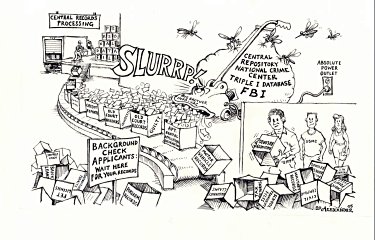
Whenever a person is arrested by the local police, his information and fingerprint data are immediately sent to the state's central repository. The computer searches to see if the person is already in the system, and if so, sends the local police department a copy of the person's records. This includes arrests, convictions, parole, and parole violations, anything that would have had a record attached to it. At this point, the data trip is just beginning.
The fingerprint and identity information is now sent to what is known as the Interstate Identification Index maintained by the FBI at the National Crime Information Center's computer center. In this data bank, two things are searched for: previous criminal convictions for all felonies in every state and certain serious misdemeanors, and any federal convictions. Results will be returned from what is known as Triple I, which is law enforcement jargon for the Interstate Identification Index. Another file maintained on the National Crime Information Center computer is the wanted person index. This too is searched to see if there are any outstanding arrest warrants for the individual. If there are any matches, the information is given to the local police department.
In most states, criminal conviction data are public records. Some states allow the public direct access to the central state repository. The usual method of operation in these states is that, anyone can request a search on anyone's name and birthdate without the consent of the person concerned. There are some states that do not allow the public to have this access. Their central state repositories are for law enforcement and governmental use only. In states such as these, searches may be made at the county level. In all counties within these states, criminal record searches can be done by anyone, because these court records are public records. Another source of statewide criminal records is those of the corrections department. In states where the central repository is off limits, a Department of Corrections check for incarceration records may be performed instead. Incarceration records will apply to most felony convictions where a state prison term was assigned.
With the exception of records maintained by the FBI on the Triple I database, most of these other sources of information are freely available to those companies performing background checks. But there is a big problem with this system. In many states, arrest records, even those where the person is ultimately found not guilty, and even in cases where the arrest itself was a mistake, will also be released. The damage that can be done to an innocent person in instances such as these is incalculable. There is also a problem with mistaken identity as when a record belonging to one individual is attributed to someone else with the same, or similar, name and birth date. In many cases, the individual who is denied employment because of records wrongly attributed to him, has no way to find out that the decision denying him or her a job was based on an error, or wrongly assumes that a mistaken arrest record has been expunged, when in reality, it is still readily available.
As the number of places that check criminal records increases, the fallout of being wrongly arrested, or arrested and exonerated, but still having the arrest come up in a background check, cannot be underestimated. Consider the following example. A man wants to move into an apartment complex. He fills out the application, duly noting the boilerplate at the bottom of the tenancy application about background and credit checks. Ten years ago he was wrongly arrested in a burglary investigation. The police realized their error within a few hours and he was released. But during the arrest, he was fingerprinted and his prints and personal information were sent to the state central criminal repository and to the FBI. Unfortunately, in his state, arrest records are also released for background checks. The apartment complex management receives a copy of the applicant's arrest record for burglary and he is denied the rental.
What many people do not know is that in a large percentage of wrongful arrests or arrests where the suspect is found not guilty – no information as to the dismissal of the charge or the exoneration in court ever appears on the record attached to the arrest. Simple human nature usually rules here. Even if the person was cleared and by some miracle the record does show that, most places will take a “better safe than sorry” attitude, and simply not consider anyone who has an arrest record, because after all, only guilty people get arrested, right?
Another major privacy violation occurs when background checks are made using fingerprints. A fingerprint check background investigation is particularly common with public school teachers. The problem most people are not aware of is that when they allow their fingerprints to be used for a background check, these prints are used to establish an identification file used by every law enforcement agency whose system they are run against.
So what does this mean in everyday language? Consider a school district that runs background checks on new employees through their local police department. The local police department will run the fingerprints through their own database, and then submit them to their state repository, which in turn submit them to the FBI.
What our innocent teacher does not realize is that a new file will be created in each one of these systems. This file will contain the submitted fingerprints along with a description of the applicant – full name, birth date, sex, race, and any physical identifiers. In most systems, a unique fingerprint identification number will be assigned. Nowhere do any laws specifically authorize this practice, but the lack of any regulation means that this practice has flourished. Law enforcement agencies love this because if they had their way, all Americans would be fingerprinted (and DNA'd too) well before they became adults. As fingerprint background checks become more common, the FBI gets ever closer to its goal of having the fingerprints of everyone in country in its files.
Much of the rationale for doing fingerprint background checks is faulty. The reason most often given, particularly in the case of those who will work around children, is that these checks are necessary to catch or prevent child molesters from getting these positions. But just how true is this? The reality is these checks do not catch the majority of child molesters. When schoolteachers are arrested for having sex with students, the majority of them have no prior record, and they have successfully passed a background check. The sad fact is that most child molesters who are working with children have no previous criminal record. Once these people are caught, it is the effective end of any involvement with children because they are prosecuted, serve many years in prison, and then have a scarlet letter placed on them by their inclusion in the state child molester database.
The other questions raised by the pervasive spreading of background checks is, do people with criminal records deserve the right to be in the labor force, and if not, what is to become of them? Nearly 50 million Americans have a criminal record of some sort. Many of these people are now being fired from jobs because belated background checks uncover old convictions, many times for minor crimes. One of the fallouts from our background check crazed society is that anyone with any type of negative information in their past, true or not, can be made unemployable. Airport jobs are a good example. A person with any type of conviction is virtually unemployable at an airport. Airport employment encompasses millions of jobs. Airport employment is not limited to pilots, flight attendants, and mechanics, but also the millions who work in airport shops, restaurants, cleaning services, etc. In many cities, the airport is the largest employer. Many people with records from years ago have been fired from airport jobs they have done well. What is to become of these people?
Negative information is not limited to criminal records, however. A typical background check will involve checking a person's financial history and driving record. Many people with bad credit or driving accidents may be denied employment. The problem with using these records as a basis for exclusion from employment is that there is no objective standard for how “bad” they must be to be ineligible for a particular job. Is ignoring a traffic ticket sufficient to be denied work cleaning clothing? Would it be more likely that being arrested, but not convicted for rape is bad enough, but a warrant for a traffic ticket isn't? Where is the line drawn and who draws it?
Bad credit is another good example. Is one bad account enough to put a person out of consideration, or is bankruptcy? What about the fact that nearly 50% of all credit reports have factual errors in them, errors that could cause the denial of an offer of employment? Errors on credit reports can consist of late payments, charged off accounts, or bad accounts that belong to other people. Over a million people have negative information on their credit reports because of identity theft. These people can be denied employment and have no timely recourse. They may not even know why they have been denied that job or that apartment. What the credit report says is considered gospel and the applicant isn't even given the opportunity, in most cases, to be made aware there is a problem.
Driver records can also be problematical. If you were involved in an automobile accident, even if it was not your fault, you might be denied employment because they classify you as being risky or accident-prone. And this is the entire problem with being crazed for background checks. Any mistake in a person's past or information that can be perceived as negative can be retrieved and used as a reason to deny employment.
We need to address fundamental questions raised by the background check crazed society. The first is the privacy issue. How easy should it be to compile detailed dossiers of every mistake that someone has ever made, (and in some cases mistakes that someone else made) and should this information be used to deny employment? What legal strictures should govern who can compile and sell this data? One thing is clear – when there is a vacuum of legislation regulating this business, practices develop that favor the widest possible dissemination of personal data to the detriment of personal privacy. The same is true with government agencies creating fingerprint files on people when their prints are submitted for background checks. No law specifically authorizes this practice, but government agencies are using it to compile fingerprints on tens of millions of Americans who have no involvement with criminal activity. If widespread background checks are to be a feature of our society, is there a way that this can be accomplished, yet provide protection of personal privacy rights?
The answer is yes. The first step that needs to be taken is that criminal record information needs to be released only if an arrest led to a conviction. Federal laws need to be written that require states to release only criminal conviction information, and prohibits them from releasing arrest data. This restores the basic fairness of people being judged only on what they have been proven to have done wrong, not merely what has been alleged or happened in error.
Secondly, a thorough background check can be done without the use of fingerprints. Applicants who possess good, verifiable identity documents can have a complete background check without fingerprints. Many places prefer to use fingerprints because it means far less work for them. Verifying identity documents is easy to do with the many identification guides that are available, and the most common form of identification – the driver's license, can be verified in real time with the motor vehicle department in the state that issued it. If fingerprint background checks are to continue to be done, federal law needs to be changed so that only a search for a matching criminal record is done – and if none is found, no new file should be permitted to be created, and a certification statement from the state and the FBI should be returned to the applicant along with the original of the submitted fingerprint card.
Finally, third party information brokers that provide background check services should be legally liable for the accuracy of the data they supply. Many people are damaged when records belonging to someone with the same name and birthdate are identified wrongly with them. Information brokers should be required to attempt to verify that a record actually belongs to the subject of the background search, and the subject of that search should have the right to dispute the accuracy of the record before it is given to the potential employer and the damage done. The same applies to credit records and driving records. The damage done once erroneous information is released is severe, particularly in light of the rapid growth of identity theft and the destroyed credit histories as a result.
If we are going to do background checks, we should be aware of the potential damage that can be done to innocent citizens and act responsibly to prevent that as much as possible. A system of checks and balances is necessary to insure that errors by background checking companies are not allowed to become part of the public record. Every effort to protect the privacy and good name of the innocent should be made.
Loompanics Unlimited l
2005 Fall Supplement
LOOMPANICS UNLIMITED Online Catalog

Order Toll-Free 1-800-380-2230
YOUR ORDER IS SHIPPED WITHIN 24 HOURS OF RECEIPT!
(Monday Through Friday, 8am to 4 pm)
We need to first examine what exactly is a background check. In a nutshell, a background check is a search for negative information that will disqualify an individual from consideration for the employment they seek. This negative information can be of numerous types. The disqualifier that immediately comes to mind for most people is that of a criminal record. Other disqualifying information can be negative financial records, a poor driving history, or even general behavior of questionable character.
Where do background checkers get their data? Let's begin by examining the shadowy area of criminal records. Criminal information on an individual generally begins the first time an individual is cited or arrested for suspicion of involvement with criminal conduct. Notice I said, “when arrested or cited,” not necessarily convicted of anything. If the person is later convicted, then a “record” of this conviction is created. If a prison or jail sentence is the result, additional “records” are created at the state department of corrections and/or local jail system. The final “record” for this particular criminal event would be created by the probation and parole department at the time the convicted person would have completed serving his sentence.
Criminal records information is available from a number of sources. Most states have a central repository for all criminal records. In most states, this repository will also contain all records of arrest. This is better understood if we take a quick look at how information is moved along through the law enforcement system.
Whenever a person is arrested by the local police, his information and fingerprint data are immediately sent to the state's central repository. The computer searches to see if the person is already in the system, and if so, sends the local police department a copy of the person's records. This includes arrests, convictions, parole, and parole violations, anything that would have had a record attached to it. At this point, the data trip is just beginning.
The fingerprint and identity information is now sent to what is known as the Interstate Identification Index maintained by the FBI at the National Crime Information Center's computer center. In this data bank, two things are searched for: previous criminal convictions for all felonies in every state and certain serious misdemeanors, and any federal convictions. Results will be returned from what is known as Triple I, which is law enforcement jargon for the Interstate Identification Index. Another file maintained on the National Crime Information Center computer is the wanted person index. This too is searched to see if there are any outstanding arrest warrants for the individual. If there are any matches, the information is given to the local police department.
In most states, criminal conviction data are public records. Some states allow the public direct access to the central state repository. The usual method of operation in these states is that, anyone can request a search on anyone's name and birthdate without the consent of the person concerned. There are some states that do not allow the public to have this access. Their central state repositories are for law enforcement and governmental use only. In states such as these, searches may be made at the county level. In all counties within these states, criminal record searches can be done by anyone, because these court records are public records. Another source of statewide criminal records is those of the corrections department. In states where the central repository is off limits, a Department of Corrections check for incarceration records may be performed instead. Incarceration records will apply to most felony convictions where a state prison term was assigned.
With the exception of records maintained by the FBI on the Triple I database, most of these other sources of information are freely available to those companies performing background checks. But there is a big problem with this system. In many states, arrest records, even those where the person is ultimately found not guilty, and even in cases where the arrest itself was a mistake, will also be released. The damage that can be done to an innocent person in instances such as these is incalculable. There is also a problem with mistaken identity as when a record belonging to one individual is attributed to someone else with the same, or similar, name and birth date. In many cases, the individual who is denied employment because of records wrongly attributed to him, has no way to find out that the decision denying him or her a job was based on an error, or wrongly assumes that a mistaken arrest record has been expunged, when in reality, it is still readily available.
As the number of places that check criminal records increases, the fallout of being wrongly arrested, or arrested and exonerated, but still having the arrest come up in a background check, cannot be underestimated. Consider the following example. A man wants to move into an apartment complex. He fills out the application, duly noting the boilerplate at the bottom of the tenancy application about background and credit checks. Ten years ago he was wrongly arrested in a burglary investigation. The police realized their error within a few hours and he was released. But during the arrest, he was fingerprinted and his prints and personal information were sent to the state central criminal repository and to the FBI. Unfortunately, in his state, arrest records are also released for background checks. The apartment complex management receives a copy of the applicant's arrest record for burglary and he is denied the rental.
What many people do not know is that in a large percentage of wrongful arrests or arrests where the suspect is found not guilty – no information as to the dismissal of the charge or the exoneration in court ever appears on the record attached to the arrest. Simple human nature usually rules here. Even if the person was cleared and by some miracle the record does show that, most places will take a “better safe than sorry” attitude, and simply not consider anyone who has an arrest record, because after all, only guilty people get arrested, right?
Another major privacy violation occurs when background checks are made using fingerprints. A fingerprint check background investigation is particularly common with public school teachers. The problem most people are not aware of is that when they allow their fingerprints to be used for a background check, these prints are used to establish an identification file used by every law enforcement agency whose system they are run against.
So what does this mean in everyday language? Consider a school district that runs background checks on new employees through their local police department. The local police department will run the fingerprints through their own database, and then submit them to their state repository, which in turn submit them to the FBI.
What our innocent teacher does not realize is that a new file will be created in each one of these systems. This file will contain the submitted fingerprints along with a description of the applicant – full name, birth date, sex, race, and any physical identifiers. In most systems, a unique fingerprint identification number will be assigned. Nowhere do any laws specifically authorize this practice, but the lack of any regulation means that this practice has flourished. Law enforcement agencies love this because if they had their way, all Americans would be fingerprinted (and DNA'd too) well before they became adults. As fingerprint background checks become more common, the FBI gets ever closer to its goal of having the fingerprints of everyone in country in its files.
Much of the rationale for doing fingerprint background checks is faulty. The reason most often given, particularly in the case of those who will work around children, is that these checks are necessary to catch or prevent child molesters from getting these positions. But just how true is this? The reality is these checks do not catch the majority of child molesters. When schoolteachers are arrested for having sex with students, the majority of them have no prior record, and they have successfully passed a background check. The sad fact is that most child molesters who are working with children have no previous criminal record. Once these people are caught, it is the effective end of any involvement with children because they are prosecuted, serve many years in prison, and then have a scarlet letter placed on them by their inclusion in the state child molester database.
The other questions raised by the pervasive spreading of background checks is, do people with criminal records deserve the right to be in the labor force, and if not, what is to become of them? Nearly 50 million Americans have a criminal record of some sort. Many of these people are now being fired from jobs because belated background checks uncover old convictions, many times for minor crimes. One of the fallouts from our background check crazed society is that anyone with any type of negative information in their past, true or not, can be made unemployable. Airport jobs are a good example. A person with any type of conviction is virtually unemployable at an airport. Airport employment encompasses millions of jobs. Airport employment is not limited to pilots, flight attendants, and mechanics, but also the millions who work in airport shops, restaurants, cleaning services, etc. In many cities, the airport is the largest employer. Many people with records from years ago have been fired from airport jobs they have done well. What is to become of these people?
Negative information is not limited to criminal records, however. A typical background check will involve checking a person's financial history and driving record. Many people with bad credit or driving accidents may be denied employment. The problem with using these records as a basis for exclusion from employment is that there is no objective standard for how “bad” they must be to be ineligible for a particular job. Is ignoring a traffic ticket sufficient to be denied work cleaning clothing? Would it be more likely that being arrested, but not convicted for rape is bad enough, but a warrant for a traffic ticket isn't? Where is the line drawn and who draws it?
Bad credit is another good example. Is one bad account enough to put a person out of consideration, or is bankruptcy? What about the fact that nearly 50% of all credit reports have factual errors in them, errors that could cause the denial of an offer of employment? Errors on credit reports can consist of late payments, charged off accounts, or bad accounts that belong to other people. Over a million people have negative information on their credit reports because of identity theft. These people can be denied employment and have no timely recourse. They may not even know why they have been denied that job or that apartment. What the credit report says is considered gospel and the applicant isn't even given the opportunity, in most cases, to be made aware there is a problem.
Driver records can also be problematical. If you were involved in an automobile accident, even if it was not your fault, you might be denied employment because they classify you as being risky or accident-prone. And this is the entire problem with being crazed for background checks. Any mistake in a person's past or information that can be perceived as negative can be retrieved and used as a reason to deny employment.
We need to address fundamental questions raised by the background check crazed society. The first is the privacy issue. How easy should it be to compile detailed dossiers of every mistake that someone has ever made, (and in some cases mistakes that someone else made) and should this information be used to deny employment? What legal strictures should govern who can compile and sell this data? One thing is clear – when there is a vacuum of legislation regulating this business, practices develop that favor the widest possible dissemination of personal data to the detriment of personal privacy. The same is true with government agencies creating fingerprint files on people when their prints are submitted for background checks. No law specifically authorizes this practice, but government agencies are using it to compile fingerprints on tens of millions of Americans who have no involvement with criminal activity. If widespread background checks are to be a feature of our society, is there a way that this can be accomplished, yet provide protection of personal privacy rights?
The answer is yes. The first step that needs to be taken is that criminal record information needs to be released only if an arrest led to a conviction. Federal laws need to be written that require states to release only criminal conviction information, and prohibits them from releasing arrest data. This restores the basic fairness of people being judged only on what they have been proven to have done wrong, not merely what has been alleged or happened in error.
Secondly, a thorough background check can be done without the use of fingerprints. Applicants who possess good, verifiable identity documents can have a complete background check without fingerprints. Many places prefer to use fingerprints because it means far less work for them. Verifying identity documents is easy to do with the many identification guides that are available, and the most common form of identification – the driver's license, can be verified in real time with the motor vehicle department in the state that issued it. If fingerprint background checks are to continue to be done, federal law needs to be changed so that only a search for a matching criminal record is done – and if none is found, no new file should be permitted to be created, and a certification statement from the state and the FBI should be returned to the applicant along with the original of the submitted fingerprint card.
Finally, third party information brokers that provide background check services should be legally liable for the accuracy of the data they supply. Many people are damaged when records belonging to someone with the same name and birthdate are identified wrongly with them. Information brokers should be required to attempt to verify that a record actually belongs to the subject of the background search, and the subject of that search should have the right to dispute the accuracy of the record before it is given to the potential employer and the damage done. The same applies to credit records and driving records. The damage done once erroneous information is released is severe, particularly in light of the rapid growth of identity theft and the destroyed credit histories as a result.
If we are going to do background checks, we should be aware of the potential damage that can be done to innocent citizens and act responsibly to prevent that as much as possible. A system of checks and balances is necessary to insure that errors by background checking companies are not allowed to become part of the public record. Every effort to protect the privacy and good name of the innocent should be made.
(Monday Through Friday, 8am to 4 pm)