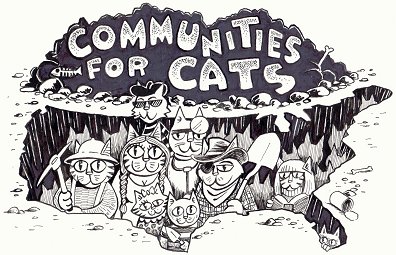
 Article © 2004 by Claire Wolfe Illustration © 2004 by Bob Crabb
Communities for Cats
by Claire Wolfe
After years of idle talk, there'a a current in the air. There's a change coming for people who crave freedom.
Have you felt it? Suddenly, after years of idle talk, there's a current in the air. There's a change coming for people who crave freedom.
We freedom lovers have been trying to save the world. But the world isn't interested in our kind of “saving.” Maybe it will be, once government has gotten even more tyrannical and people are desperate enough to take risks. But today?
Time to save ourselves, folks. And our kids. And to save freedom – even if we have to save it by practicing it – like ancient Christians in the Roman catacombs – in secrecy.
It's time to start gulching.
What's gulching?
Gulching is the act of physically retreating from the mainstream world in company with other freedom seekers. In a gulch, you trade freely with free people, live quietly, and preserve your values in hopes of bringing them back to the outside world later. As a community, you practice as much self-sufficiency as possible.
Gulching is for those who are most passionately committed to living what we believe, not as lone Outlaws, but as members of a free society.
“Gulching” is named after Galt's Gulch, the hidden mountain community to which the heroes of Ayn Rand's Atlas Shrugged retreated when their increasingly socialistic world used and abused them.
To gulch is to retreat. But not to be defeated. It's a strategic retreat. It's regrouping. It's marshalling our resources for a future foray.
Gulching is for those who are most passionately committed to living what we believe, not as lone Outlaws, but as members of a free society.
Gulching is precisely what a small, but important, number of freedom seekers have finally begun to do.
And halellujah – gulching is precisely what a small, but important, number of freedom seekers have finally begun to do.
But isn't the whole notion just plain impractical?
Anybody reading this article could probably make a list of 100 reasons why the idea of gulching is completely hare-brained, impractical, unsuitable for individualists, and too difficult to accomplish under the nose of the surveillance state.
Because you can't herd cats.
Because people have to work for a living & gulches must be remote.
Because they'll Waco you.
Because it's too expensive to build a gulch.
Because self-sufficiency is an absurd ideal in this day and age, and it's inefficient, besides.
Because they'll Waco you.
Because you can't ever hope to hide an entire community from the surveillance state.
Because if you set up free-market community services like banking or medical care without regulation ... they'll Waco you.
Because technology - for communications, health care, etc.– requires expensive equipment and/or extensive infrastructure that an isolated community can't provide.
Because they'll Waco you.
Yep. All true. If we're looking for good reasons not to act, we can find a million of them. But ... What if we could ...?
Gulch without gulching. Hide in plain sight.
Ayn Rand protected Galt's Gulch from sight with a marvelous “ray screen” that made the gentle valley look like a forbidding mountaintop. Then damn, she forgot to leave us the instructions for building that thingy.
A gulch doesn't even have to be all in one place.
No matter. Today, we have a few tools Rand's heroes didn't have. Interstate highways. The Internet (and better still, for our purposes, the old FidoNet!). Readily available public-key encryption. A nationwide – even worldwide – network of freedom activists. Nevada and Wyoming corporations. Cellphones. Phone scramblers. Several ongoing free-state projects (which could play a very different role than they were set up to play). And many more assets no one writer could think of.
We also have very creative brains – brains that can invent, and execute, new kinds of gulches.
Because after all, a gulch doesn't have to be exactly what Ayn Rand described. A gulch doesn't even have to be all in one place.
What if our gulches looked like this:
Joe Liberty, his wife, and kids own 80 acres in Montana. Not far away, a developer is selling 40-acre parcels of primitive recreation land on EZ terms for $500 per acre. Joe invites his brother and his cousin to buy land a mile away from his spread. Joe's wife Jill persuades her best friend, an RN, to buy her own parcel, also. The investment and commitment are minimal at this point. People can re-locate at their own pace and in the meantime, they've got vacation property – probably owned in the name of a corporation or a trust. They control their own spreads – no communalism. No big “compound” to be Wacoed. Yet they can trade skills and goods, do some degree of mutual defense, and otherwise function as a rural community – without anyone outside even realizing a freedom community exists.
You don't have to become a primitive homesteader or move to a remote area unless you want to.
Thirty miles away Tomasina Paine and Patricia Henry buy a home in a small town, where they can open up a retail store. Dr. H. David Throeau also moves to that little town and sets up his medical practice there, just because he likes its quality of life. And so do Daisy Crockett and her husband Jefferson. Nobody makes any big fuss about “taking over” or “changing the local culture.” They just do it. Because it's a place they like to be. It's a bit off the beaten path, but they can still earn a living.
In a larger town, software geek Sam L. Adams doesn't move at all. He just stays at home and helps set up communications networks.
Communications
Each mini-settlement creates a secure, intra-community form of communication – secure both in terms of privacy and in terms of being strong against attack.
Gradually, the mini-settlements also set up intercommunity communications networks.
These networks might use Freenet (http://www.freenet.sourceforge.net/index.php?page=faq) and/or use the old FidoNet (www.fidonet.org) protocols. Individual computers are RFI shielded to keep from broadcasting their activity to waiting electronic ears. Those few gulches that actually have physically connected homesteads might use underground utility connections between dwellings – and for that matter, underground tunnels for other purposes.
A large network of communities can provide medical services, black-market pharmaceuticals, unregulated jobs, free-market banking services, and more.
However they set it up, the communities then use these communications networks not just to share information, but to do real, community-type things in the real world.
Mini-Gulch A doesn't necessarily know exactly where Mini-Gulch B is located or who's involved with it – merely what services it can provide. Gulch B has well-drilling equipment. Gulch D has a breeder of border collies. Gulch X has a science teacher. Gulch Z has a brewer. Gulch M has an IT manager.
The communities trade – gradually weaning themselves from FRNs and switching to digital gold or barter. And as the outside world is forced ever deeper into the web of national ID, databases, regulations, and surveillance, the gulch network turns ever more inward, relying on its growing numbers to provide goods and services that dissenting individuals can no longer obtain privately, freely, and legally in the mainstream. Or to provide goods and services that are untaxed, unregulated, and unrecorded by government.
Some services and goods are independent of location. Others are very dependent on location – like health care, for example. But even some of those intimate services can be provided with discretion: “Chiropractor needed for individual in Coos County, New Hampshire” – says the relayed announcement, source undisclosed. “Internist and full range of clinic services available to gold-paying customers in Pocatello, Idaho.”
Information can be passed via traditional cell structures, augmented by anonymous electronic communications. More services become feasible as the community networks grow. People who initially kept “outside” jobs come in from the cold. Institutions are established – quietly, always quietly.
There's no timeline, no mass movement, no big project. There's just individuals and small groups making very practical connections – more and more of them as tyranny siezes the outside world.
Theoretically, you could gulch – or at least be part of a gulching network – without ever leaving home. For example, you could offer your urban townhouse as a station on an underground railroad or (like Sam L. Adams) as a communications hub. Or your could be a “beard” who provides respectable cover or pseudo-mainstream employment for undocumented citizens.
Bear, one of the participants on The Claire Files discussion forums (www.thementalmilitia.org/clairefiles), put it well. “Think of a gulch as an extended neighborhood.”
Advantages
Because recruitment for any one mini-community is small-scale, you can succeed if you get only five or six families to join you.
You're recruiting people with whom you already have trusted relationships. That's no guarantee of security or stability – but it beats the heck out of figuring out whether you can trust a stranger.
Gulches where each participant owns property avoid some of the loss of control and built-in dissention that come with communal or corporate efforts.
There's something for everybody. You don't have to become a primitive homesteader or move to a remote area unless you want to.
The gulches are perfectly legal – though many activities within them won't be. (So what else is new?)
The temptation – and the ability – to “Waco” any one gulch is less because of the utter lack of “compounds.” Even if one mini-community is attacked, others on the outside can get help, alert the news media, etc. (as the Branch Davidians could not).
Difficulties
Because recruitment must remain private, it will necessarily be gradual.
Many individuals will have to take initiative if many mini-communities are to be built – and most people don't like taking initiative.
Any large-scale endeavor has a problem with people opening their yaps. This system is no exception. However, with “node” and cell communications the risk is minimized.
The difficulties and dangers of setting up and maintaining unregulated businesses can't be understated. They are vast.
When relying on underground – that is, black-market – services, there's an exceptional amount of trust required and risk taken. If your free-market banker absconds with your gold credits, the fedgov is not going to step in and make you whole again.
A gulch cannot totally remove you from “the real world” by magic. It can only do as much as the individuals within it are capable of doing and are willing to risk doing.
No reason not to begin
This short article can't even begin to solve all the problems of such a gulch-network system – or describe all its workings and virtues. But what I'm talking about is also not airy theory.
People are already building gulches. Some are already starting to network their gulches, planning to trade skills, services, and resources.
The folks I know who are making gulching work are neither jumping into the project on impulse nor sitting around stymying themselves on the overwhelming challenges. They're setting a few basic goals ... then leaping in with a handful of like-minded people to solve the problems “in real-time.”
The great beauty of this style of gulching is that it works whether 40 or 40,000 participants ultimately get involved. A tiny community that can only trade vegetables, water, communication, and self-defense skills is still better than no community at all. A larger network of communities that can provide medical services, black-market pharmaceuticals, unregulated jobs, free-market banking services, and more is better yet.
But either is better than being forever a lone-wolf Outlaw or living a life of endless, soul-crushing compromise with no hope of escaping the tender embrace of the state.
For more information see:
The Claire Files forums (click on the Gulching forum): www.thementalmilitia.org/clairefiles
The Gulchers Guide www.libertymls.com/gulch/
Check out Claire Wolfe's new book, Freedom Outlaw's Handbook featured in this supplement, She has also written I Am Not a Number!, Think Free to Live Free, and several other titles as well as articles.
Loompanics Unlimited l
2004 Fall Supplement
LOOMPANICS UNLIMITED Online Catalog
 Order Toll-Free 1-800-380-2230
YOUR ORDER IS SHIPPED WITHIN 24 HOURS OF RECEIPT!
Order Toll-Free 1-800-380-2230
YOUR ORDER IS SHIPPED WITHIN 24 HOURS OF RECEIPT!
(Monday Through Friday, 8am to 4 pm)