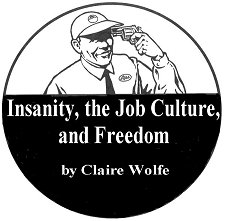
And consider this: When you're raised in an insane environment and you have no points of reference outside the insane system, you believe your environment and its values to be sane.
We're all raised with certain values that we accept without conscious analysis. Even iconoclasts who vigorously reject their society's biggest shibboleths still operate on countless numbers of taken-for-granted assumptions.
You must fit in. Zits are ugly. When you get out of school, you get a job. Sexism is unfair. Thin is more attractive than fat. Without government, there'd be violent chaos. The races should integrate. Without religion, people would have no morals. A woman should be shorter and younger than her man. Body odor is bad. America is the freest nation on earth. Unemployment is bad. Meth use is epidemic. Adults should not have sex with 15-year-olds. Individualism is good. A growing economy is by definition a healthy economy.
Agree? Disagree? No matter. Cultural assumptions surround us and – for good or ill – rule our society more firmly than laws. They influence us even when we personally reject them.
Some cultural assumptions enhance survival. Others are nothing more than knee-jerk reactions that can change in an instant. Yet while we hold them, they seem as immutable as the word of God. Challenging these "givens" is difficult, to say the least.
I just wrote a book for Loompanics called How to Kill the Job Culture Before It Kills You. It's a slender book. Pretty short. But it was hard work. What made it hard was that it sought, among other things, to draw a picture of the Job Culture while standing inside the Job Culture.
That's like a flea trying discuss a dog with its fellow fleas. They're all standing on the dog's back, but none can truly perceive it as it is.
The book challenges basic assumptions of the Job Culture. That's a flea saying to its fellow dog suckers, "Munching canine might not be good for us." Ouch. The flea knees jerk. Little flea voices cry, "Whacko!" Or maybe even, "Burn the heretic!"
But we've got to try to perceive, understand, and (I believe) ultimately reject the Job Culture for the sake of our own sanity and our humanity. The Job Culture – a parasite so deeply attached to the culture that it's virtually impossible to distinguish between the two – is extremely unhealthy for individuals, families, and communities.
And catastrophically – despite intense cultural conditioning that constantly hammers the exact opposite message into our heads – the Job Culture is destructive to freedom, as well.
But first, what is the Job Culture?
The Job Culture isn't just jobs, work, and business institutions. It's a comprehensive way of life in which millions of people place institutional paid employment at the center of their world.
"What do you do?" is immediately understood to mean, "What kind of paid employment do you have?"
In the Job Culture, family life, recreation, deep personal interests, and desires all must be structured around and subordinated to The Job.
Even things like how we eat (fast foods), how we spend our leisure time (TV, shopping) and how we save for a rainy day (investing in stocks and bonds) are dictated by a culture of job holding and corporate institutions.
Our conversations, our holidays, our dress, our choice of neighborhood, choice of vehicle, health-care options, and a thousand other things are all dictated by one central force: The Holy Job.
This is normal? No, this is whacko. This is not the way human beings evolved to live. This is a new and artificial lifestyle gradually imposed over the last couple of centuries – imposed for the sake of institutions, rather than individuals. We've gotten so used to it that we take it for granted. Then we wonder why we're so stressed, so plagued by low-level health complaints, and why the non-job parts of our life tend to suffer so much.
The Job Culture has its benefits, certainly. But in many ways it's nutty and damaging. Most of us are just too deep inside the system to perceive the real insanity.
Ask some questions:
Why is unemployment a bad thing? Why can't it be a glorious opportunity for leisure, contemplation, and creativity? Why is paid work of higher status than unpaid work, even when the unpaid work may be more enjoyable or beneficial? Why is getting a "good" job such an all-consuming goal – especially when most people find their jobs boring, aggravating, meaningless, or otherwise stressful? Why would anybody in his right mind think some dismal thing called a "work ethic" is good for a person?
We all "know" that cheap, mass-produced goods are among the major benefits of the Industrial Revolution (and the Job Culture) – so why do we find the pursuit of things so ultimately unsatisfying? Why are our lives a dizzying rush through shopping malls, fast-food joints, jobs, appointments, classes, rigidly scheduled recreation, and highly organized "play" when such a lifestyle stresses us out?
Modern society requires specialization – which is what jobs are all about. We can no longer live well-rounded lives. The Job Culture requires narrow focus for 40 or more hours a week. But what does a healthy human being require? As Robert Heinlein pointed out, "Specialization is for insects."
And insects are lousy role models for free people.
How the Job Culture destroys freedom
The traditional case against jobs and the Job Culture comes from the left, which warns us of exploited workers, mindless consumerism, and environmental destruction. Meanwhile, the right cheers what it mistakenly calls free enterprise.
But if anybody should rail against the Job Culture and endeavor to bring it down, it should be libertarians, anarcho-capitalists, and true conservatives.
Free enterprise – if that's truly what we had – would be an overall good.
A true system of free enterprise is one in which the largest number of individuals are free to engage in the widest possible variety of enterprises, in the widest possible variety of ways.
In a system of genuine free enterprise, millions (perhaps even billions) of people could lead highly self-determined lives. Millions of free enterprisers could choose to set their own hours, make products of their own choice, trade with whom they wished, close up shop when they didn't care to work, bring the kids and dogs into the business, work from home, bring in helpers as needed, follow the rhythms of the seasons, or otherwise structure their own lives as they saw fit.
The cultural assumption of a true free enterprise system would be: "Individuals are responsible for their own lives and labors. They trade as equals, but are beholdin' to nobody."
Free enterprise isn't anything like big-corporate capitalism. We've been told the two are equivalent, but that's just another bit of cultural brainwashing.
Think about it. Job holders by definition aren't capitalists. Job holders, no matter how well paid they might be, function merely as the servants of capitalists, just as medieval serfs functioned as the servants of lords. They are beholdin'. They function in a climate of diminished responsibility, diminished risk, and diminished reward. A climate of institutional dependency.
I certainly don't dispute that job-holding is necessary for the functioning of our current culture – the Job Culture. I don't think that job holding is necessarily a bad thing for those who are free to choose it or reject it. You can also argue that submission, regimentation, and specialization are absolute necessities in a complex technological society.
I merely point out that we're living a cultural lie. And that both the lie and the way of life are damaging us.
The daily act of surrendering individual sovereignty – the act of becoming a mere interchangeable cog in a machine – an act we have been conditioned to accept and to call a part of "capitalism" and "free enterprise" when it is not – is the key reason why the present Job Culture is a disaster for freedom.
James Madison, the father of the Bill of Rights, wrote:
"The class of citizens who provide at once their own food and their own raiment, may be viewed as the most truly independent and happy. They are more: They are the best basis of public liberty, and the strongest bulwark of public safety. It follows, that the greater the proportion of this class to the whole society, the more free, the more independent, and the more happy must be the society itself."
Madison was speaking specifically about independent farmers, but he was also a believer in the independent entrepreneur – and for the same reasons.
Madison (and his like-minded friend Jefferson) knew that people who are self-sufficient in life's basics, who make their own decisions, whose livelihood relies on their own choices rather than someone else's, are less likely to march in lockstep. Independent enterprisers are far more likely to think for themselves, and far more capable of independent action than those whose first aim is to appease institutional gods.
Living in the Job Culture, on the other hand, has conditioned us to take a "someone else will deal with it" mentality. "I'm just doing my job." "The boss makes the decisions." "I'm just following orders." But if someone else is responsible for all the important choices in life, then we by definition, are not.
An attitude and work-style of true free enterprise would leave millions spectacularly independent from both the juicy blandishments and the inhumane dictates of large corporate institutions (both governmental and private). It would leave millions free to say, "Screw you!" to institutional masters and "No thanks" to those who dangle tempting "benefits" in exchange for loss of personal autonomy. It would mean that more individuals dealt with each other on a more equal footing, with fewer corporate or political masters.
That's what both free enterprise and true freedom are all about.
And that's not merely different than what we now have in the Job Culture. This is the opposite of the prosperous, yet servile bondage we've come to accept – so mistakenly – as "freedom."
Check out Claire Wolfe's new book, How to Kill the Job Culture Before it Kills You, in our Winter Supplement category you can find in the Supplement section located on the left bar.
(Monday Through Friday, 8am to 4 pm)