 © 2001 by Claire Wolfe
Artwork © 2001 by Nick Bougas
© 2001 by Claire Wolfe
Artwork © 2001 by Nick Bougas
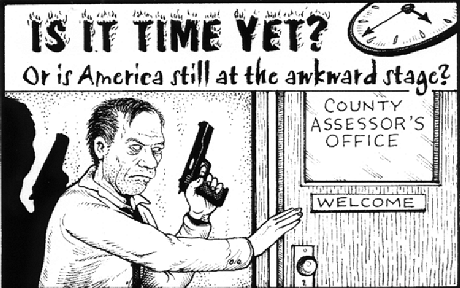
IS IT TIME YET?
Or is America still at the awkward stage?
by Claire Wolfe
On June 21, 2000, a 39-year-old California businessman, Stuart Alexander, shot three government meat inspectors to death. Alexander’s sausage plant had just re-opened after losing its federal license in January. The two federal inspectors and state inspector were reportedly there to serve another citation. The bureaucrats said his products didn’t conform to health regulations; Alexander said not a single customer had complained about product quality in the 79 years since his great-grandfather started the business.
On June 21, 2000, a California businessman shot three government meat inspectors to death.
In the wake of the shooting, friends called Alexander a good, but troubled man who felt he was being persecuted. One, Ellen Luque, commented, “[He] got a bad deal from the very beginning. Maybe too much came down on him all of a sudden.”
Others, however, spoke of a hothead who hated following rules and who’d once been accused of beating up an elderly neighbor for snapping photos of his messy backyard. A widely reprinted report from Knight-Ridder Newspapers opened with a comment about Alexander’s “anti-government wrath” and noted:
“…acquaintances say he also carried a grudge against fire marshals, police, building inspectors and nosy neighbors -- anyone he felt was burdening him with unnecessary red tape. …”
“I don’t think he was trying to get away with wrongdoing -- he was just somebody who doesn’t have a lot of patience for the government process or regulations,” said San Leandro City Councilman Gordon Galvan, who grew up with the man accused of fatally shooting three inspectors Wednesday at his meat plant. “He thought the bureaucrats were putting too much burden on the small-business owner.”
This shooting eerily echoed one committed by New Hampshireman Carl Drega in 1997. After years of trying to “fight city hall” in the courts over property rights, Drega finally reached his line in the sand after state troopers stopped him for having rust holes in the bed of his pickup truck. His toll: two troopers, a newspaper editor and a judge he believed was persecuting him.
After the California killings, a newspaperman tracked me down and asked me to comment. What, me? How did a mainstream reporter even know of my existence, and what could I possibly say about a shooting a thousand miles (and a whole world) away? But I didn’t have to ask what made him think of me.
Famous First Words
In 1996 I scrawled a pair of sentences that resonated with a lot of freedom activists.
America is at that awkward stage.
It’s too late to work within the system,
but too early to shoot the bastards.
Since then, I’ve heard those words quoted thousands of times. I’ve watched people argue about whether it is or isn’t “time.” Whenever some new government abuse makes the news, someone is bound to wisecrack, “Is it time yet, Claire?” Most alarmingly, I receive occasional glassy-eyed e-mails from strangers assuring me that the instant I issue the order, my Faithful Self-Appointed Lieutenant will remove any nearby oppressors from the face of the earth. (No such orders shall be forthcoming.)
Morally, of course it’s time to shoot the bastards.
Obviously, I voiced something a lot of people have been thinking about. Four years have passed since I flippantly said it’s too early. Is it time yet to shoot the bastards? At least it seems time to take keyboard in hand and give a straight answer -- yes, no, maybe and whatever turns your crank.
Yes
Morally, of course it’s time to shoot the bastards. It has been since long before I wrote those sentences -- before I learned my ABCs, before anybody reading this was born.
It was time the first day the first court upheld the first blatantly unconstitutional law for the sake of political expediency. It was time the first day the fedgov got the notion to use regulations or executive orders to control We the People, rather than merely the internal workings of agencies. All the abuses since - ninja raids, confiscatory taxation, rules too obscure to comprehend, bullying bureaucrats, millions imprisoned for victimless crimes, burgeoning nanny state, ever-increasing centralized control - are government gravy. The truth is, morally it’s been “time” since at least Lincoln’s day. And it’s time now.
It was time the first day the first court upheld the first blatantly unconstitutional law for the sake of political expediency.
It’s past time, since all those earlier Americans failed to get out the tar, the feathers or the M1 Garands because they were too quiescent, or too persuaded that justice would prevail. Or because -- like us -- they valued due process and knew the chaos that disregard for it could bring. Or because -- like us -- they feared the personal consequences. Or because -- like us -- they weren’t ever sure whether that moment was the right moment.
Whenever it becomes impossible to get justice or have freedom “within the system” of course it’s morally right to fight back. Even Gandhi recognized that, saying:
“He who cannot protect himself or his nearest and dearest or their honor by non-violently facing death, may and ought to do so by violently dealing with the oppressor. He who can do neither of the two is a burden.”
Maybe it was even “time” on the day federal inspectors tried to close down a little, family-owned sausage plant whose product had been safely used by consumers for eight decades. I don’t know. Stuart Alexander thought it was.
But is it practical? Sensible? In that sense, no. And no surprise. It’s not time to shoot.
And for all the individual injustices or perceptions of injustice that always exist in the world, have things gotten any worse in the last four years?
No
Too bad there’s no Tyran-O-Meter -- a gauge, like the atomic scientists’ Doomsday Clock -- that could provide a measure of just how close we are to reaching some critical mass of tyranny. If there were, it might show that some things have actually improved since 1996.
- Back then, the abusive IRS seemed to be going strong despite a lot of talk about alternative tax systems. Today, the IRS is on its knees. The agency openly acknowledges that 65 million Americans scoff at filing requirements (though most, of course, still “contribute at the office,” even if they don’t file their 1040s). Bill Benson’s research showing that the Sixteenth Amendment was never ratified has within the last year gotten airings in such public forums as C-SPAN and USA Today. And lo and behold, in 1998 Congress passed a Taxpayers Bill of Rights that wasn’t merely a toothless tiger.
- In 1996, the 104th Congress regurgitated one law after another designed to bring Americans’ activities under the microscope (if not the immediate control) of federal bureaucrats. Today, under extreme public pressure, Congress is making serious noises about protecting privacy - including undoing some of their own legislation.
- A newly aroused public threw monkey wrenches into the FDIC’s Know Your Customer bank-snoop regulations, invasive home health care questionnaires, SSN-based drivers licenses, “unique identifying numbers” for everyone visiting a doctor, and drove the USPS back from the worst of its efforts to control private mailbox holders. Things got so hot that when once-all-powerful OSHA tried to extend its authority into the homes of telecommuting workers earlier this year the agency was forced to retreat in a single weekend -- no hearings, no lengthy debates, just a whimper. (God bless the Internet and several key groups of activists who used it so well.)
- As of August, a new law put the burden of proof on government in civil forfeiture cases, protecting the property of many innocent owners.
- While Australia and Britain bowed meekly to confiscation of firearms, American citizens stood adamant. Congress dared pass few new anti-gun laws. Even our polite Canadian neighbors -- too genteel even to rebel against King George III -- have rebelled against their 1995 universal registration law, making enforcement almost impossible.
- In the rowdy West, when the Forest Service refused to re-open a washed-out road to a recreation area, thousands resisted, forming the Jarbridge Shovel Brigade -- and re-opened the road themselves, to nationwide cheers and support. The fedgov may yet have the last word -- but this time they knew better than to come in with tanks, helicopters and ski masked faces.
Some of these are very, very big things. All are encouraging signs that Americans may yet be able to take back freedom
without shooting.
In light of that, maybe some would think I should be revisiting the other part of my statement, that it’s “too late to work within the system.” Aren’t all these advances evidence that “the system” can still work for freedom?
I still don’t think so.
On the other hand …
Aside from a heightening of public consciousness on privacy issues, there hasn’t been a single actual
improvement in freedom’s circumstances. At best, activists have merely slowed the advance of tyranny. Even at that, the meaning of some apparent triumphs is unclear.
- The IRS’s collapse may be merely a PR ploy to prepare the way for yet another giant federal tax system. Federal revenues (including income tax revenues) haven’t suffered. On the contrary, according to 1999 Congressional Budget Office figures, “During the past five years, federal revenues have increased at an average rate of 8.3 percent a year … Consequently, revenues as a percentage of GDP have risen from 18.4 percent in 1994 to 20.5 percent in 1998 and will reach a postwar high of 20.7 percent in 1999 …”
Some of the so-called privacy protection measures Congress is considering would make matters worse -- for instance, by giving a federal “privacy czar” regulatory power over private databases.
- Some of the so-called privacy protection measures Congress is considering would make matters worse -- for instance, by giving a federal “privacy czar” regulatory power over private databases. The number of wiretaps is soaring, cell phones have been mandated into tracking devices, the CIA admits to backing snoop technology firms, and the FBI has announced numerous initiatives to spy upon the innocent and guilty alike.
- The public beat back many invasive regulatory proposals -- but often not until the damage had been done. And regulatory proposals are still coming at us like something from a John Carpenter movie. (As James Bovard writes in his book I Feel Your Pain, during the Clinton administration “…Federal agencies issued more than 25,000 new regulations -- criminalizing everything from reliable toilets to snuff advertisements on race cars.”)
The drug war still rampages on, having ravaged lives, property rights and the ideal of honest law enforcement beyond repair. Prison populations continue to bloat.
- The drug war -- though increasingly losing its moral sanction -- still rampages on, having ravaged lives, property rights and the ideal of honest law enforcement beyond repair. Prison populations continue to bloat.
- If Congress didn’t act against gun-rights, the executive branch did. The FBI has learned (no doubt to its bureaucratic glee) that it can halt all dealer gun sales in America, simply via a computer system glitch -- as it did for three days earlier this year, during the height of weekend gun shows. Though entitled by law to go on selling when the “instant background check” database is unreachable, dealers are too terrified of federal enforcers to do so. And the Clinton administration has used federal clout and lawsuits to pressure, if not cripple, the firearms industry.
The courts have already held, in Paladin Press’s Hit Man case, that the mere act of selling a book to a stranger can be culpable.
- It is now a federal crime -- with Draconian prison sentences to publish details about “destructive devices.” Theoretically, the punishments only pertain if you have reason to believe your audience intends to commit a crime. The courts have already held, in Paladin Press’ Hit Man case, that the mere act of selling a book to a stranger can be culpable. Congress is now considering a bill with virtually identical language forbidding anyone to teach, publish or otherwise convey information about “controlled substances.”
- In 1996, the federal government gobbled up $1.538 trillion of our substance. The OMB’s estimate for fiscal year 2000 spending is $1.766 trillion, and for FY 2001, $1.835.
Although federal civilian employment is actually down, the number of federal police has increased by 21 percent.
- Although federal civilian employment is actually down (2,799,000 today vs 2,895,275 in 1995 -- with no figures available for 1996), during the same period, the number of federal police has increased by 21 percent (86,087 to 104,096). Anyone wonder why they’re needed -- when actual crime nationwide has been dropping?
Numb time
Is America still “at that awkward stage”? More than ever. The movement to reduce government’s grasp is certainly at a more awkward stage than it was in 1996. We’ve fought for liberty -- some of us for years, some for decades. Nothing great has happened. But neither -- lately -- has anything catastrophic -- just the usual crawl toward total government domination. And the nation is content. Even we have trouble sustaining our sense of urgency. What are we malcontents shouting about? Things aren’t so bad. Eventually, we begin to feel a sense of unreality, of sensory deprivation from our lack of connection to what our neighbors and the media tell us is the real world. We become uncomfortably numb.
On top of that, many of us threw a lot of energy into preparing for The-Y2K-That-Wasn’t. Though we all officially dreaded Y2Kaos, the truth is we needed a crisis that would bring matters to a head. When nothing happened a lot of us felt like the girl who’s gotten all dressed up for the dance, only to have her date not show.
But now we’re just exhausted and dispirited. If some Prince Charming showed up and offered to sweep us off to the Freedom Ball in his coach, we might just say, “Not tonight, Prince Baby. I’m tired.”
Future in the haze
Unless some unforeseeable trigger event strikes, we may remain at that awkward stage for a long time (maybe decades). Liberty will continue to erode, but not so fast we’ll jump out of the boiling pot. Freedom lovers will continue to shout that they’d rather die on their feet than live on their knees -- but will go on living on their knees. Congress and regulators will make minor adjustments when angry people make things hot for
them, but will always gradually work toward total control. And the few poor saps who take action to halt it will languish in prison or the grave.
In his Sept. 21, 1997 column on Carl Drega, Vin Suprynowicz pegged the whole situation:
“The problem … [is] that our chemical castration is so gradual that there can NEVER be a majority consensus that this is finally the right time to respond in force. In this death of a thousand cuts we’re ALWAYS confronted with some harmless old functionary who obviously loves his grandkids, some pleasant young bureaucrat who doubtless loves her cat and bakes cookies for her co-workers and smilingly assures us she’s “just doing her job” as she requests our Social Security number here ... our thumbprint there ... the signed permission slip from your kid’s elementary school principal for possessing a gun within a quarter-mile of the school ... and a urine sample, please, if you’ll just follow the matron into the little room …”
It doesn’t take an oracle to know that anyone who starts shooting government agents now is going to hurt himself more than the system. And no Minutemen are going to rush to the aid of Stuart Alexander. No members of the “Henry Bowman Brigade,” inspired by John Ross’ novel, Unintended Consequences, are going to take some future Carl Drega’s act as a signal to follow suit.
Still, an increasing number of Alexanders and Dregas, standing on their own individual Concord Greens, will decide: No more. And I can’t by any means declare that it will never be me, or thee, or my next door neighbor who discovers one day that it is time to shoot, even if the entire rest of the world disagrees.
But am I gonna say you should turn meat inspectors into meat? Am I going to suggest you rig a bomb to the engine of your local tax man’s car? No way, not me. (If you do, make sure his wife and kiddies aren’t the next ones to get into the vehicle, though. That isn’t playing nice.)
Is is time? Morally, yes. Absolutely. If you do it, and if there’s a heaven, I hope you get a good seat.
Is it time? Morally, yes. Absolutely. If you do it, and if there’s a heaven, I hope you get a good seat. But if you pot a bureaucrat figuring it’ll light some fire under the cold, dead butts of a complacent nation … good luck.
Loompanics Unlimited 2001 Main Catalog