© 2000 by John Q. Newman Artwork © 2000 by Jim Blanchard
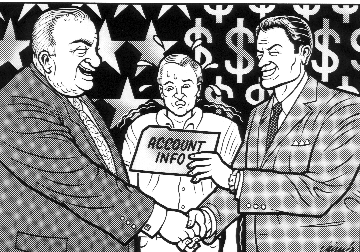
The assault on the personal privacy of individu-als marches on, and a powerful new weapon has been added to the arsenal of those who oversee every aspect of the life of every American. Your local banker has been deputized by the federal government to maintain a continuing peek into how every person with a bank account spends his money, and to report to the feds anytime something "out of pattern" happens with this account. Once a report is made, various government agencies will start an investigation of the account holder, and in a worst-case scenario, can result in the hapless depositor's funds being impounded. How did this come to be? Over the years, in an attempt to catch money-laundering drug dealers, and other high-income cash-business tax evaders, the federal government has enacted various laws requiring banks and businesses to report certain types of financial transactions.
If an individual deposits or withdraws $10,000 or more in cash, the transaction must be reported to the Treasury Department. If you purchase $3,000 or more in money orders or traveler's checks, a report will be filed. And don't even think about paying for a new car with cash, if you want to stay free of government scrutiny.
Numerous other transactions can now be considered suspicious or "out of pattern." These can include having a safety deposit box, and using it too often, or conversely, not often enough. A customer who lives far outside of a bank's normal service area can also be regarded as suspicious under the new regulations. An unusually large deposit will certainly attract unwanted attention.
It should be clear that the elasticity of what is considered to be suspicious is so great that most customers will at some point engage in a transaction that appears to be fraudulent. One example might be the deposit twice yearly of large royalty checks by a writer into his bank account.
What happens when a bank files a report? The reports, known formally as suspicious activity reports, or SARs, are sent to the Financial Crimes Enforcement Network, or FINCEN. FINCEN is a unit of the U.S. Treasury Department, and is the single largest repository of personal financial information in the United States. The SAR will contain the name, Social Security number, address, occupation, and account number and other details about the subject of the report. Once this report is filed, it sets a number of wheels in motion.
The IRS and other government agencies will begin to compare data on the subject of the SAR with other information they already possess. Did the subject's tax returns justify the amount of the transaction? What other accounts does the subject have, and has he been the focus of law enforcement investigations before? The subject's bank account may be monitored for an extended period of time, and in a worst case, the accounts may be frozen until the individual can prove he is not a criminal.
The worst part of the reporting process is that the consumer is not notified that he has been reported. By law, the bank is prohibited from doing so. In most cases, the SAR results in no action being taken, because the transaction can be explained. But the damage is already done to the consumer's privacy. The number of SARs being filed is increasing dramatically each year, because now banks can be held criminally liable for the actions of their customers if a judge determines an SAR should have been filed and was not. By the same token, the banks have been given immunity from lawsuits if an SAR is wrongfully filed and results in a customer suffering financial damages.
One might think that the information on SARs would only be used for the narrow purpose of fighting money laundering and tax evasion. Not so. As is typical of government, information initially collected for one reason winds up being used for many other purposes. The IRS wants to begin accessing these reports for civil tax cases, and 50 state and local law enforcement agencies have direct access to the database. Other agencies can ask to see SAR forms by request. In 1999, well over 12,000 SARs were filed, with the number sure to grow every year.
This is but one government program where banks act as partners with big brother to destroy the financial privacy of Americans. Federal child support enforcement legislation requires banks to screen all of their account holders' basic personal identifiers -- name, birth date, and Social Security number -- against a nationwide database for child support scofflaws. If a match is made, this must be reported immediately to the state, which will then institute collection activity. The depositor is explicitly not to be informed for a period of time that allows the state to freeze the account.
Some smaller banks, to avoid the expense of hiring employees and installing the computer software to accomplish this task, have availed themselves of a second option the law allows. These banks simply turn over all of their account holder information to the state, and allow them to perform the data matching.
The fundamental problem with both the suspicious activity reports and the child support enforcement program is that both require the financial privacy of all Americans be destroyed to go after the relatively small number of people who violate these laws. This is contrary to the essence of democracy. Totalitarian nations remove all of the privacy and freedom from the individual for the good of society. This may create a society with little crime, but also little joy, intellectual life and artistic expression. These laws bring us, in incremental fashion, closer to this state of affairs. I call it the "monitored" society. Each individual is allowed to go on his way, provided that the monitors -- large computer databases of those who are undesirable for one reason or another -- allow him to pass by.
A practical question is what can one do if one is intent on maintaining some sort of financial privacy? It is clear that one must remove oneself from the U.S. banking system. The Swiss have made financial privacy a cornerstone of their nation for centuries, and many Americans would benefit themselves by taking advantage of that nation's predilection for privacy. l
John Q. Newman writes frequently on privacy issues. His latest book is The ID Forger.