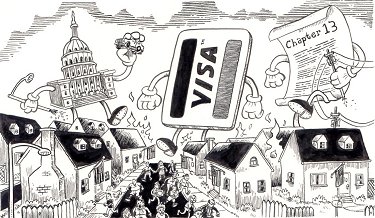
On October 17th, 2005, a lot of things changed for the worse for Americans who are having serious financial troubles. On that date the new Federal bankruptcy law took effect. The new law imposes numerous odious conditions on consumers who need to file for bankruptcy. The new law makes bankruptcy a much more expensive and drawn out process than it was under the former law. This was a law written for big business, with little concern for the individual. No political party can claim any innocence on this law. The heavy lobbying by the credit card industry ensured that this law was passed by hefty majorities in both houses of Congress. The Senate was truly in the pocket of Visa, MasterCard and their ilk, approving the bill by a 75 to 24 margin.
Heavy lobbying by the credit card industry ensured that this law was passed by hefty majorities in both houses.
So how is this law unfavorable to the consumer? The first negative provision is that it changes the basis of bankruptcy law. Under the new law there is a fundamental assumption of “bad faith” on the part of the debtor. This assumption of bad faith expresses itself in the various provisions of the law. Under the former law, a person filing bankruptcy was given the benefit of the assumption that they were in financial trouble, and needed immediate relief from collection and foreclosure action until his case could be presented in bankruptcy court.
A typical example of consumers using the “good faith” presumption of the former bankruptcy law is the case of someone facing an imminent foreclosure on his home. Under the former law, this individual could go to a bankruptcy attorney and receive an immediate stay of the foreclosure action when the attorney filed bankruptcy for him. This is no longer possible. Before the attorney can even file for bankruptcy, the debtor will have to show that he has first taken a course in financial management. A person who faces a foreclosure on Tuesday afternoon will no longer be able to see a bankruptcy lawyer on Monday morning to stop the foreclosure sale. The banking community will argue that it may still be possible for the debtor to keep custody of his home, but it will cost a lot more and take a lot longer than before.
Many people file for bankruptcy because of unexpected medical bills, a job loss, or divorce.
That credit counseling course debtors must take before filing for bankruptcy? The debtor will be forced to pay for it, even though he is already facing financial difficulty. This course is mandatory even if there is no possibility the debtor could pay off his bills. Many people file for bankruptcy because of unexpected medical bills, a job loss, or divorce. In fact, those three categories of individuals account for the majority of the 1.4 million people who filed for bankruptcy last in year in the United States.
The law changes how most people will have their bills discharged once they enter the bankruptcy system. Under the former law most people do what is called a Chapter 7 bankruptcy. The current bills of the debtor were liquidated with whatever assets were available, minus any exemptions that the federal law, and the law of the state provided. These exemptions included such things as a certain amount of home equity, a certain dollar value in a car, tools, personal goods, etc. The court paid out whatever was available to the creditors, and the debtor was discharged from bankruptcy, and free to make a fresh start without having to worry about creditors garnishing wages or attaching bank accounts. The philosophy of the former law was although you may lose most of what you have today, what you earn tomorrow is yours. Basically, Chapter 7 gave the debtor a fresh start.
The new law will see more people pushed into what is known as Chapter 13 bankruptcy. The former Chapter 13 was what is known as a wage earner plan. The debtor and his lawyer came up with a repayment schedule for the debt that was presented to the bankruptcy court. If the judge accepted the offer, the debtor paid a set amount into the court each month, and the court distributed the money amongst the creditors. These agreements generally ran for no more than 3 years. At the end of this time, the debts were considered paid in full, and the bankruptcy was discharged.
Under the new provisions of Chapter 13, things are not so favorable to the debtor. Now, the repayment plans can stretch over 5 years, and the amount of legal paperwork, and hence the cost, increases dramatically over the former system. The amounts that the debtor can be forced to pay back increase considerably.
A new means test is applied based on Internal Revenue Service guidelines. If a person has an excess of $100 a month more than these IRS guidelines, or earns more than the median income for his state, a Chapter 13 plan can be required that takes this additional income from the debtor and uses it for repayment. The individual may also be forced into Chapter 13 if the bankruptcy court determines that the consumer can repay at least 25% of what is owed.
Lawyers face sanctions if they attempt to get a debtor into Chapter 7 under the new law and fail. If the Chapter 7 petition is denied, the attorney can be forced to pay a “penalty fee” – for lack of a better term, which is given to the creditors by the court.
Many debtors have postponed doctor visits or face eviction.
These provisions overlook many of the realities facing debtors in serious trouble. Many debtors have postponed doctor visits or face eviction. Under the new law it is easier for landlords to evict someone who has filed for bankruptcy. The new law also has geographic and economic inequities. If you happen to live in Florida or Texas, the homeowners' exemptions in those states allow a debtor to protect a home worth millions of dollars so long as they have lived there a few years to qualify. Very wealthy people can use specially designed trusts to protect their assets. In most states, for example, the amount of homeowner equity that can be protected is less than $20,000. This should be a wake-up call for the millions of Americans who have taken out home equity loans to finance the good life. If something goes wrong, you will most likely lose your home to creditors.
So how did this new law come to be, and why was Congress so willing to toe the line of the credit card companies? No doubt, this law is the child of the credit card industry. The card companies lobbied Congress very hard, and couched the legislation in terms of bankruptcy law abuse. The bankruptcy law, according to their view, was nothing more than legalized stealing that cost honest, responsible Americans hundreds of dollars a year in additional interest and fees. Help us eliminate this injustice, and all Americans will benefit.
Credit card lending is extremely profitable for banks.
This sounds plausible, until one looks at the facts behind credit card lending in America today. Credit card lending is extremely profitable for banks. Last year credit card companies made nearly $32 billion dollars in profits. If bankruptcy filings were making credit cards unprofitable, why would the industry continue to send out hundreds of millions of unsolicited offers to American consumers? Ask any person with even marginal credit how many of those “preapproved” solicitations they received last year. It will be 10 or more for the typical person.
If bankruptcy filings were making credit cards unprofitable, why would the industry continue to send out hundreds of millions of unsolicited offers to American consumers?
Do credit card companies lose money on those who don't pay their bills and eventually declare bankruptcy? The answer to this question may surprise you. No! The reality is that if you look at the amount that was originally owed when the debtor went first went delinquent, all of this amount and then some has already been received by the creditor by the time the bankruptcy filing happens.
Take the example of a woman who owes $1000 on a credit card. The first month she is late with her payment, the credit card company will charge a late fee, now typically around $40. The interest rate on her account will now be shifted into penalty pricing, which could add six to ten percent to her interest rate. If the account is now over limit, an over limit fee, also typically around $40, will now be applied to the account. But the bad news does not stop here. Many credit card companies will raise your rates on an account even if you are current with them, but have late payments or are over limit on another account with a different creditor. So our hapless woman now has the interest rate jacked up on other credit cards she has because of the problems at the one creditor. By the time this woman files for bankruptcy, she has long ago paid the $1000 that she was delinquent on. Between late fees, over limit fees and penalty interest rates, the card company has actually made a profit on her.
Creditors will frequently steer debtors like this woman into the bankruptcy alternative – the credit counseling services who advertise so heavily. But these services have some drawbacks. One of them is a little known provision in federal tax law. If a creditor gives a debtor a settlement that reduces the amount owed on a bill by $600 or more, this must be reported to the IRS as taxable income. A person who goes to one of these services and has his bills reduced by $8000 in an agreement with creditors will now have to declare this on his income tax return, and face a tax bill on this new “income.”
The law also smacks of letting the credit card industry have its cake and eat it too. The credit card industry has vastly extended its tentacles. Cards are offered to people such as college students, who usually have no or very limited incomes. Each year many thousands of college students ruin their credit and have to file bankruptcy because of the binge of credit cards on campuses. At the beginning of any semester at most colleges, you will see the credit card companies' representatives en mass at booths or tables signing up the next generation of debtors. Many of these companies pay lip service to providing students with advice and information on the wise use of credit. But this rings hollow when you see written on college credit card application forms “you do not need your parents' permission” to apply for this card, or when their college advertising talks about how you can use your card to buy pizza or concert tickets. Is it any surprise that many of these students four years later have ruined credit and are insolvent?
This new law further encourages credit card companies to offer credit to more people who have no ability to reliably repay it. The credit card industry's ability to collect money from people of small means has been strengthened greatly by the new law. A credit card company executive now knows more of these people can be solicited without increasing account charge-off rates because the new bankruptcy law will allow them to shake a few dollars more out of these peoples' pockets.
Make no mistake, the former bankruptcy law was no bed of roses for debtors, even though this is what the credit card companies would have you believe.
The passage of this law illustrates some of the worst aspects of our system of government.
A bankruptcy filing results in bad credit for up to 10 years, and the debtor's name is published in the paper. Many bankrupts find it very difficult to rent an apartment, because many landlords have a policy of not renting to those who have a bankruptcy on their record. Anytime a credit check is done on the debtor, the bankruptcy will come up, and although federal law prohibits this, many private sector employers will not hire bankrupts. If the debtor has a job that requires a federal security clearance, or works for law enforcement in some states, they can face the loss of a job.
On October 17th, the world became a little less financially secure for all Americans.
The passage of this law illustrates some of the worst aspects of our system of government. A law clearly harmful to the interests of the vast majority of the American people was passed due to the massive big money lobbying by the credit card and banking industry. This law is all about the phrase “money talks.” It is also in line with what President Bush calls his “ownership society.” Many of the consumer and social protections we enjoy came out of the disaster of the Great Depression. Bank deposit insurance, favorable mortgage rules, bankruptcy laws and Social Security, all came to be as ways to transfer much risk from the individual to the government or large corporations that can better shoulder these economic gyrations. The change in the bankruptcy law is the first step in undoing this, and putting many uncertainties back on the shoulders of ordinary people. On October 17th, the world became a little less financially secure for all Americans.
John Q. Newman is also the author of the following books: The Heavy Duty New Identity, Understanding U.S. Identity Documents,The I.D. Forger, Identity Theft, The I.D. Master and Credit Power.