by Thomas G. Spitzoli
A CD purchased through one of the conventional retail outlets usually costs somewhere between $14 and $18, maybe even more. However, there are many people who have figured out a way to fight back and obtain hundreds, perhaps even thousands of CDs in just a few short months and they paid practically nothing for their collections. This can’t help but cause you to wonder how they do it. These are scammers or mail-order predators. They live on the edge and take a few calculated risks and it is the mail-order CD clubs that are their prey.
After the CDs are acquired, our scammers can sell them to resale shops. Granted this isn’t going to make them rich, but a lot of these guys only want to pad their low or subsistence level incomes; give themselves a little extra cash. Contraband CDs are also used as holiday and birthday gifts for friends and family, and to build extensive collections of music for the scammer.
Getting busted is always a possibility, but that is part of living on the edge, part of being a scammer, and that may be part of the attraction to that kind of lifestyle. In addition, realistically, the odds of our scammer getting busted are low. Part of the reason for this is that nobody really cares if these big mail-order CD clubs are scammed. That is a big part of what the mail-order predator has going for him and how he keeps getting away with his rip-offs. Those big companies are not going to pursue someone who swindles a few CDs. They are making mega-money with the big “something for nothing” deal that thousands of people fell for when they answered their ad, and those folks are paying. It is a beautiful scheme to the scammer.
Here is how the CD scammer operates. First, he signs up for various clubs several times under different aliases. Then, he needs to acquire a delivery address. Ideally, this address will be a temporary one, such as an apartment in a college town. After all, everyone knows that collegiate apartments are filled with “transients” who may or may not be on the lease agreement. The mail carrier can’t be expected to learn everyone’s name, especially when dealing with the proverbial student ghetto. Generally speaking, if a package is sent to one of these addresses, the scammer will get the package, regardless of the addressee. (A good scammer will even put “fake” names on the mailbox temporarily, and then pull them right back off after the first shipment is received, thereby avoiding any potential problems with the landlord.) Thus, the scammer gets the introductory packages filled with numerous CDs and then simply ignores the invoices. Some mail-order predators like to play with their quarry. They will write “addressee unknown, return to sender” on the invoice envelopes and leave them for the mail carrier to send back to the CD club. Eventually, the notices stop coming or the account is handed off to a collection agency. More invoices and notices come to the scammer’s fake name, but that is all. When it is convenient, the school year ends, or just the semester, or the scammer decides to move to a fairer climate, he/she sets up in a new apartment and pulls the fraud again… again… and again. The scammer never puts in a mail forwarding order for their alias or fake name. After they move, it is goodbye to those annoying invoices and incriminating notices forever.
Scammers have even used addresses in buildings where they don’t live. Frequently apartment complexes have secluded mailrooms or mail areas, and these have allowed a mail-order predator or CD scammer to grab packages without any fear of detection. They simply slip the box into their backpack and walk out casually.
Some scam operators have been squeamish about registering a PO box in their own names. They always manage to find or make other options for themselves. In a college town, finding a fake ID isn’t all that challenging a quest. The Internet also has all kinds of ways to get fake ID. Sometimes scammers simply use real ID that has been lost or stolen. Some of these scammers have even been lucky enough to score ID with a photo that resembles them.
Finally, this last option is the easiest one I’ve ever seen used, even though it is also the riskiest and the most nerve-wracking. The Post Office has a rule that if a person doesn’t have ID available, they will have the carrier verify that the person really does live at the location where he says he does. When this has gone according to plan, the person pulling this scam has been given his PO box the following day. First, he memorized a person’s name and address from the phone book. Then he walked in to the Post Office and asked to open a PO box. He filled in the form, using the name and address he had memorized, and prepared to pay the fee. When they asked for his ID, he explained that his wallet had been stolen (stolen is better than lost as it generates more sympathy) and that it would be several weeks before the appropriate documents from home would arrive so that he could get replacement ID. He innocently asked them, “Isn’t it true that you can have my route’s carrier verify that is my address and I can get a box that way?” This guy even added that he thought his mail was being stolen as well and that he needed a secure place for the documents that would allow him to get his ID replaced, to be sent. The clerk agreed (most would under those circumstances), and after returning the next day, the scammer got his box. Then he added the usual suspects to his box and was all set to rack up some considerable CD acquisitions.
The risks he took! What if the clerk knew the individual that the scammer wanted to impersonate or even worse, that it was the clerk himself? As the scammer said, “That’s the risk and the rush.” Nevertheless, he also said that he was sure to enter the Post Office when they were the least busy and certainly was prepared to hightail it out the door at the slightest provocation. He added that in his experience, that had never been necessary.
The key to serious CD scamming has been to establish a network. The scammer had one “introductory” package sent to the vacant apartment next door, and another to his PO box. Once he received his shipments, he was able to sell enough to pay off his first invoice (using a money order, of course). After that was done, he had it made.
This is where the mail-order predator builds his fake network. Most clubs have offers where you can get a free CD if you sign up friends and or relatives. The scammer’s “friends” were the other names on the PO box or the extra mailboxes and aliases at the vacant apartment. He sent off the sign-up cards, got the new shipment, paid off the first invoice, and collected his free bonus CD a few weeks later. This worked exceedingly well for the scammer, who racked up an amazing amount of CDs in an equally amazing short amount of time. He lathered, rinsed and repeated as often as necessary.
When the selections offered in the CD club’s monthly newsletters were too limited for the mail order predator, he called the CD club and asked for a complete catalog. They were only too happy to oblige him. He even asked for the catalog numbers of the exact CDs that he was interested in. Never did he settle for the one-hit wonders that were on the current listing the CD club sent out.
There have been times when scammers were asked to pay in advance. This was especially true if there had been previous scammers at that address. The mail-order predator paid with a smile. He knew he’d make his money back in the long run.
The best networks were created in densely packed suburbs, or “twin city” college towns. There were abundant opportunities to rent several PO boxes simultaneously. Scammers who weren’t greedy kept their networks going and didn’t get caught. It worked well for them.
You can see now the methods scammers and mail-order predators have used to acquire several hundred CDs for their own personal collections, as well as having several left over to re-sell for cigarette money or what have you. The best CDs for resale have turned out to be those “nostalgic” tunes from yesterday. We are talking David Bowie, ABBA, and the Carpenters. Don’t laugh!
Scammers and predators agree that music stores in college towns paid more per CD, easily, than other locales. Used CDs are a big business in university settings, and the stores need all the raw product they can get. In fact, the difference was so substantial (up to $5 per CD as opposed to $2) that it was worth driving to a school campus town just to sell the CDs that had been acquired.
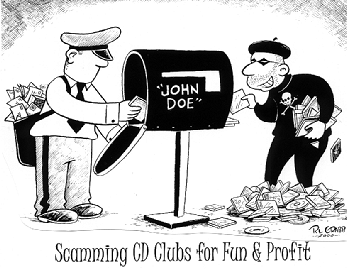
Scamming CD Clubs for Fun & Profit
Many people have figured out a way to obtain thousands of CDs in just a few short months and they paid practically nothing for their collection.
The typical CD scammer is around college age and lives in an urban environment.
Nobody really cares if the big mail-order CD clubs are scammed.
Scammers have even used addresses in buildings where they don’t live.
The key to serious CD scamming is to establish a network.
When the selection offered in the CD club’s monthly newletters was too limited for the CD scammer, he called the CD club and asked for a complete catalog. They were only too happy to oblige him...
Used CDs are a big business in university settings, and the stores need all the raw product they can get.
As one experienced scammer commented, “It may not be the most glamorous job that I’ve ever held, but it sure beats flipping burgers.”
Loompanics Unlimited 2001 Main Catalog