TWO-WAY RADAR EQUATION
(BISTATIC)
|
Summary of Two-Way Bistatic Radar Equations Developed
In This Section
 Peak power at the Peak power at the
radar receiver input is:
or in simplified log terms:
10log Pr = 10log Pt + 10log
Gt + 10log Gr + G -
-  Tx - Rx
(in dB) Tx - Rx
(in dB)
Note: Losses due to antenna polarization
and atmospheric absorption are not included in these equations. |
Target gain factor;
G = 10log + 20log f1
+ K2 (in dB) |
One-way free space loss;
Tx or Rx = 20log (f1 RTx
or Rx) + K1 (in dB) |
K2 Values
(dB) |
RCS ()
(units)
m 2
ft 2 |
f1
in MHz
K2 =
-38.54
-48.86 |
f1
in GHz
K2 =
21.46
11.14 |
|
K1 Values
(dB) |
Range
(units)
NM
Km
m
yd
ft |
f1
in MHz
K1 =
37.8
32.45
-27.55
-28.33
-37.87 |
f1
in GHz
K1 =
97.8
92.45
32.45
31.67
22.13 |
|
BISTATIC RADAR
There are also true bistatic radars - radars where the transmitter
and receiver are in different locations as is depicted in Figure
1. The most commonly encountered bistatic radar application is
the semi-active missile. The transmitter is located on, or near,
the launch platform (surface or airborne), and the receiver is
in the missile which is somewhere between the launch platform
and the target.
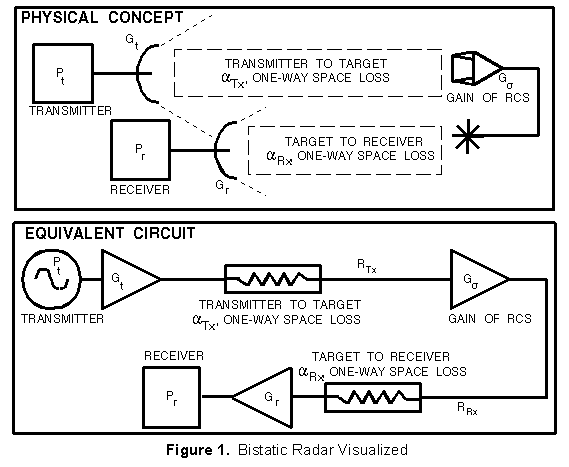
The transmitting and receiving antennas are not the same and
are not in the same location. Because the target-to-radar range
is different from the target-to-missile range, the target-to-radar
and target-to-missile space losses are different.
The peak power at the radar receiver input is :

* Keep  or c, , and R in the same units.
On reducing the above equation to log form we have:
10log Pr = 10log Pt + 10log Gt
+ 10log Gr + 10log - 20log f +
20log c - 30log 4 - 20log RTx - 20log RRx
 [2]
[2]
or in simplified terms:
10log Pr = 10log Pt + 10log Gt
+ 10log Gr + G - Tx
- Rx (in dB)  [3]
[3]
Where Tx corresponds to transmitter to target
loss and Rx corresponds to target to receiver
loss, or:
Tx = 20log (f1 TTx)
+ K1 (in dB) and Rx
= 20log (f1TRx) + K1 (in
dB)
with K1 values provided in the summary equation
box at the beginning of this section and with f1
being the MHz or GHz value of frequency.
Therefore, the difference between monostatic and bistatic calculations
is that two 's are calculated for two different ranges and
different gains may be required for transmit and receive antennas.
To avoid having to include additional terms for these calculations,
always combine any transmission line loss with antenna gain.
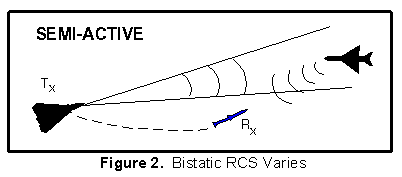
As shown in Figure 2, it should also be noted that the bistatic
RCS received by the missile is not always the same as the monostatic
RCS. In general, the target's RCS varies with angle. Therefore,
the bistatic RCS and monostatic RCS will be equal for receive
and transmit antennas at the same angle to the target (but only
if all three are in a line, as RCS also varies with elevation
angle).
Return to: EW
& Radar Handbook Home Page | Table
of Contents