 A microwave circulator
is a nonreciprocal ferrite device which contains three or more ports. The input from port n will
come out at port n + 1 but not out at any other port. A three-port ferrite junction circulator,
usually called the Y-junction circulator, is most commonly used. They are available in either
rectangular waveguide or strip- line forms. The signal flow in the three-port circulator is assumed
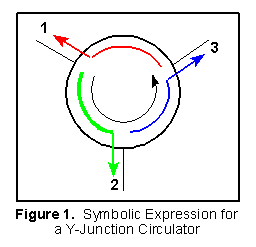
as 1 to 2, 2 to 3, and 3 to 1 as shown in Figure 1.
A microwave circulator
is a nonreciprocal ferrite device which contains three or more ports. The input from port n will
come out at port n + 1 but not out at any other port. A three-port ferrite junction circulator,
usually called the Y-junction circulator, is most commonly used. They are available in either
rectangular waveguide or strip- line forms. The signal flow in the three-port circulator is assumed
as 1 to 2, 2 to 3, and 3 to 1 as shown in Figure 1.If port 1 is the input, then the signal will come out of port 2; in an ideal situation, no signal should come out of port 3 which is called the isolated port. The insertion loss of the circulator is the loss from 1 to 2, while the loss from 1 to 3 is referred to as isolation. A typical circulator will have a few tenths of a dB insertion loss from port 1 to 2 and 20 dB of isolation from port 1 to 3 for coaxial circulators (30 dB or more for waveguide circulators). When the input is port 2, the signal will come out of port 3 and port 1 is the isolated port. Similar discussions can be applied to port 3.
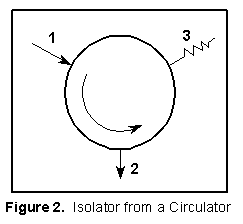
| As shown in Figure 2, if one port of a circulator is loaded, it becomes an isolator, i.e. power will pass from ports one to two, but power reflected back from port two will go to the load at port three versus going back to port one. |
|
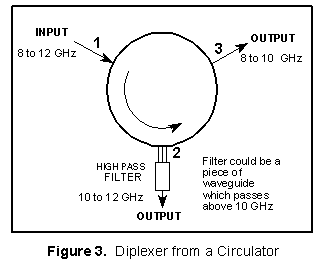
| As shown in Figure 3 this circulator is made into a diplexer by adding a high pass filter to port
two. Frequencies from port one that are below 10 GHz will be reflected by port two.
Frequencies above 10 GHz will pass through port two. At the 10 GHz crossover frequency of the
diplexer, a 10 GHz signal will be passed to both ports two and three but will be half power at each
port. Diplexers or triplexers (one input and three output bands), must be specifically designed for
the application.
| 
|
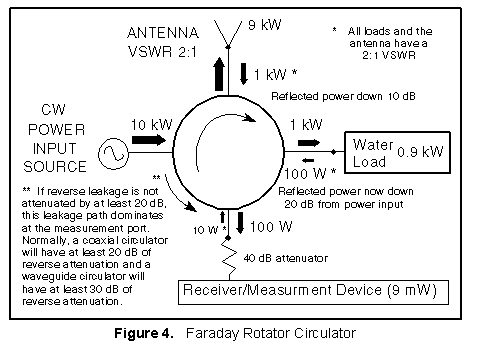
The Maximum Input Power to a Measurement Device - The ideal input to a measurement device is in the 0 to 10 dBm ( 1 to 10 mW) range. Check manufacturer's specification for specific maximum value.
If the RF transmission lines and their components (antenna, hybrid, etc.) can support the wider
frequency range, circulators could be used to increase the number of interconnecting RF ports
from two as shown in Figure 5, to four as shown in Figure 6.
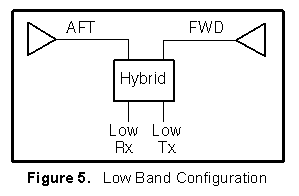 | 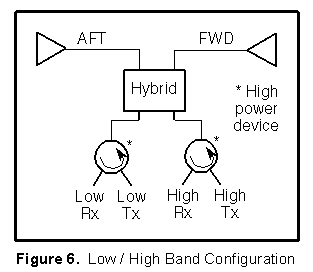 |
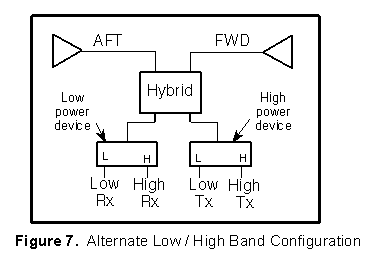
Figure 7 shows an alternate configuration using diplexers which could actually be made from
circulators as shown previously in Figure 3.