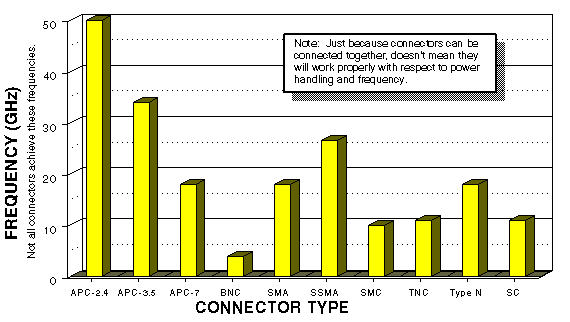
For high-frequency operation, the average circumference of
a coaxial cable must be limited to about one wavelength in order
to reduce multimodal propagation and eliminate erratic reflection
coefficients, power losses, and signal distortion. Except for
the sexless APC-7 connector, all other connectors are identified
as either male (plugs) which have a center conductor that is a
probe or female (jacks) which have a center conductor that is
a receptacle. Sometimes it is hard to distinguish the types as
some female jacks may have a hollow center "pin" which
appears to be male, yet accepts a smaller male contact. Occasionally
a company will identify the type when referencing the outer connector
vice the inner conductor. An adapter is a nearly zero loss interface
between two connectors and is called a barrel when both connectors
are identical. Twelve types of coaxial connectors are described
below, however other special purpose connectors exist, including
blind mate connectors where spring fingers are used in place of
threads to obtain shielding (desired connector shielding should
be at least 90 dB).
APC-2.4 (2.4mm) - The 50  APC-2.4 (Amphenol Precision Connector-2.4 mm) is also known as
an OS-50 connector. It was originally conceived by Hewlett-Packard
(HP), but was developed and manufactured by Amphenol (and others).
It was designed to operate at extremely high microwave frequencies
(up to 50 GHz).
APC-2.4 (Amphenol Precision Connector-2.4 mm) is also known as
an OS-50 connector. It was originally conceived by Hewlett-Packard
(HP), but was developed and manufactured by Amphenol (and others).
It was designed to operate at extremely high microwave frequencies
(up to 50 GHz). |
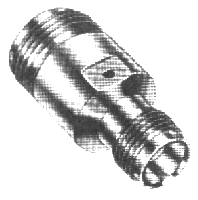
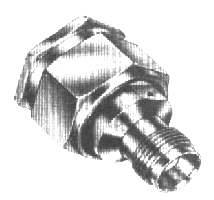
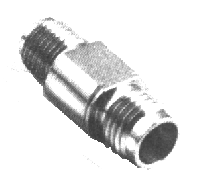 2.4 mm jack - 3.5 mm jack
 |
|
APC-3.5 (3.5mm) - The APC-3.5 connector provides repeatable
connections and has a very low VSWR. Either the male or female
end of this 50 connector
can mate with the opposite type of SMA connector. The APC-3.5
connector can work at frequencies up to 34 GHz. |
|
APC-7 (7mm) - The APC-7 was also developed by HP, but
has been improved and is now manufactured by Amphenol. The connector
provides a coupling mechanism without male or female distinction
and is the most repeatable connecting device used for very accurate
50 measurement applications.
Its VSWR is extremely low up to 18 GHz. Other companies have
7mm series available. |
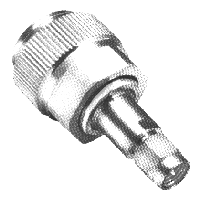
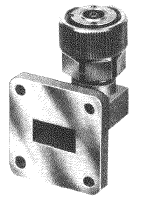
7mm - 3.5mm plug |
|
BNC (OSB) - The BNC (Bayonet Neill-Concelman) was originally
designed for military system applications during World War II
and was named for its inventors . It is also referred to as Bayonet
Navy Connector, Bayonet Nut Coupling, Barrel Nut Connector, Baby
N Connector, etc by IEEE and other sources. The connector operates
best at frequencies up to about 4 GHz; beyond that it tends to
radiate electromagnetic energy. The BNC can accept flexible cables
with diameters of up to 6.35 mm (0.25 in.) and characteristic
impedance of 50 to 75 . It
is now the most commonly used connector for frequencies under
1 GHz. |
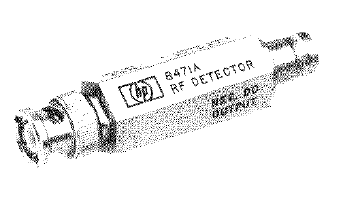
BNC plug - BNC jack |
|
SC (OSSC) - The SC coaxial connector is a medium size,
older type constant 50
impedance. It is larger than the BNC, but about the same as Type
N. It has a frequency range of 0-11 GHz. |
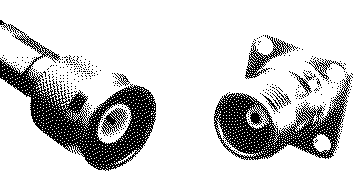
SC plug - SC jack |
|
C - The C is a bayonet (twist and lock) version of the
SC connector. |
|
SMA (OSM/3mm) - The SMA (Sub-Miniature A) connector was
originally designed by Bendix Scintilla Corporation, but it has
been manufactured by the Omni-Spectra division of M/ACOM (as
the OSM connector) and many other electronic companies. It is
a 50 threaded connector.
The main application of SMA connectors is on components for microwave
systems. The connector normally has a frequency range to 18 GHz,
but high performance varieties can be used to 26.5 GHz. |
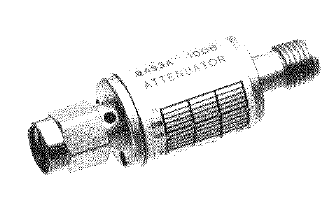
SMA plug - SMA jack |
|
SSMA (OSSM) - The SSMA is a microminiature version of
the SMA. It is also 50 and
operates to 26.5 GHz with flexible cable or 40 GHz with semi-rigid
cable. |
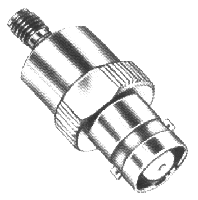
SSMA jack - BNC jack |
|
SMC (OSMC) - The SMC (Sub-Miniature C) is a 50 or 75 connector that is smaller than the SMA. The
connector can accept flexible cables with diameters of up to
3.17 mm (0.125 in.) for a frequency range of up to 7-10 GHz. |
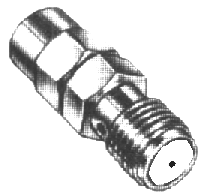
SMC plug - SMA jack
(Some call this a SMC jack, even though it has a female connector) |
|
SMB (OSMB) - The SMB is like the SMC except it uses quick
disconnect instead of threaded fittings. It is a 50 / 75 connector which operates to 4
GHz with a low reflection coefficient and is useable to 10 GHz. |
|
TNC (OST) - The TNC (Threaded Neill-Concelman) was named
after the inventors but is a.k.a. Threaded Navy Connector, etc.
It is merely a threaded BNC. The function of the thread is to
stop radiation at higher frequencies, so that the connector can
work at frequencies up to 12 GHz (to 18 GHz when using semi-rigid
cable). It can be 50 or 75 . |
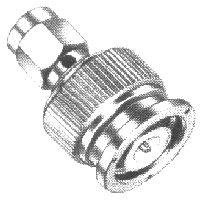
SMA plug - TNC plug |
|
Type N (OSN) - The 50 or 75
Type N (Neill) was named after inventor Paul Neill but is a.k.a.
Navy connector. It was originally designed for military systems
during World War II and is the most popular measurement connector
for the frequency range of 1 to 11 GHz. The precision 50 APC-N and other manufacturers
high frequency versions operate to 18 GHz. |
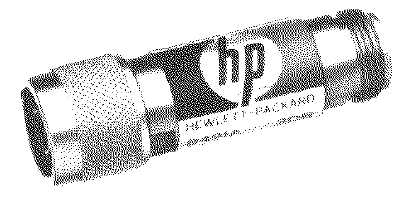
Type N plug - Type N jack |