
miles - Multiply 0.2 times the number of seconds which have elapsed between seeing the flash and hearing the noise. Note: Sound vibrations cause a change of density and pressure within a media, while electromagnetic waves do not. An audio tone won't travel through a vacuum but can travel at 1100 ft/sec through air. When picked up by a microphone and used to modulate an EM signal, the modulation will travel at the speed of light. |
| THE SPEED OF LIGHT | ||
| ACTUAL VALUE | UNITS | RULE OF THUMB |
| 2.9979246 x 10 8 | m/sec | 3 x 10 8 |
| 299.79 | m/usec | 300 |
| 3.27857 x 10 8 | yd/sec | 3.28 x 10 8 |
| 5.8275 x 10 8 | NM/hr | 5.8 x 10 8 |
| 1.61875 x 10 5 | NM/sec | 1.62 x 10 5 |
| 9.8357105 x 10 8 | ft/sec | 1 x 10 9 |
| 9.8357105 x 10 2 | ft/usec | 1 x 10 3 |
The speed of EM radiation through a substance such as cables is defined by the following formula:
V = c / (u r e r) 1/2
Where: u r = relative permeability and e r = relative permittivity
The
real component of e r = dielectric constant of medium.
EM propagation speed in a typical cable might be 65-90% of the speed of light in a vacuum.
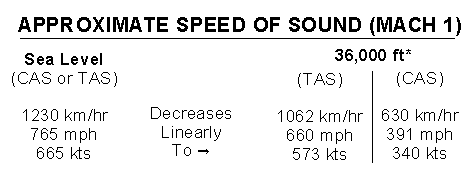
* The speed remains constant until 82,000 ft, when it increases linearly to 1215 km/hr (755 mph, 656 kts) at 154,000 ft. Also see Mach number section for discussion of Calibrated Air Speed (CAS) and True Airspeed (TAS) and a plot of the speed of sound vs altitude.
| SPEED OF SOUND IN VARIOUS MEDIUMS | ||
| SUBSTANCE | SPEED (ft/sec) | |
| Vacuum | Zero | |
| Air | 1,100 | |
| Fresh Water | 4,700 | |
| Salt Water | 4,900 | |
| Glass | 14,800 | |
| Steel | 20,000 | |
| PHYSICAL CONSTANT | QUOTED VALUE | S* | SI UNIT | SYMBOL |
| Avogadro constant
Bohr magneton
Boltzmann constant | 6.0221367 x 10
23
9.2740154 x 10 -24
1.380658 x 10 -23 | 36
31
12 | mol
-1
JT -1
JK -1 | NA
u B
k(=R N A) |
| Electron charge
Electron specific charge
Electron rest mass | 1.602177 33 x 10 -19
-1.758819 62 x 10 11
9.1093897 x 10 -31 | 49
53
54 | C
Ckg -1
kg | -e
-e/m e
m e |
| Faraday constant
Gravity (Standard Acceleration) Josephson frequency to voltage ratio
| 9.6485309 x 10⁴
9.80665 or 4.8359767 x 10¹⁴
| 29
14 . . | Cmol-1
m/sec 2 or HzV -1
| F
g 2e/h
|
| Magnetic flux quantum
Molar gas constant
Natural logarithm base
Newtonian gravitational constant | 2.06783461 x 10 -15
8.314510
2.71828
6.67259 x 10 -11 | 61
70
-
85 | Wb
Jmol -1 K -1
dimensionless
m 3 kg -1 s -2 | Phio
R
e
G or K |
| Permeability of vacuum
Permittivity of vacuum
Pi | 4pi x 10 -7
8.8541878 x 10 -12
3.141592654 | d
d
| H/m
F/m
dimensionless | u o
e o
Pi |
| Planck constant Planck constant/2
Quantum of circulation
Radius of earth (Equatorial)
Rydberg constant | 6.62659 x 10 -34 1.05457266 x 10 -34
3.63694807 x 10 -4
6.378 x 10
6 or
1.0973731534 x 10 7 | 40 63
33
-
13 | Js Js
Jskg -1
m or
m -1 | h h(=h2)
h/2m e
-
R x |
| Speed of light
Speed of sound Standard volume of ideal gas
Stefan-Boltzmann constant
| 2.9979246 x 10 8
331.4 22.41410 x 10 -3
5.67051 x 10 -8
| 1
- 19
19
| ms -1
ms-1 m 3mol -1
WK -4 m -2
| c
- V m
sigma
|
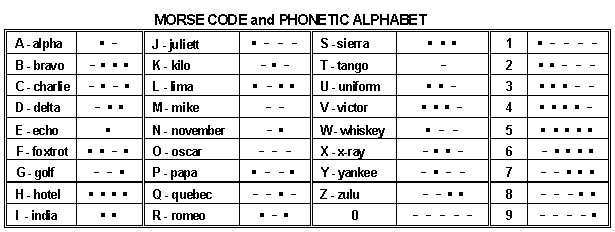
Note: The International Maritime Organization agreed to officially stop Morse code use by February 1999, however use may continue by ground based amateur radio operators (The U.S. Coast Guard discontinued its use in 1995)
| Decimal | Binary | Hex | . | Decimal | Binary | Hex | . | Decimal | Binary | Hex |
| 1 | 00001 | 01h | . | 11 | 01011 | 0Bh | . | 21 | 10101 | 15h |
| 2 | 00010 | 02h | . | 12 | 01100 | 0Ch | . | 22 | 10110 | 16h |
| 3 | 00011 | 03h | . | 13 | 01101 | 0Dh | . | 23 | 10111 | 17h |
| 4 | 00100 | 04h | . | 14 | 01110 | 0Eh | . | 24 | 11000 | 18h |
| 5 | 00101 | 05h | . | 15 | 01111 | 0Fh | . | 25 | 11001 | 19h |
| 6 | 00110 | 06h | . | 16 | 10000 | 10h | . | 26 | 11010 | 1Ah |
| 7 | 00111 | 07h | . | 17 | 10001 | 11h | . | 27 | 11011 | 1Bh |
| 8 | 01000 | 08h | . | 18 | 10010 | 12h | . | 28 | 11100 | 1Ch |
| 9 | 01001 | 09h | . | 19 | 10011 | 13h | . | 29 | 11101 | 1Dh |
| 10 | 01010 | 0Ah | . | 20 | 10100 | 14h | . | 30 | 11110 | 1Eh |
When using hex numbers it is always a good idea to use "h" as a suffix to avoid confusion with decimal numbers.
For example, to convert 60 (decimal) to hex, we have 60/16=3 with 12 remainder. 12 is C (hex) - this becomes the right-most character. Then 3/16=0 with 3 remainder. 3 is also 3 (hex). This becomes the next (and final) character to the left in the hex number, so the answer is 3C h.
A radian is the angular measurement of an arc which has an arc length equal to the radius of the given circle, therefore
there are 2 radians in a circle. One radian = 360° /2 = 57.296....°