Lasers are divided into the following classes:
| Class 1 | Low power / non-hazardous |
| Class 2/2a | Low power / minor controls necessary. Emit less than 1 mW visible CW radiation. Not considered hazardous for momentary (<0.25 sec) unintentional exposure. Class 2a lasers are those class 2 lasers not intended to be viewed, i.e. supermarket scanners. |
| Class 3a/3b | Medium power / direct viewing hazard / little diffuse reflection hazard. Class 3a is visible lasers with 1-5 mW power output, invisible lasers, and those having 1-5 times the Accessible Emission Limit (AEL) of class 1 lasers. Class 3b is all other class 3 lasers at all wavelengths which have a power output less than 500 mW. |
| Class 4 | High power / eye and skin hazard / potential diffuse reflection hazard or fire hazard |
There are several pertinent instructions and guidelines regarding laser use. They are:
Every Navy command which uses lasers must have a Laser System Safety Officer (LSSO). There are two categories of LSSOs, and each command should determine which type is appropriate considering their mission, types of lasers being used, and size of the laser safety program.
The CAT I LSSO must attend formal training at Naval Safety School. They are qualified to
The CAT II LSSO does not have the technical capability to calculate or measure laser safety parameters, and cannot serve as an instructor of other LSSO's. They are qualified to:
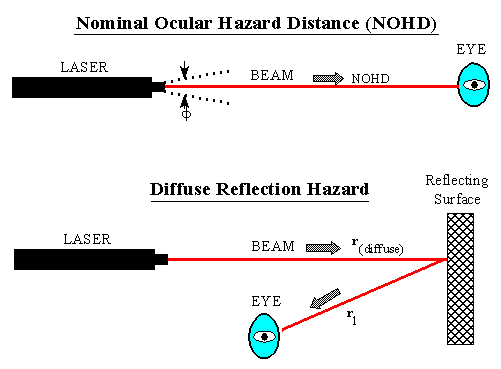
The hazard ranges of interest are the NOHD for direct viewing of a beam and the r1(safe) or r2(safe) for viewing a beam reflected off an object such as a wall. These are discussed in SPAWARINST 5100.12B and are depicted in figure 1.
The hazard range for a laser can be calculated using the information from enclosure (5) of SPAWARINST 5100.12B. The Maximum Permissible Exposure (MPE) values present laser safety levels as a function of exposure time, laser PRF, pulse duration, and wavelength. Different tables are used for eye safety while directly viewing a beam, for viewing a diffusely reflected beam, and for skin exposure.
For repeated pulses the following equation is used to calculate the maximum permissible exposure (MPE).

Where PRF is the pulse repetition frequency of the laser and te is the exposure duration.
For visible lasers te is usually taken as 1/4 second and for non-visible lasers a value of 10 seconds is used.
Range laser safety officers shall be designated for external operations. Range test plans shall specify:
During laser operations no portion of the laser beam may extend beyond the controlled target area unless adequate surveillance can prevent radiation of unprotected areas. Class 3 and class 4 lasers shall not be directed above the horizon unless coordinated with those responsible for the given airspace (FAA, Navy, Air Force, etc).
In an industrial environment, warning and hazard signs and lights will be posted, a hazard zone shall be designated when lasers are in operation, and training shall be provided to operators in the proper eye and body (skin) protection required. Interlocks to laser operation shall be provided when there is the possibility of unauthorized personnel entering the hazard area.
Fiber optic cables usually have laser power sources so appropriate warnings or labels need to be applied to connections or possible breakage points.