 3. UNAMBIGUOUS
RANGE (DISTANCE BETWEEN PULSES):
3. UNAMBIGUOUS
RANGE (DISTANCE BETWEEN PULSES):
 with t = time to
reach target
with t = time to
reach target
| Rules of Thumb | |
| In one usec round trip time, a wave travels to and from an object at a distance of: | The time it takes to travel to and from an object at a distance of:
|
| 150 m 164 yd 500 ft 0.08 NM 0.15 km
| 1 m = 0.0067 usec 1 yd = 0.006 usec 1 ft = 0.002 usec 1 NM = 12.35 usec 1 km = 6.7 usec
|
2. ONE WAY RANGE: R = ct with t = time to reach target
| Time | Distance Traveled | . | Distance | Time it Takes |
| 1 milli sec (ms) | 165 NM | . | 1 NM | 6.18 usec |
| 1 micro sec (us) | 1000 ft | . | 1 km | 3.3 usec |
| 1 nano sec (ns) | 1 ft | . | 1 ft | 1 nsec |
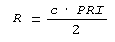
3. UNAMBIGUOUS
RANGE (DISTANCE BETWEEN PULSES):
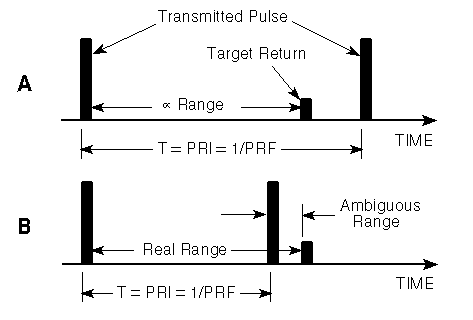
Normally a radar measures "distance" to the target by measuring time from the last transmitted pulse. If the inter-pulse period (T) is long enough that isn't a problem as shown in "A" to the right. When the period is shortened, the time to the last previous pulse is shorter than the actual time it took, giving a false (ambiguous) shorter range (figure "B").
| Rules of Thumb |
| RNM = 81Pms |
| Rkm = 150Pms |
4. RANGE RESOLUTION
5. BEST CASE PERFORMANCE: