1) Hazards of Electromagnetic Radiation to Personnel (HERP)
2) Hazards of Electromagnetic Radiation to Ordnance (HERO)
3) Hazards of Electromagnetic Radiation to Fuel (HERF)
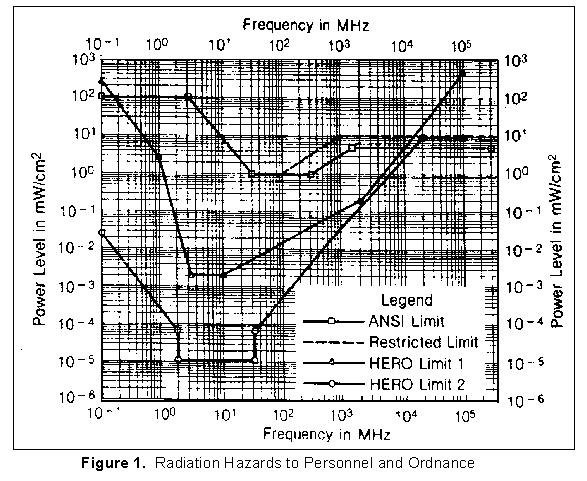
The current industrial specifications for RADHAZ are contained in ANSI/IEEE C95.1-1992 which was used as a reference to create the combined Navy regulation NAVSEA OP3565 / NAVAIR 16-1-529. Volume I contains HERP and HERF limits - its current version is REV 5. Volume II (REV 6) covers HERO. These limits are shown in Figure 1 although all values have been converted to average power density.
OP 3565 specifies HERO RADHAZ levels at frequencies below 1 GHz in peak value of electric field strength (V/m), while levels above 200 MHz are specified in average power density (mW/cm2) - note the overlapping frequencies. Since Figure 1 depicts power density as the limits, you must convert the average values to peak field strength for use at lower frequencies. Also many applications of EMC work such as MIL-STD-461 use limits based on the electric (E) field strength in volts/meter. Remember that P=E2/R, and from the power density section, we note that R=377 for free space. It can also be shown that the magnetic field strength (Amps/meter) = I/m where I=E/R. Don't forget that RMS = 0.707 Peak. With the units of PD in mW/cm2, E in V/m, and H in A/m, then PD = E2 / 3770 = 37.7 H2. It should thus be noted that a 100 times increase in power (mW/cm2) is only a 10 times increase in V/m.
The potential dangers to ordnance and fuels are obvious because there could be an explosive "chain reaction" by exploding; consequently, these limits are generally lower than personnel limits. There are three HERO categories. The HERO limit 2 is for HERO "unsafe" or "unreliable" explosive devices with exposed wires arranged in optimum (most susceptible) receiving orientation. This usually occurs during the assembly/disassembly of ordnance, but also applies to new/untested ordnance until proven "safe" or "susceptible." The HERO limit 1 is for HERO susceptible ordnance fully assembled undergoing normal handling and loading operations. HERO safe ordnance requires no RF radiation precautions. A list of which specific ordnance (by NALC) falls into each category can be found in OP 3565 along with specific frequency restrictions for each piece of ordnance. For example, all missiles of one variety are susceptible (HERO 1 limits), while another missile has both susceptible and safe variants (with no RADHAZ limits). Other ordnance may be HERO unsafe (HERO 2 limits).
The danger of HERP occurs because the body absorbs radiation and significant internal heating may occur without the individuals knowledge because the body does not have internal sensation of heat, and tissue damage may occur before the excess heat can be dissipated. As shown in figure 1, the current "restricted" limit is for individuals more than 55" tall because they have more body mass. In other words, all people may be exposed to the lower limit, but only persons taller than 55" may be exposed to the higher limit of 10 mW/cm2.
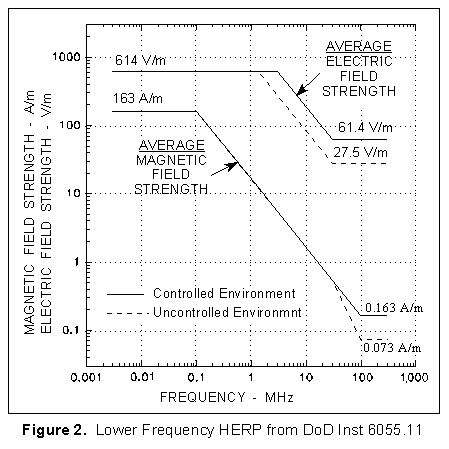 NAVSEA OP 3565 will be updated in the future to be compatible with DoD
INST 6055.11 dated Feb 21, 1995 which supersedes it. The personnel radiation levels in
Figures 2 and 3 were taken from the new release of DoD INST 6055.11.
NAVSEA OP 3565 will be updated in the future to be compatible with DoD
INST 6055.11 dated Feb 21, 1995 which supersedes it. The personnel radiation levels in
Figures 2 and 3 were taken from the new release of DoD INST 6055.11.
Unlike the existing "restricted limit" of NAVSEA OP 3565 discussed above, in the revised DoD instruction for personnel radiation hazards, a different approach to exposure was taken.
Two maximum hazard limits are defined;
1) Controlled Environments - where personnel are aware of the potential danger of RF exposure concurrently with employment, or exposure which may occur due to incidental transient passage through an area, and;
2) Uncontrolled Environments - A lower maximum level where there is no expectation that higher levels should be encountered, such as living quarters.
These Personnel Exposure Limits (PELs) are based on a safety factor of ten times the Specific Absorption Rate (SAR) which might cause bodily harm. The term PEL is equivalent to the terms "Maximum Permissible Exposure (MPE)" and "Radio Frequency Protection Guides (RFPG)" in other publications.
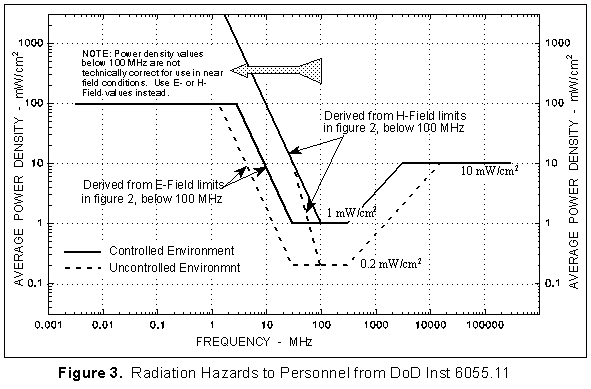
There are several exceptions to the maximum limits in figures 2 and 3 (in some cases higher levels are permitted):
The PELs listed in Figures 2 and 3 were selected for an average RF exposure time at various frequencies. In a controlled environment, this averaging time was selected as 6 minutes for 0.003 to 15,000 MHz. If the exposure time is less than 6 minutes, then the level may be increased accordingly. Similar time weighted averages apply to uncontrolled environments, but it varies enough with frequency such that DoD INST 6055.11 should be consulted.
NAVSEA OP 3565 contains a list of Navy avionics which transmit RF as well as radars along with their respective hazard patterns. Special training is required for individuals who work in areas which emit RF levels which exceed the uncontrolled levels. Warning signs are also required in areas which exceed either the controlled or uncontrolled limits.
Although E-Field, H-Field, and power density can be mathematically converted in a far-field plane wave environment, the relations provided earlier do not apply in the near field, consequently the E- or H-field strength must be measured independently below 100 MHz. It should be noted that the specifications in NAVSEA OP 3565 for lower frequency HERO limits are listed as peak E-field values, whereas lower RF limits in DoD INST 6055.11 on HERP are in average (RMS) E-field values. Upper frequency restrictions are based on average (RMS) values of power density in both regulations except for certain circumstances.
HERF precautions are of more general concern to fuel truck operators. However, some general guidelines include: