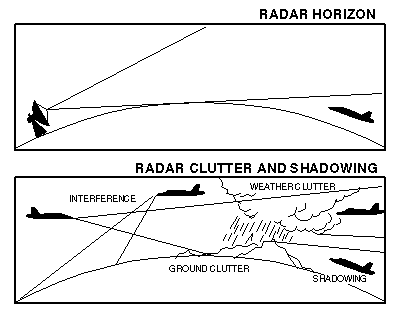
 There are limits to the reach of radar signals. At the frequencies normally used for radar, radio waves usually
travel in a straight line. The waves may be obstructed by weather or shadowing, and interference may come
from other aircraft or from reflections from ground objects (Figure 1).
There are limits to the reach of radar signals. At the frequencies normally used for radar, radio waves usually
travel in a straight line. The waves may be obstructed by weather or shadowing, and interference may come
from other aircraft or from reflections from ground objects (Figure 1).As also shown in Figure 1, an aircraft may not be detected because it is below the radar line which is tangent to the earths surface.
Some rules of thumb are:
Range (to horizon):
Range (beyond horizon / over earth curvature):

In obtaining the radar horizon equations, it is common practice to assume a value for the Earth's radius that is 4/3 times the actual radius. This is done to account for the effect of the atmosphere on radar propagation. For a true line of sight, such as used for optical search and rescue, the constant in the equations changes from 1.23 to 1.06 (see later equations which round this to 1.05 for ease of computing).
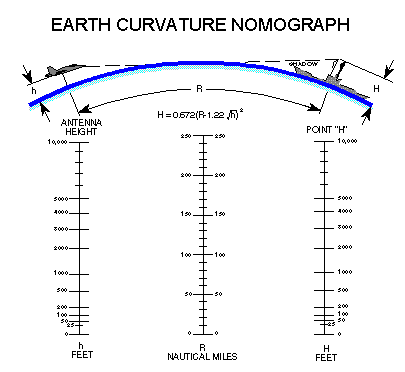
A nomograph for determining maximum target range is depicted in Figure 2. Although an aircraft is shown to the left, it could just as well be a ship, with radars on a mast of height "h". Any target of height (or altitude) "H" is depicted on the right side.
This data was expanded to consider the maximum range one aircraft can detect another aircraft in Figure 3.
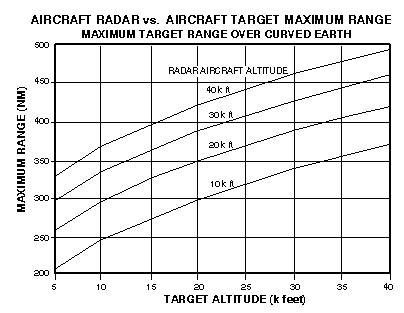
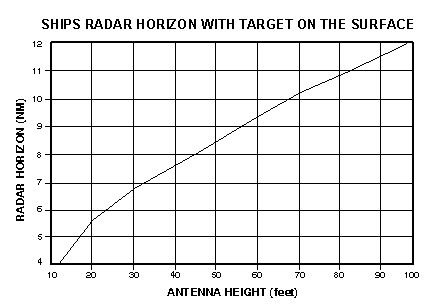 Figure 4 depicts the maximum range that a ship height antenna can detect a zero height object (i.e. rowboat
etc).
Figure 4 depicts the maximum range that a ship height antenna can detect a zero height object (i.e. rowboat
etc).
In this case "H" = 0, and the general equation becomes:
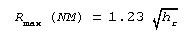
Where hr is the height of the radar in feet.
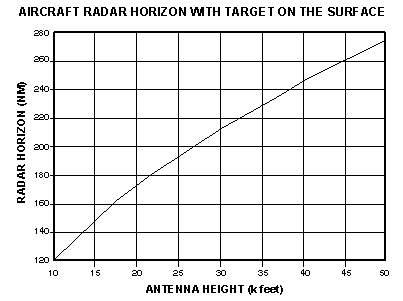
Figure 5 depicts the same for aircraft radars. It should be noted that most aircraft radars are limited in power output, and would not detect small or surface objects at the listed ranges.
Other general rules of thumb are (with R in NM and aircraft altitude in feet):
For Visual SAR: 
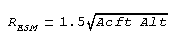
For ESM: