
Introduction: The RS-485 is the recommend standard by the Electronic Industries Association (EIA) that specifies the electrical characteristics of generators and receivers that may be employed for the interchange of binary signals in multipoint interconnection of digital equipments. When implemented within the guidelines, multiple generators and receivers may be attached to a common interconnecting cable. An interchange system includes one or more generators connected by a balanced interconnecting cable to one or more receivers and terminating resistors.
Electrical Characteristics: The electrical characteristics that are specified are measured at an interconnect point supplied by the devices manufacturer. Figure 1 shows an interconnection application of generators and receivers having the electrical parameters specified.
The elements in the application are: generators, receivers, transmission cables, and termination resistances (Rt). The loads on the system caused by each receiver and passive generator shall be defined in terms of unit loads. Each generator can drive up to 32 unit loads consisting of both receivers and generators in the passive state. The loading caused by receivers and passive generators on the interconnect must be considered in defining the device electrical characteristics. Two areas are of concern: the DC load and the AC load characteristics. The DC load is defined as a number or fractions of "unit loads". The AC loading is not standardized but must be considered in the design of a system using the devices meeting this standard.
General System Configuration: The generators and receivers conforming to the RS-485 standard can operate with a common mode voltage between -7 volts and +7 volts ( instantaneous ). The common mode voltage is defined to be any uncompensated combination of generator-receiver ground potential difference and longitudinally coupled peak noise voltage measured between the receiver circuit ground and cable with the generator ends of the cable short circuited to ground, plus the generator offset voltage (Vos).
Grounding Arrangements: Proper operation of the generator and receiver circuits requires the presence of a signal return path between the circuit grounds of the equipment at each end of the interconnection. The grounding arrangements are shown in Figure 2.
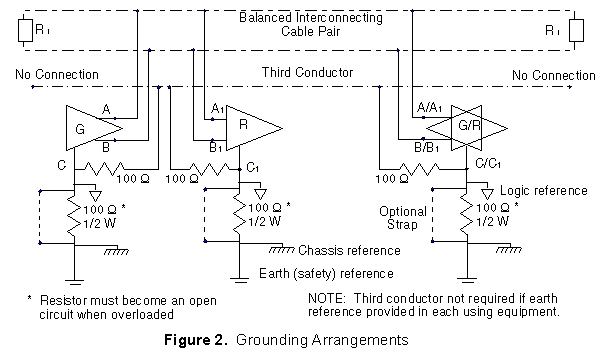
Where the circuit reference is provided by a third conductor, the connection between circuit common and the third conductor must contain some resistance ( e.g., 100 ohms ) to limit circulating currents when other ground connections are provided for safety. Some applications may require the use of shielded interconnecting cable for EMI or other purposes. The shield shall be connected to frame ground at either or both ends, depending on the application.
Similarity with RS-422-A:
In certain instances, it may be possible to produce generators and receivers that meet the requirements of both RS-422-A and of RS-485. Table 1 depicts the differences in parameter specifications which exist between the two documents.
| Characteristic | RS-422-A | RS-485 |
| Min. output voltage |
2V into 100 ohm > 1/2 open circuit V |
1.5 V into 54 ohms |
| Ishort to ground | 150 mA maximum | - |
| Ishort to -7, +12 volts | - | 250 mA peak |
| trise time | < 0.1 t b , 100 ohm load | < 0.3 t b , 54 ohm, 50 pF load |
Where t b = time duration of the unit interval at the applicable data signalling rate (pulse width).