Poor
Man’s Spectrum
Analyzer
 June 1999 Nuts & Volts Magazine
There is a solution. A
number of years ago, I wrote a column in a magazine called Ham Radio. One of
the projects I built for the column was a Spectrum Analyzer kit offered by
I recently ran across the Science Workshop web site,
and found to my delight that the project is still being offered, but with some
upgrades. I obtained the pieces from Science Workshop and did it again.
The Poor Man’s
Spectrum Analyzer (PMSA) got its start back in 1978 when
The cable TV tuners
output the converted signal on an IF frequency close to 53 MHz (normal to TV
receivers). The SW-6006 main board is a receiver that will down convert the
53-MHz IF signal to a low IF of 10.7 MHz, and then demodulate it. The bandwidth
of the output signal is approximately 250 KHz, so there is a resolution problem
that may be a problem on crowded bands. The problem does not prevent you from
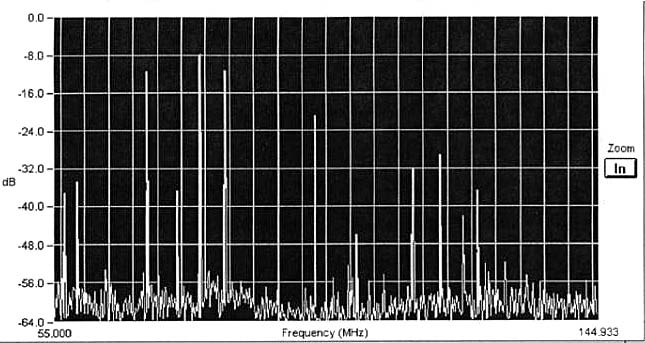
using the device to check the output of a transmitter for spurs and harmonics,
however. Fortunately, there is a Switched Filter Upgrade kit (SW-6010) that
permits selection of 250 KHz, 55 KHz, or 15 KHZ bandwidths.
It should also be
possible to use a regular VHF receiver as the IF, and get even better
resolution. A number of general coverage receivers will go to the required
range. Alternatively, there are ham radio six-meter band converters that can be
used as well. However, my experience with the Science Workshop product
indicated that the SW.6006 worked satisfactorily for my purposes.
The sawtooth waveform needed to sweep the tuner
through the range (with Center Frequency, Sweep Width, and Sweep Rate controls)
is provided by the Ramp Board (SW-6001).
One of the problems with
the original PMSA that I built was the necessity of calibrating the frequency
dial. I used a chart comparing 0-999 micrometer dial (connected to the tuning
voltage potentiometer) readings to frequency. The current offering has a
Frequency Readout Board (SW-6007) that converts the pre-scaler output of the
cable-TV tuner to drive a digital voltmeter that serves as the frequency
readout.
Frequency
can also be measured using an optional Marker Generator (MSG-100). This is also
a cable TV tuner in which the voltage tuned local oscillator is used to provide
a signal to mix with the front-end signal. It puts a “pipper”
on the oscilloscope display that indicates frequency. By measuring this
frequency with a digital frequency counter, we can make accurate determinations
of frequency.
Also available is a
Tracking Generator upgrade (SW-5900). This type of Instrument is basically a
signal generator that tracks the Spectrum Analyzer center frequency. It can
therefore be used to make frequency response measurements of circuits and
devices. The tracking generator was a really neat addition to the system
because it permits testing that is not possible with the PMSA alone.
The various pieces of the
PMSA are available from Science Workshop in either kit form or wired and
tested. Add a “K” to the kit number for kit and “W” for
wired.
The bottom line is that
the Poor Man’s Spectrum Analyzer is one way to get a reasonably
performing Spectrum Analyzer without laying out a huge amount of cash. Will it
do everything that a $30,000.00 professional model will? Nope, but that’s
not the question. The real question is: Will it do the jobs that you need it to
do? NV