
We are proud to present, with permission of The New York Press, the complete text of Web Feats: Surf's Up On the Cyber Sea, the feature cover story from the issue of January 11-17, 1995 (Volume 8, Number 2).
The New York Press is the PREMIER free newspaper in New York, and a great asset for visitors and natives alike, with page upon page of entertainment, restaurant, and cultural event listings, mixed with fascinating features, cartoons, and an eclectic selection of personal ads.
Esoteric Resources Incorporated has converted this newspaper article into a hypertext resource, complete with clickable URLs to as many Web pages as we could find. If you know of any URL that we have missed (and there are a few) please e-mail us at esoteric@inch.com .
Esoteric Resources Incorporated would like to thank John Strausbaugh, Associate Editor, for his help in making this Web Page possible.
All text from Web Feats: Surf's Up On the Cyber Sea is copyright ©1995 The New York Press.It is presented on this Web Page by permission The New York Press.
The cover illustration is copyright © 1995 David Bamundo. Presented by courtesy of David Bamundo.
The design of this Web Page, and the placement of hypertext connections (clickable URLs), is copyright © 1995 Esoteric Resources Incorporated.
Article by John Strausbaugh
Illustration by David Bamundo 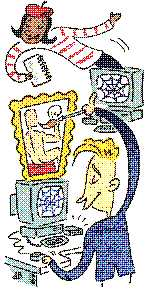 Copyright © 1995 David Bamundo.
Shortly after the Russian revolution, the Bolshevik/Futuristic poet Vladimir Mayakovsky was invited to give a reading on state radio. Before he went on, someone at the station told him, in effect, Look, I don't want to make you nervous, but I do want you to know that your poems are about to be heard by a million people. To which Mayakovsky coolly replied, "Not enough."
For Douglas Davis, Remo Campopiano and the other arty types flooding onto the World Wide Web, " Not Enough " could be a motto.
"If you're trying to reach out to the general public, you want to use the Web," Campopiano says. "If you're a writer, for instance, you don't want to publish for 200 people, you want to publish for 10 or 20 million."
That' s how many people were estimated to have access to the Internet when Campopiano said that to me last week; maybe a million had direct access to the Web. Like everything else about the Web, that figure has probably grown by now.
You've read about the science and business uses of the Web in the Times or Wired. You know it was developed by programmers at CERN, the European physics lab in Geneva, as a global net of computer interconnectivity that can make the Internet as you know it seem as antique as drums along the Mohawk. "Don't look now," the Oct. '94 issue of Wired raved about it, "but Prodigy, AOL and CompuServe are all suddenly obsolete..."
The Web's been up for a few years, and growing explosively since it became widely accessible to users in the fall of '93. Which in computer land makes it, as a techie at the NYU Center for Digital Multimedia said to me with a sarcastic half-a-sneer, "really old news." For art types, though, the Web is as much a promising new territory as the radio was to Futurist poets in 1917. While it's still mostly occupied by university and government science labs, virtual shopping malls and assorted techno-nerdy "shovelware," artists have been pouring onto the Web in the last six months or so. They're not all doing interesting things with it yet, but the good ones are already noodling with the form, thinking about it as a new way to make art.
"It's a means of getting into this web of minds, so that the work becomes not just the product of one single person but of the shifting collaboration of all these minds," Davis says. What's interesting to him isn't the technology itself, but "the minds that are coming alive through it."
The Web is so attractive to non-techies because it's so very easy to negotiate. Using graphical "browsing" software like Mosaic and the newer Netscape, any dummy with a mouse can surf around the Web with point-and-click ease. Trust me, I've done it. When Mosaic was released in 1993, there hadn't been such a buzz about new idiot-proof software since Windows.
What makes the Web such a great leap toward the Gibsonian vision of an easily navigable data grid is that it's multimedia and hypermedia. Web files can incorporate text, photos, video, animation and sound. And every file on the Web can be linked to any other file in an effectively infinite net of interconnections. Just by clicking on highlighted words or images, you find yourself squirting off to Web "sites" all around the globe. It's dazzlingly simple. Campopiano calls it "the taming of the Internet. It's just like the railroad tamed the Wild West. It was only for the brave at heart at first. Now it's easy and fun."
At NYU, Webmeister Gary Welz, who's been helping scholars and art types like Davis get up to speed, lets me try it for myself. To start with, I'm looking at a screen showing Welz's resume (with his photo in the corner). Scanning through a list of articles and papers he's written for/about the Web, I click on the title of one that's about hypermedia. Instantly, I drop into that article. There he refers to an essay, The Art of Renaissance Science: Galileo and Perspective by CUNY science historian Joseph Dauben, that Welz has turned into a hypermedia document and launched on the Web. I click on that highlighted title, and instantly I'm shot over to the Los Alamos National Laboratory's Web site, where the essay resides.
Browsing around at Los Alamos, I see a highlighted reference to a "virtual Louvre" someone on the East Coast has created. Click, I'm at the Louvre, wandering around among gorgeous digitalized versions of the paintings. Somewhere at the Louvre I click again and zip over to WAXWeb, a site entirely devoted to second-by-second deconstruction of the movie Wax: The Discovery of Television Among the Bees.
I sit back wearing the sort of sated and goofy grin you have after eating too many glazed doughnuts. A data sugar rush. Around the world in 20 minutes, just by pointing and clicking on the highlights. Think of it, Welz suggests, as a net of documents with footnotes that not only refer to other documents, but give you instant access to them. Click. Click. Click. Like dropping through an endless series of trap doors.
For a writer, it can be a bit disturbing. The temptation to keep clicking on those highlights, shooting yourself from site to site around the Web, is irresistible. In the few hours I've spent on the Web, I've not read a single text in its entirety. I never sat still long enough at any site. When the whole world's out there at a click, you get antsy staying anywhere too long. If you think of traditional text as a horizontal and linear organization of data, the Web is vertical and fractal. Click, drop, click, drop, like a nickel in a candy machine. The data-grazing is aleatoric and serendipitous.
Welz is right when he says it's less like reading that like watching a tv with thousands and thousands of channels. So is Davis when he likens it to a sea of data. "I'm swimming around in this thing, so happy," he says, giving me that glazed-doughnut grin.
In early December, Davis sat at a terminal in the art gallery of Lehman College in the Bronx. He was connected BBS-style to Swiss artist Nathalie Novarina at a terminal in Geneva. Together, they began writing what he calls The World's First Collaborative (And Longest) Sentence. Between now and the middle of next month, he hopes to have thousands of people around the world adding their own bits of text, sound and images, building a hypermedia sentence three miles long. The only restriction is that you don't put any periods on what you contribute.

A couple of weeks ago, when I asked him why three miles, he shrugged and said, "It has to end somewhere." Back then he intended to end the sentence during a performance in a Warsaw art gallery on Feb. 15, when he would ceremoniously add the period at the end. Now he's not so sure. Since the sentence can theoretically be infinite, sitting out there in cyberspace and growing forever, he's been noodling with the idea that "maybe only God should add the final period."
Davis isn't a techie, not a young Top Gun of a computer jock, yet it makes complete sense that he'd be among the first artists to dive into the Web. He's been pushing ideas of interactive and "long-distance" art for almost 30 years. In the late 60s he was an early video artist, but unlike much video art, which used the technology as a new presentational mode, his approach was conceptual. At a time when nearly everyone was complaining that tv was a one-way medium that separated and isolated people, Davis was making satellite tv art projects (with Nam June Paik and Joseph Beuys) that tried to show how the technology could be used interactively to connect people.
Now he's doing the same for computer art and the Web. Where many of the artists I've seen on the Web are basically using it as a new way to present traditional art images - creating "virtual art galleries" and "virtual studios" and such - Davis is playing with it as a new way for people to make art together. He's itching to get people past notions of virtual anything. He insists that the real potential of all the computer-jockeyed communication going on out there - the Web, the 'Net, bulletin boards, chatlines, all of it - is about "breaking out of the virtual closet" into "the real real." If the buzz sounds clunky, remember that he's making this up as he goes, like everyone else.
"This goddamned thing is growing all over the world, and it's growing without any plan or direction," he enthuses. "People are just getting into it and inventing their own kind of tropes. And nobody's in control of it. And we don't want anybody to be in control of it. It's literally unstoppable - the sex, the friendships, the debates..." People are learning to express themselves much more freely and directly on-screen than they ever would face-to-face, he claims. "It's a form of address and a way of penetrating into somebody's psyche that has no parallel. It's a wonderfully intense level of contact.
"And it seems to me this is finally the end of the global village idea," he adds. "'Village' has the connotation of a bunch of like-minded people linked very closely together in a common culture. And the first thing you learn when you get on-line and talk to all these people is how wildly different they are from you. That's one of the fascinating things about it."
Davis also likes the way putting art or writing out on the Web is challenging artists to develop whole new attitudes about the sale and ownership of their work. For instance, he's got this essay he's about to publish not in print but on the Internet. "I'll put the copyright line on it, but that isn't going to cut any ice," he smiles. "People are going to download that thing and make all the use of it they want. So what? Who cares? It's not what matters. What are you writing for if not to communicate with people?"
He remembers the early days of video art, when artists were complaining, "'Oh my god, anybody can copy my videotapes. How are you going to earn a living from it?' That had to do with thinking about an artist making his living in the mode of being a painter. A painter lives and dies on the sale of the original. The video artist can't. There's no way in the world we can compete with [traditional gallery artists] on that level. We don't create these big fucking objects."
Luckily for Davis, there's at least one art collector who's hip to what he means. Gene Schwartz, who also collects traditional art objects, has been "buying" Davis' all-concept, no-object projects for years. In a witty little essay called "Why I Throw Money Away On Doug Davis' Art," he explains that he has "gleefully commissioned the non-collectible work of Doug Davis" because "the day will come when we will all bow and give that work the reverence it deserves. And I - willingly - will profit not at all from that day of recognition...I have never found a more beautiful way of wasting money!"
Last week, in what Davis calls "a ridiculous obeisance to tradition," he presented Schwartz with a couple of diskettes containing some of the computer projects Schwartz has funded. In effect, those disks are a parody of traditional art objects. As collectibles they're worthless, since the same work's freely available to anyone on the Web.
I'm sitting at a terminal with Campopiano in a clean, empty former art gallery at 426 Broome St. Trucks clang into loading docks next door, but in here there's just that subliminal electro-hum common to computer workplaces. The white gallery walls aren't' hung with art, but with what you could call art-in-potentiality: printed loose-sheet booklets called FAQs (Frequently Asked Questions) with non-techie explanations of the Internet, the Web and Campopiano's new ArtNet. He calls the space an "Internet reading room," and plans to open it to the public Feb. 1. Eventually he wants to include a couple of terminals where novices can learn how it all works.
Campopiano's been in Soho for two years. Before that he was in Minneapolis, working both as a sculptor and the co-founder of the local arts magazine Artpaper, which he put out for 15 years. Four years ago when his wife became pregnant he bought his first Mac, thinking it would help them organize family finances. Although he played around a little with making computer art, he says he really got excited about computers "when I went on-line. Publishing a magazine and putting together an on-line environment have a lot of similarities."
ArtNet, which he's been developing with artist Robbin Murphy, combines a local BBS with a Web site. The BBS differs from other arts bulletin boards like the well-established ArtsWire in that it's a hypermedia environment. Anyone in the 212 area code with a Mac and a modem can logon and start using ArtNet now. (Software for PC users should be available sometime in the spring.) The Web site goes on-line this Fri. Jan. 13.
As it gets fully up and running over the next few months, ArtNet will include a library of free software and how-to's; a "magazine," Views, with articles to which readers can append responses and commentary; local art calendar listings and press releases; and other familiar BBS services. For a few hundred bucks, Campopiano will make digital images of an artist's work, write some hypermedia programming for it and launch it onto the Web as part of ArtNet's "slide registry," where potentially millions of people around the world can see it. The work looks great on the screen; as bunches of gallery owners start surfing the Web, it could be a big improvement over the old approach of mailing out slides.
In a section he calls "virtual real estate," he can set an artist up with a virtual studio that includes digitalized artworks, multimedia documentation of exhibits, the artist's journals, message forums, whatever. Art galleries and some downtown museums are starting to put their stuff on ArtNet as well.
The Web site also has a "special projects" section, where artists will create new work. Not suprisingly, Davis is one of the first; starting Friday, his sentence will be there for people with Web access to contribute to. The other project is by Adrianne Wortzel; it's an anthropological look back at the present from the 24th Century.
Campopiano stresses how easily and cheap this all is. The ArtNet BBS is free (although members may be charged a nominal monthly fee at some time in the future.) To get access to the Web you rent a "slip" from a "server," with monthly fees usually around $35. After that, because the Web itself and the browsing software to surf it were created by government and university types, it's all free and readily accessible. And launching a Web site of you own "can be as simple as setting up one computer, getting a 56K line into it, and using the free software to create the site," Campopiano says. "You need a little technical expertise, but not a hell of a lot."
Which is why, Gary Welz tells me, new Web sites are coming on-line in a torrent. The day he gave me my tour of the Web at NYU, we clicked onto a "What's New" site, updated three times a week. It listed dozens of new or updated sites for that week alone: an Amnesty International site, a research lab at Penn State, a microbiology institute in Belgium, a J.C. Penney shop, something called the New Media Lab in Moscow, a plasma physics forum, a Godiva Chocolates site, golf tournament schedules, a Mexican politics discussion group, sites for windsurfers and geologists and mortgage insurance brokers and The Sacramento Bee.
ArtNet won't be the first Web site for artists; in fact, there's already one call ARTnet based in L.A. I saw another L.A. one called Kaleidospace, one from Detroit called the Weird Workshop, that virtual Louvre, and one that markets the multimedia products of Thomas Dolby. There's a really entertaining site that was set up when Anthology Film Archives hosted a bunch of Fluxus performances last fall.
And then there are the sites for the National Institute of Standards, Mother Jones, the American Institute of Physics, Ogilvy and Mather, Time Publications, the Downtown Anywhere shopping mall, the inevitable one selling Star Trek memorabilia, and the infamous one from MIT that shows a videocam's view of a pot of coffee, updated every 60 seconds, so that MIT geeks at their terminals in other parts of the building always know how much is left.
As more and more commercial interests get into the Web - MCI, AT&T, the Home Shopping Network, et al. - some people worry that it will become one big virtual shopping center. Others acknowledge that it's being commercialized, but say there's room in the virtual real estate for everybody.
"Almost every ism or niche is setting up a Web site," Campopiano says. "If you're a model airplane enthusiast, I'm sure there's a Web site for that. Whatever your interest is, eventually there's going to be a Web site for it."
In on of his articles, Welz wrote: "Today a multimedia/hypermedia publication can be created on a desktop and distributed instantly to viewers around the globe for the cost of a little disk space on a server. Expect hypermedia electronic publishing to be the cottage industry of the 90s. Universities, schools, small publishers and individuals are flocking to the Web in droves."
He should know. He was teaching math at John Jay College before he transformed himself into a Webmeister. He runs his own cottage industry, the Science and Engineering Television Network. Along with producing and programming videos for scientists (with exciting titles like Natural Minimal Surfaces via Theory and Computation, Forced Lattice Vibrations and Chaos, Fractals and Dynamics), he creates Web sites and documents for commercial interests, scholars, and artists like Davis. You can tell he's one of those techies who actually gets a kick out of dealing with the rest of us.
When I last spoke to Davis, something like 50 people had added words, images and a 10-second fragment of piano music to his collaborative sentence, from computers around the country and in South Africa, Haiti, Moscow and elsewhere. That was before a global call for contributors went out through e-mail and, obviously, before it goes on the Web this Friday.
The art space Here (145 6th Ave., between Spring & Dominick Sts.) is hosting a press conference at noon on Tues., Jan. 17, officially launching Davis' project on the Web. The public is invited, and can add to his sentence.
(To logon to ArtNet - Mac only until spring - the modem number is 212 - 925 - 2280; or send e-mail to remo@awa.com, or call 925 - 1885.
To contact Gary Welz at SETN, send e-mail to gary@setn.org; on the Web, he's at http://found.cs.nyu.edu/found.a/CAT/misc/welz .
To see Davis' art exhibit or add to his sentence, the Web address is http://math240.lehman.cuny.edu/art/ .)
This Web Page was produced by the staff of Esoteric Resources
Incorporated:
Hard work by Lauri Howell.
URL insertion by
"JEOPARDY!" Jim Vichench.
Page design by Pamela Lynn Howell.
Esoteric Resources takes full responsibility for the content of this page; if you have any comments, please e-mail us.
This page design is Copyright © 1995 by Esoteric Resources Incorporated, New York, NY, USA.