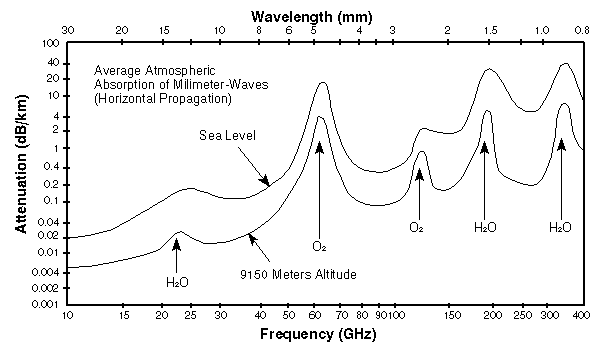
Figure 1. Atmospheric Absorbtion of Milimeter Waves
Signal losses are associated with each stage of signal processing in both the transmitting and receiving portions of the system. The transmitting losses include power transmission efficiency, waveguide and antenna losses, and duplexer losses. In the receiver, losses include antenna, waveguide, RF amplifier, mixer, and IF amplifier.
In addition to these losses, energy traveling through the atmosphere suffers from atmospheric attenuation caused primarily by absorption by the gasses. For lower frequencies (below 10 GHz), the attenuation is reasonably predictable. For high frequencies in the millimeter wave range, the attenuation not only increases, but becomes more dependent upon peculiar absorbing characteristics of H2O, O2 and the like.
Figure 1 shows the areas of peak absorption in the millimeter wave spectrum.
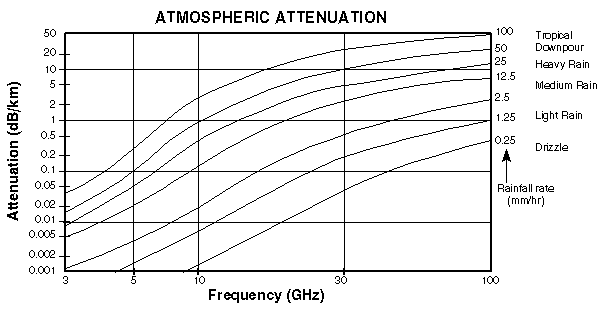
Figure 2 shows how the intensity of precipitation can affect atmospheric attenuation.
Ducting is an increase in range that an electromagnetic wave will travel due to a temperature inversion of the lower atmosphere (troposphere) as shown in Figure 3.
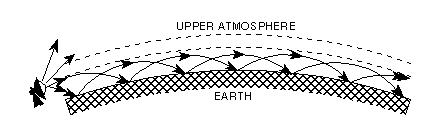
The temperature inversion forms a channel or waveguide (duct) for the waves to travel in, and they can be trapped, not attenuating as would be expected from the radar equation. Ducting may also extend range beyond what might be expected from limitations of the radar horizon (see Radar Horizon Section).
The ducting phenomena is frequency sensitive. The thicker the duct, the lower the minimum trapped frequency.
A similar occurrence takes place with ionospheric refraction, however the greatest increase in range occurs in the lower frequencies. This is familiar to amateur radio operators who are able to contact counterparts "around the world".