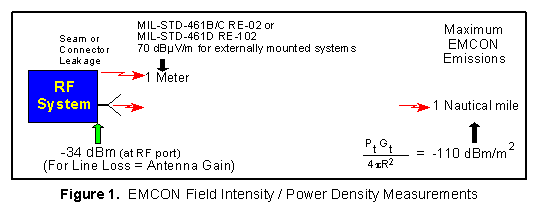
When EMCON is imposed, RF emissions must not exceed -110 dBm/meter2 at one nautical mile. It is best if systems meet EMCON when in either the Standby or Receive mode versus just the Standby mode (or Off). If one assumes antenna gain equals line loss, then emissions measured at the port of a system must not exceed -34 dBm (i.e. the stated requirement at one nautical mile is converted to a measurement at the antenna of a point source - see Figure 1). If antenna gain is greater than line loss (i.e. gain 6 dB, line loss 3 dB), then the -34 dBm value would be lowered by the difference and would be -37 dBm for the example. The opposite would be true if antenna gain is less.
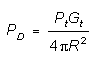
To compute the strength of emissions at the antenna port in Figure 1, we use the power density equation (see Power Density Section)
 |
|
|
 R2) R2) |
|
Pt Gt = PD (4R2)
= (10-11mW/m2)(4)(1852m)2
= 4.31(10)-4 mW = -33.65 or approximately -34 dBm at
the RF system antenna as given.
or, the equation can be rewritten in Log form and each term multiplied by 10:
R2)  [3]
[3]Since the m2 terms on the right side of equation [3] cancel, then:
If MIL-STD-461B/C RE02 (or MIL-STD-461D RE-102) measurements (see Figure 2) are made on seam/connector leakage of a system, emissions below 70 dBµV/meter which are measured at one meter will meet the EMCON requirement. Note that the airframe provides attenuation so portions of systems mounted inside an aircraft that measure 90 dBµV/meter will still meet EMCON if the airframe provides 20 dB of shielding (note that the requirement at one nm is converted to what would be measured at one meter from a point source)
The narrowband emission limit shown in Figure 2 for RE02/RE102 primarily reflect special concern for local oscillator leakage during EMCON as opposed to switching transients which would apply more to the broadband limit.
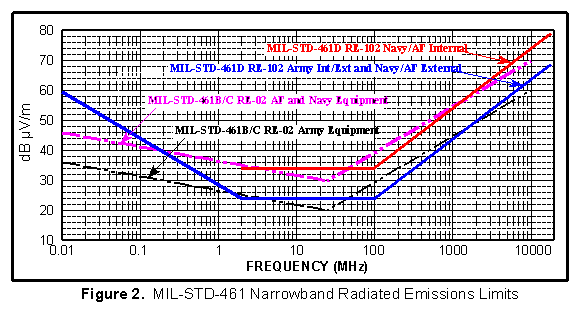
Note that in MIL-STD-461D, the narrowband radiated emissions limits were retitled RE-102 from the previous RE-02 and the upper frequency limit was raised from 10 GHz to 18 GHz. The majority of this section will continue to reference RE02 since most systems in use today were built to MIL-STD-461B/C.
For the other calculation involving leakage (to obtain 70 dBµV/m)
we again start with: 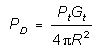
(see Decibel Section).The measurement is at one meter so R2 = 1 m2
we have: 
Using the field intensity and power
density relations:
Changing to microvolts (1V = 106 µV) and converting to logs we have:
20 log (E) = 20 log (106 x 36.2x10-4 ) = 20 log (0.362x10⁴ ) = 71.18 dBµV/m, which is approximately70 dBµV/m as given in Figure 1.
Some words of Caution
A common error is to only use the one-way free space
loss coefficient  directly from Figure 6, in
the One-Way Radar Equation Section to
calculate what the output power would be to achieve the EMCON
limits at 1 NM. This is incorrect since the last term on the right
of equation [3] (10 Log(4R2)) is simply the
Log of the surface area of a sphere - it is NOT the one-way
free space loss factor . You cannot interchange power
(watts or dBW) with power density (watts/m2 or dBW/m2).
directly from Figure 6, in
the One-Way Radar Equation Section to
calculate what the output power would be to achieve the EMCON
limits at 1 NM. This is incorrect since the last term on the right
of equation [3] (10 Log(4R2)) is simply the
Log of the surface area of a sphere - it is NOT the one-way
free space loss factor . You cannot interchange power
(watts or dBW) with power density (watts/m2 or dBW/m2).
The equation uses power density (PD), NOT received power (Pr). It is independent of RF and therefore varies only with range. If the source is a transmitter and/or antenna, then the power-gain product (or EIRP) is easily measured and it's readily apparent if 10log (Pt Gt) is less than -34 dBm. If the output of the measurement system is connected to a power meter in place of the system transmission line and antenna, the -34 dBm value must be adjusted. The measurement on the power meter (dBm) minus line loss (dB) plus antenna gain (dB) must not be higher than -34 dBm.
However, many sources of radiation are through leakage, or are otherwise inaccessible to direct measurement and PD must be measured with an antenna and a receiver. The measurements must be made at some RF(s), and received signal strength is a function of the antenna used therefore measurements must be scaled with an appropriate correction factor to obtain correct power density.
When RE-02 measurements are made, several different antennas are chosen dependent upon the frequency range under consideration. The voltage measured at the output terminals of an antenna is not the actual field intensity due to actual antenna gain, aperture characteristics, and loading effects. To account for this difference, the antenna factor is defined as:
[4]| where: |
E = Unknown electric field to be determined in V/m ( or µV/m) V = Voltage measured at the output terminals of the measuring antenna |
 line (receiver),
the theoretical antenna factor is developed as follows:
line (receiver),
the theoretical antenna factor is developed as follows:
From the One-Way Radar Equation Section
we see that Ae = Gr  2/4,
and from the Field Intensity / Power Density
Section, E2 = 377 PD therefore we have:
2/4,
and from the Field Intensity / Power Density
Section, E2 = 377 PD therefore we have:

Reducing this to decibel form we have: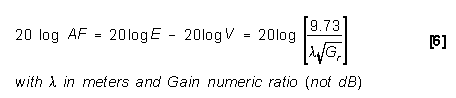
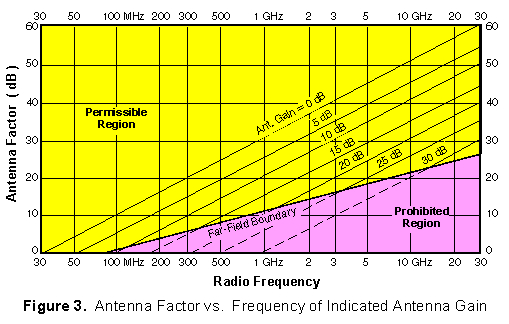
This equation is plotted in Figure 3. Since all of the equations in this section were developed using far field antenna theory, use only the indicated region.
In practice the electric field is measured by attaching a field intensity meter or spectrum analyzer with a narrow bandpass preselector filter to the measuring antenna, recording the actual reading in volts and applying the antenna factor.
[7]Each of the antennas used for EMI measurements normally has a calibration sheet for both gain and antenna factor over the frequency range that the antenna is expected to be used. Typical values are presented in Table 1.
|
|
|
Antenna Factor |
|
|
|
|
22-58 dB |
|
|
|
|
0-18 dB |
|
|
|
Conical Log Spiral | 17-26 dB |
|
|
|
Conical Log Spiral or Ridged Horn | 21-48 dB |
|
|
|
Double Ridged Horn | 21-47 dB |
|
|
|
Parabolic Dish | 20-25 dB |
|
Or in log form:
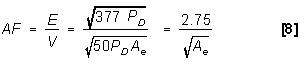
While this relation holds for any antenna, many antennas (spiral, dipole, conical etc.) which do not have a true "frontal capture area" do not have a linear or logarithmic relation between area and gain and in that respect the parabolic dish is unique in that the antenna factor does not vary with frequency, only with effective capture area. Consequently a larger effective area results in a smaller antenna factor.
A calibrated antenna would be the first choice for making measurements, followed by use of a parabolic dish or "standard gain" horn. A standard gain horn is one which was designed such that it closely follows the rules of thumb regarding area/gain and has a constant antenna factor. If a calibrated antenna, parabolic dish, or "standard horn" is not available, a good procedure is to utilize a flat spiral antenna (such as the AN/ALR-67 high band antennas). These antennas typically have an average gain of 0 dB (typically -4 to +4 dB), consequently the antenna factor would not vary a lot and any error would be small.
Suppose that we want to make a very general estimation regarding the ability of a system to meet EMCON requirements. We choose to use a spiral antenna for measurements and take one of our samples at 4 GHz. Since we know the gain of the spiral is relatively flat at 4 GHz and has a gain value of approximately one (0 dB) in that frequency range. The antenna is connected to a spectrum analyzer by 25 feet of RG9 cable. We want to take our measurements at 2 meters from the system so our setup is shown below:

Our RG9 cable has an input impedance of 50, and
a loss of 5 dB (from Figure 5, in the Microwave
Waveguide and Coaxial Cable Section).
First, let's assume that we measure -85 dBm at the spectrum analyzer and we want to translate this into the equivalent strength at 1 NM. Our power received by the antenna is: Pr = -85 dBm + 5 dB line loss = -80 dBm
also PD = Pr/Ae and Ae
= G 2/4 = (G/4)x(c/f)2
= (1/4 )x(3x10⁸/4x109)2
= 4.47x10⁻⁴ m2
In log form: 10 Log PD = 10 Log Pr - 10 Log Ae = -80 dBm + 33.5 = -46.5 dBm/m2 at our 2 meter measuring point.
To convert this to a value at 1 NM, we use
Pt Gt = PD@1 nm 4R12
= PD@2 m 4R22 and
we solve for PD@1 nm
in log form after cancelling the 4 terms:
10 Log PD@1 nm = 10 Log PD@2 m + 10 Log (R2m/R1nm)2 = -46.5 dBm/m2 - 59.3 dB = -105.8 dBm/m2 which is more power than the maximum value of -110 dBm/m2 specified.
If we are making repetitive measurement as we might do when screening an aircraft on the flight line with numerous systems installed, or when we want to improve (reduce) the leakage on a single system by changing antennas, lines, connectors, or EMI gaskets or shielding, this mathematical approach would be unnecessarily time consuming since it would have to be repeated after each measurement. A better approach would be to convert the -110 dBm/m2 value at 1 NM to the maximum you can have at the measuring instrument (in this case a spectrum analyzer), then you could make multiple measurements and know immediately how your system(s) are doing. It should be noted that -90 to -100 dBm is about the minimum signal level that can be detected by a spectrum analyzer, so you couldn't take measurements much further away unless you used an antenna with a much higher gain.
In order not to exceed EMCON, the power density must not exceed -110 dBm/m2 at 1 NM, which is 10-11 mW/m2.
Pt Gt = PD@1 nm 4R12
= PD@2 m 4R22
We solve for PD@2 m = 10-11(1852m)2/(2m)2 = 8.57 x 10⁻⁶ mW/m2 = -50.7 dBm/m2
We'll be using a spectrum analyzer, so we want to compute what the maximum power or voltage may be.
Method 1 - Using the Power Density Approach
Using logs/dB and the values of PD@2 m and Ae determined previously:
10 Log Pr = 10 Log PD + 10 Log Ae = -50.7 - 33.5 = -84.2 dBm
Taking line loss into account we have: -84.2 - 5 dB = - 89.2 dBm as the maximum measurement reading.
If we wanted to calculate it in volts, and take into account our line impedance we would have the following:
also Ae = G2/4
so solving for V we have:
Since our line loss is 5 dB, we have -5dB = 20 Log V2 /V1. Solving for V2 we get 7.79x10⁻⁶ volts or -89 dBm as a maximum at our measurement device input. We can see immediately that our value of -85 dBm that we measured on the previous page would not meet specifications, and neither would any signal with more power than -89 dBm.
Method 2 - Using the Antenna Factor Approach
Starting with the same value of power density that we obtained above (8.57x10⁻⁹ W/m2), we find the field intensity from Table 1, in the Field Intensity / Power Density Section to be approximately 65 dBµV/m. Also from Figure 3 in this section, AF = 43 dB @ 4 GHz. (by calculating with equation [6], the exact value is 42.3 dB)
From equation [6]:
20log V = 20log E - 20log AF
20log V = 65 - 43 = 22 dBµV/m.
Since dBµV/m = 20 log (V)(106) = 20 log V + 20 log 106 = 20 log V + 120 , we see that to get an answer in dBV we must subtract 120 from the dBµV/m value so: VdB = 22 - 120 = -98dBV. We then subtract our line loss (-5dB) and we have:
V = -98 - 5 = -103 dBV = 17 dBµV = 7.1x10⁻⁶ volts
Using the fact that P = V2/R and for the input line
R = 50 , P = 1x10-12 W = -120 dBW = -90 dBm
Although this method is just as accurate as that obtained using method 1, the values obtained in Table 1, of the Field Intensity / Power Density Section, and Figure 3 must be interpolated, and may not result in values which are as precise as the appropriate formulas would produce.
Sample Problem: What is the approximate transmit power from a receiver?
| A. 1 nanowatt (nW) | F. 100 µW | K. 10 W |
| B. 10 nW | G. 1 milliwatt (mW) | L. 100 W |
| C. 100 nW | H. 10 mW | M. 1 kilowatt (kW) |
| D. 1 microwatt (µW) | I. 100 mW | N. 10 kW |
| E. 10 µW | J. 1 watt (W) | O. 100 kW |
The question may seem inappropriate since a receiver is supposedly a passive device which only receives a signal. If the receiver was a crystal video receiver as shown in the Receiver Types and Characteristics Section, it wouldn't transmit power unless a built-in-test (BIT) signal was injected after the antenna to periodically check the integrity of the microwave path and components. The potential exists for the BIT signal to leak across switches and couple back through the input path and be transmitted by the receiver's antennas.
If the receiver uses a local oscillator (LO) and a mixer to translate the signal to an intermediate frequency (IF) for processing (such as a superhet shown in the Receiver Types and Characteristics Section), there is the potential for the CW LO signal to couple back through the signal input path and be transmitted by the receiver's antenna. Normally a mixer has 20 dB of rejection for the reverse direction. In addition, the LO may be further attenuated by receiver front end filters.
In both cases, the use of isolators described in the Circulators and Diplexers Section could be used to further attenuate any signals going in the reverse direction, i.e. back to the antenna. A good receiver design should ensure that any RF leakage radiated by the receiver will not exceed the EMCON level.
In answer to the initial question, "transmit" leakage power should be less than -34 dBm (0.4 µW) to meet EMCON. Therefore, the real answer may be "A", "B", or "C" if EMCON is met and could be "D" through possibly "G" if EMCON is not met.