Skycom Telecom Ltd (STL) new Northwood Radiofacsimile tests.
The trial will run from 25 Oct until 29 Oct and will be conducted in 4 phases.
The Frequency Calling Schedule will be:
0700 - 1900z on 6484.5 Khz
1900 - 0700z on 4355.4 Khz
Transmit site is Near Blackpool NW UK
Commence monitoring trial
Phase 1 o/c STW - 261200z Oct. Staff to apply 9dB attenuation to simulate 1 Kw transmission.
STL equipment directly keying transmitter.
Phase 2 261200z - 271200z Oct. Staff to remove Attenuation - Transmitter at 10 Kw Output
STL equipment directly keying transmitter.
Phase 3 271200z - 281200z Oct. Staff to apply 9dB of attenuation to simulate 1 Kw Transmitter
Output of STL equipment to be routed to transmitter via audio line to Northwood to simulate remote keying.
Phase 4 281200z - 291200z Oct. Staff to remove attenuation - Transmitter at 10 Kw Output
Output of STL equipment to be routed to transmitter via audio line to Northwood to simulate remote keying.
STL equipment will be set to radiate a cyclic test of proposed and current products. The processor will apply a key stream to the transmitter at 0900, 1500 and
2100 during each phase.
Nominated receiver sites are to print copies of all test broadcasts and annotate prints with type of receiver and equipment used.
SKYCOM test QSL Card to anyone that sends a signal report.Please do not send imagery unless asked first.
Skycom Telecom Ltd
Pentre Mansion
Newchapel
Boncath
Pembrokeshire
SA37 0ET
00 44 1239 682665
Fax 44 1239 682645
EMAIL for Signal Reports: Sigreps@skycom.co.uk
http://www.skycom.co.uk
- USN Norfolk (NAM) is very active on 10865 KHz.
- The Pretoria Meteo (ZRO) facsimile service was terminated on 13/9/99 - due to a lack of funding and technical manpower. Source: Ian T Hunter South African Weather Bureau.
- METSAT APT STATUS REPORT 19 October 1999 from Peter Wakelin
NOAA 12 OFF 137.50 MHz Expected on in mid 2000
NOAA 14 ON 137.62 MHz
NOAA 15 ON 137.50 MHz
METEOR 2-21 OFF 137.85 MHz
METEOR 3-5 ON 137.30 MHz
OKEAN 4 (1-7) ON 137.40 MHz
OKEAN 0 ON 137.40 MHz
SICH 1 ON 137.40 MHz
RESURS 0 (1-4) ON 137.85 MHz
* Denotes change since last report
Okean and Sich transmit infrequently and normally only when within range of Russian/Ukrainian ground stations.
- Due to numerous user requests, the NWS will implement some radiofacsimile changes (USCG Boston and USCG Pt. Reyes ) on 02 November 1999
- September 20 SA navwngs state that fax transmissions from Pretoria Meteo (ZRO) - Pta Wx Bureau - ceased on 8 Sep "due to technical problems and lack of spares. Efforts to reinstate ongoing"
Source: Tom Davies, SA
- Antonio Martínez Mendoza, Spain found a new frequency from Moscow Meteo on 11450 KHz. It seem this is a day frequency with good signals here in Europe.
- OKEAN-0 is now activ on 137.400 MHz, take a look to some of the Pictures I received here in northern Germany
- Visit my MIR SSTV Picture Gallery, with pictures from different sources. I would like to show in this Gallery page SSTV pictures from MIR.
- Receiving Wefax photos on Shortwave
- Now available WXSat2.56 with Spanish help fileVersion 2.5
- There is a new Spanish documentation File for WXSat version 2.4 translated by Pauli Nunez, EA3BLQ. It's here: WXSAT_ES.DOC
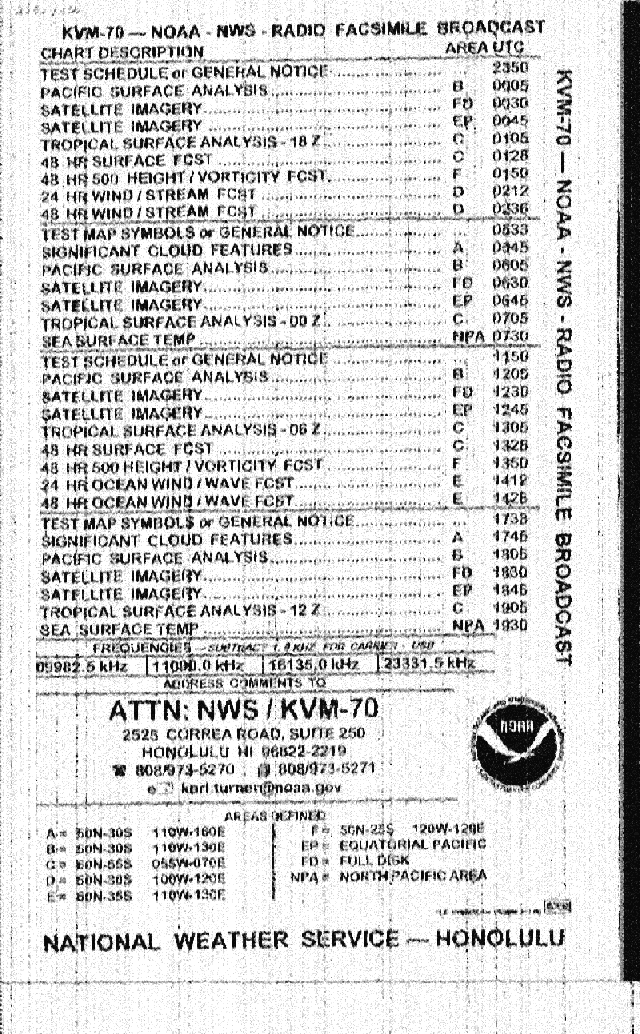
- Since a long time Honolulu Meteo (KVM 70) transmit at 07:30 UTC a Sea surface temperature chart from the North Pacific, but the chart was not listed in the latest schedule.
After sending a notice to NOAA/NWS I recieved on 7 Juli at 17:33 UTC the updated Schedule via KVM on 16135 KHz
- Okean-O was launched at 17/0538.
OKEAN-O
1 25860U 99039A 99198.56407773 -.00000049 00000-0 00000-0 0 14
2 25860 98.0582 255.5057 0001285 101.3538 314.2969 14.69777420 57
Source: Peter Wakelin
- Day Watson, UK found a 120 rpm fax station on 18255.8 KHz LSB at 16:30 UTC (Cairo ?).
- Since May there are again iregulary SSTV transmissions at weekends from MIR
- Comming soon a new version from JVCOMM and WXSAT with a lot of new functions.
- USN Rota (AOK) NEMOC no longer provides HF FAX transmissions. The products are still available via this pages.
- Day Watson UK, found a UNID USCG/NWS station on 7540.5 KHz transmitting NWS charts around 2100-2200 UTC (28/Apr)
- The Picture DX Bulletin #36 (May 1999) from ON4VT now available.
S 0 (1-4)ON 137.85 MHz
Feng Yun 1C launched 10/0133UT. No APT. CHRPT on 1700.5/1704.5 MHz
Okean and Sich transmit infrequently and normally only when within range of Russian/Ukrainian ground stations.
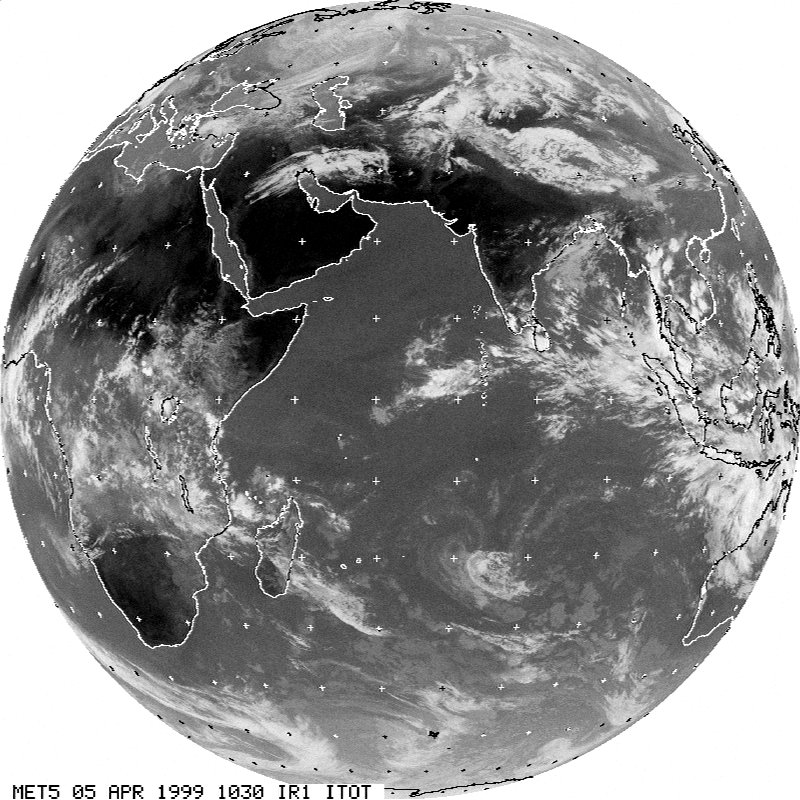
- The Dissemination schedule for Meteosat 7 was changed 01.04.99, and has a replacement of GOMS by ITOT a full Disc IR INDOEX (Indian Ocean) from Meteosat 5.
- USCG Boston (NMF) has changing the broadcast frequencies beginning 01 Aprill 1999, and add a new frequency 4400.4 KHz. (source Tom Stewart via WUN).
0230Z 4400.4/6340.5/12750 KHZ
0800Z 4400.4/6340.5/12750 KHZ
1430Z 6340.5/9110/12750 KHz
1720Z 6340.5/9110/12750 KHz
1900Z 6340.5/9110/12750 KHz
- The Unid Station on 9014 KHz is Moscow Meteo, who transmit in the morning // on 8144 KHz and afternoon on 5008 KHz.
The "first Programm" in the morning on 10980 and afternoon on 5150 KHz. The frequency 7670 KHz not in use at the moment.
Other listed Moscow frequencies 3830, 6987 und 12691 KHz not heard this year. (Source Klaus Betke, Germany).
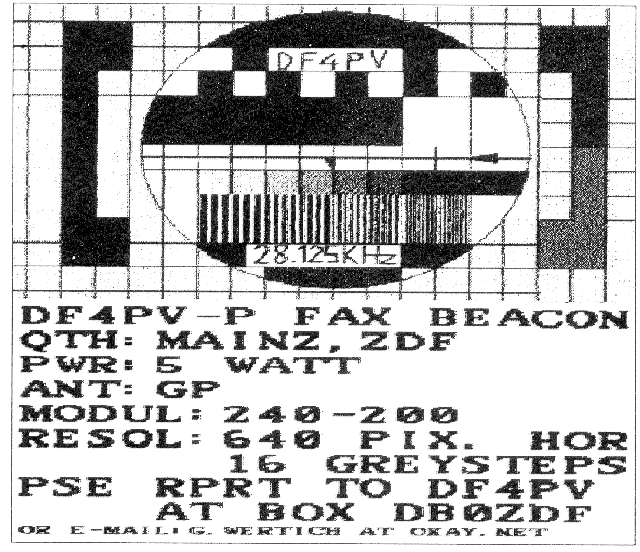
- Peter DF4PV has install a Fax Beacon on 28.125 KHz. The location is Mainz (near Frankfurt), Germany and he use 5 Watt on a Groundplane antenna.
Mode in use is: RPM 240 IOC 200 16 greylevel.
Reports to DF4PV at Box DB0ZDF or Email to: g.wertig@okay.net
- Bim (bimal296@intnet.mu) send the latest St. Denis Meteo schedule to me.
- effective 1 April 1999, the Maritime Forces Pacific HF FAX/RTTY Meteorological and Oceanographic (METOC) HF broadcast
from CF Vancouver/Victoria (CKN) will be suspended
- Here are some frequencies for the new experimental Hellschreiber and PSK 31 modes:
Hellschreiber: (all LSB) +/- 3560 - 3580 - 7037 - 10140 - 14063.5 - 21063.5 KHz
PSK 31: (all USB) +/- 3579.15 - 7034.15 - 10139.15 - 14069.15 - 21079.15 - 28079.15 KHz
- METEOR 3-5 transmitted now on 137.30 MHz, now ending the frequency shared with RESURS-01#4 which transmit continue on 137.85MHz).
- Hellschreiber, wich becomes worldwide a renewed interest is a very old mode wich was first introduced 1921 by Rudolf Hell.
The Hellschreiber is an early faximile communication, where only upper case letters were transmitted and received.
Hellschreiber is an asynchronous transfer mode where the signal is discretely coded. This means two things:
The transmitter does not tell the receiver how fast it transmits. It simply sends the message in it's own speed and the receiver must do it's best.
Hellschript is transmitted with either on or off signal. It was hence easy to implement on available radio equipement. One simply connected the transmitter to where the morse key
would be. Such signals are very sturdy to radio noise. All unwanted frequencies may be filtered away.
The hellschreiber was invented by Dr. Rudolf Hell in 1929. It was used by the Germans during WW2 and some receivers was built by the British and Americans to intercept enemy
communications.
 Nino Porcino, IZ8BLY in QSQ with Vilnes, YL2KF on 14063.5 KHz (LSB) Mode Feld Hell
Nino Porcino, IZ8BLY has make a excellent Windows 95/NT based Hell program wich used the Sound Card from your PC.
You can download the program from Nino´s Home Page
For more info on Hellschreiber you should first check Murray´s ZL1BPU Pages wich is the best source on the net.
You can find Hellschreiber transmissions during weekends at 14063.5 KHz LSB (13:00 UTC mode Feldhell), also on 7037 KHz and 3580 KHz LSB (Tuesdays 20:00 UTC) for Europe.
Check also 3560 KHz LSB at 08:00-09:30 UTC for the "Hellraisers" Net or the DX Hell frequencies at 10140, 14063.5 or 21063.5 KHz LSB between 05:00 and 10:00 UTC.
- Radek Vaclavik OK2XDX has developed a very simple downconverter for Meteosat. He has published it on the QSL Net from here you can download also some Meteosat WAV files.
- There is a limited Beat version of Radioraft3 available now. Full version is expected in April.
- USN Rota (AOK) operating on reduced power now, and was observed also on a new frequency 5519.2 KHz. Source ALRS via Day Watson, UK and Bill Borland G3EFS.
- Uploaded new schedules from Taipei Meteo (BMF) and Seoul Meteo (HLL)
- Resurs 0 (1-4) changed APT frequency to 137.85 MHz and now regulary operative (see also the "Weekly Picture").
- New version of JVComm32 ready for download.The current version is 0.97
Some new features: SSTV Robot 36 mode for MIR reception, FAX TX in B&W, Scheduler (RX and TX) for FAX and SSTV, pre-select for different Sound Cards, Different Configurations and a lot of other usefull new features.
When more time I will make all FAX schedules for JVComm32 and will upload them on the "Schedule" page.
- Beijing Meteo (BAF9): Previous loggings of this frequency 16025.1 (assigned) 16023.2 USB Monitored 12/Jan 0905-20z on 16024.2 khz (assigned) 4/Jan 0823-43z" 16024.0 khz "
and on both occasions on the LSB (of 16026.1/16025.9 resp.) Source: Day Watson UK
- Uploaded the new revised Northwood (GFY) schedule, effective Jun 01 1998.
- At the present time, MIR is expected to share its 145.985 MHz FM downlink with both the SSTV experiment as well as the MIR packet radio BBS.
The BBS is expected to run on weekdays, while SSTV runs on weekends and holidays.
- (Source: Miles Mann WF1F) The MIR SSTV system was startet Saturday December 12. The SSTV system is installed in the PRIRODA module.
There are problems with the antenna cable/filter and blocking all 70 cm (437.957) transmissions, so the SSTV transmissions are limited only on 2 meters (145.985).
The current schedule for Packet and SSTV will be keeping on 2 meters for the next few weeks. Only one project will be active at a time, either the Packet or the SSTV.
The crew will, as time permits, turn on one system then after a period of time, switch over to the other system. These changes are only made during the crews "free time".
It is not possible to develop an exact schedule announcing the times for each project. The people wanting to use Packet and SSTV will just need to be a little understanding and patient.
The Mir crew and the team at Energia have put a great amount of effort into supporting our educational Amateur Radio projects. And I know the world
appreciates all of the hard work they have invested. The switching between the two projects is excepted to continue until after the holidays. Then the
hardware situation and work load will be evaluated to see if we can get access to a different antenna.
Mir Video: The crew has been having a lot of fun with the new educational SSTV system. They have been experimenting with all different types of cameras and Camcorders.
You may even see the crew playingvideo tapes into the SSTV system.
The SSTV video is compatible with most of the equipment on Mir, and the crew has even made a long extension cable to allow the camera to be in the Mir module,
while the SSTV is located in the Priroda module.
Mir Module: The Russian space station is made up of 6 modules, Mir, Kavant-1, Kavant-2, Kristall, Spektr and Priroda.
The SSTV and Packet/PMS stations are in the Priroda module. There is also an Amateur Radio antenna located in the Mir module.
This antenna has not been tested since it was replaced with a new antenna last summer. The old antenna cracked from exposure to >space and was removed in
December 1997.
The Mir antenna is a dual band antenna, supporting 2 meters and 70 cm. It is possible that if space can be made available in the Mir module, then the PMS and
SSTV projects could be moved into the Mir module. This options is being investigated.
The SSTV system was designed to be easy for beginners on earth to use. A station with a zero gain antenna and a simple
HT or Mobile radio, should be able to easily decode at least one image per 10 minute pass. The signals have been so good
that many people with zero gain antennas have been decoding 2-3 good images per 10 minute pass.
SSTV Receiving Software: There are several SSTV software (with mode Robot 36) and hardware decoders on the market. Some you can buy while other are shareware.
If you are just starting, you may want to try a software version first such as W95SSTV. For B&W pictures you can use JVFAX also (select 36 sec.). See the Software Section.
- Frans Maris (BEL) found a CIS UNID fax station on 10083.9 kHz (1425 UTC)
- Uploaded the new revised Bracknell (GFA) schedule, effective Dec 15 1998. Thanks to Martin Stubbs who send me the new schedule.
- The MIR MAREX SSTV system is still in a testing phase. The primary operating Mode is Robot 36. It is planned that each picture transmitted from MIR will have a ROMIR ID imbedded in the picture.
A CW ID with the call ROMIR will be sent between the pictures.
The frequency in use is 437.975 FM Simplex (5 watts).
At 12 Dec 98 there was a first SSTV (test?) Transmission on 145.985 see also a Picture received today 13 Dec. 98 on 145.985
So monitor from now both frequencies for SSTV transmissions from the MIR. To decode you need SSTV software with the Robot 36 mode, such as Pasakon or WinPixPro from Silicon Pixels (see software section).
- For info on Hellschreiber, wich becomes worldwide a renewed interest , you should check the ZL1BPU Pages
- The HF-FAX Pages has been selected to receive a Links2Go Key Resource award in the Slow-Scan Television topic!
- The Blue Ridge Video and Digital Society, added another page now. This is the new Weather Page The SkyWarn Weather Source
- The Timestep pages now with all infos about their exellent Satellite equipment updated
- Alberto Casappa, Italy wrote an excellent Synop decoding program, wich can decode AAXX-BBXX-JJXX-TTAA-TTBB-TTCC-TTDD-PPBB-PPDD.
This Synop decoding program is available in Italian and English version. For downloading a Demo visit Alberto´s Homepage
- Ramon Baylina from Metosort (E) is the guy who makes us radio fax charts from Hamburg Meteo online available.
Now he has also some up-to-date charts from Bracknell Meteo on his site , these are analysis 0600, and 500hPa +24
- Moscow Meteo now four new frequencies in use. These are 3830, 5008, 6987 and 12961 kHz. Source. Klaus Betke, Germany
- Tokyo Meteo (JMH)effective 10 September 98
 Nov-15-1998
- Updated HF-FAX Stations List in table form, with links to the schedules now available.
- Updated the HF-FAX listings Nov-15-1998
- Klaus Betke, Germany found a page from DMI, Denmark where you can download up-to-date Ice charts and the schedule from Copenhagen Meteo (OXT)
- Received last week from Honolulu Meteo a chart called NWS - WSFO - KVM70 at 0730 UTC. At this time no chart is listed in the latest schedule.
- Les Hamilton, UK has launched a new Satellite tracking program called Footprint.
Footprint is program which displays the positions of an orbiting satellite and its footprint on a map of the Earth, updating its position and footprint every minute.
The program can also provide reference tables of relevant ephemeris, A.O.S. and keplerian element data.
The program reads satellites' orbital elements from keplerian element files in standard NASA 2-line format, specifically filtering out only those satellites belonging to the following classes :
NOAA, USA; Meteor Okean and Resurs, Russia; Sich, Ukraine.
Download your copy of Footprint from Les Hamilton´s Home Page.
- Dakar Meteo (6VU) is still on the air on 13671.5 kHz (LSB).
Due to interference from strong Broadcast Stations it is hard to receive clear maps. 19752 kHz is not in use. Source: Day Watson, UK
- Uploaded the new Pretoria Meteo (ZRO) schedule effective 28 Aug 1998. With thanks to Ian T Hunter, South African Weather Bureau who send it to me.
- The Hydrographic Office (UK) received a letter from a Russians organisation that their Moscow Meteo fax was shutting down. But I can still
receive transmissions on 7670 and 10980 kHz (source Day Watson UK)
- It seems that Dakar Meteo has delete his radiofax activities
- Day Watson UK, found a UNID radiofax station on 19745 kHz with RPM 60 transmissions
- Beijing Meteo (BAF) with excellent signal here in Europe on 14547.4 kHz (LSB)
- Uploaded the new schedule from CF Halifax (CFH) effective September 1998
- Launched with the same Zenit rocket as used for the Resurs-01(from Baikanur), the Thai/GB amateur satellite
TMSat-OSCAR-31 was started in the orbit.
This low orbit satellite has a "earth imaging system" with 5 cameras (3 narrow angle, 1 wide angle and 1 video) on board.
The narrow angle cameras have a high resolution 1020 x 1020 pixel (one pixel 100 meter !)
At 12-08-98 the imaging test was startet and TMSat has send a picture of the Red Sea, captured with the wide angle camera.
At 14-08-98 it has send a picture from the southern Greece and the Mediterranean Sea, captured from the narrow angle camera.
You can download these excellent pictures here
Another new amateur satellite (also launched with the same Zenit rocket)is the TechSat-1b / Gurwin-OSCAR-32 (Israel) and has also
a camera on board.
You can download the first picture from this satellite here
- Here is the latest OKEAN 1-7 schedule. Source: RPA Planeta
<Date> <rev. number> <start time (hh.mm GMT)> <end time> <sensors>
Marked with (*) are playbacks.
Denoted as $$ are time intervals when an image is recorded
for the following playback. A denotation 'MSUM4+SLR ($$)'
means an image is being recorded simultaneously with a direct
download. A playback always corresponds to the closest preceding
record.
Inrtrumentation denotations:
MSUM* near-infrared low -resolution scanning radiometer (channel no.*)
SLR side-looking radar
RM microwave (8 mm) scanning radiometer
Mode denotations:
DD direct download
R record to the spaceborn tape recorder
PB playback from the tape recorder
A playback always corresponds to the first preceding record.
OKEAN 1-7 schedule
Schedule of OKEAN 1-7 downloads (137.40 MHz)
| Date | Rev. No. | Start | End | Instrumentation/Mode |
|---|
| 17.09.98 |
| 21164 |
07.35 |
07.44 |
SLR+RM
(DD)
|
| 21166 |
10.42 |
10.49 |
MSUM4+SLR+RM
(DD)
|
| 21171 |
18.45 |
18.52 |
MSUM4+SLR+RM
(DD)
|
| 18.09.98 |
| 21177 |
04.38 |
04.45 |
MSUM4+SLR+RM
(DD)
|
| 21182 |
12.47 |
12.54 |
MSUM4+SLR+RM
(DD)
|
| 21185 |
17.28 |
17.35 |
MSUM4+SLR+RM
(R)
|
| 21186 |
19.02 |
19.09 |
-- (PB)
|
| 19.09.98 |
| 21196 |
11.35 |
11.42 |
MSUM4+SLR+RM
(DD)
|
| 21198 |
14.51 |
14.58 |
MSUM4+SLR+RM
(DD)
|
| 21199 |
16.17 |
16.24 |
MSUM4+SLR+RM
(R)
|
| 21201 |
19.28 |
19.35 |
-- (PB)
|
| 20.09.98 |
| 21205 |
02.07 |
02.14 |
MSUM4+SLR+RM
(DD)
|
| 22.09.98 |
| 21236 |
04.44 |
04.51 |
MSUM4+SLR+RM
(DD)
|
| 21239 |
09.36 |
09.43 |
MSUM4+SLR+RM
(DD)
|
| 21241 |
12.53 |
13.00 |
MSUM4+SLR+RM
(DD)
|
| 21246 |
20.54 |
21.01 |
MSUM4+SLR+RM
(DD)
|
| 23.09.98 |
| 21253 |
08.23 |
08.30 |
MSUM4+SLR+RM
(DD)
|
| 21260 |
19.41 |
19.48 |
MSUM4+SLR+RM
(DD)
|
| 24.09.98 |
| 21266 |
05.43 |
05.52 |
MSUM4+SLR+RM
(DD)
|
| 21267 |
08.23 |
08.30 |
MSUM4+SLR+RM
|
| 21269 |
10.29 |
10.36 |
MSUM4+SLR+RM
(DD)
|
| 21274 |
18.30 |
18.37 |
MSUM4+SLR+RM
(DD)
|
| 25.09.98 |
| 21281 |
06.09 |
06.18 |
MSUM4+SLR+RM
(DD)
|
| 21287 |
15.37 |
15.44 |
MSUM4+SLR+RM
(R)
|
| 21290 |
20.26 |
20.33 |
-- (PB)
|
| 26.09.98 |
| 21294 |
03.04 |
03.11 |
MSUM4+SLR+RM
(DD)
|
| 21296 |
06.38 |
06.45 |
MSUM4+SLR+RM
(DD)
|
| 21299 |
11.21 |
11.28 |
MSUM4+SLR+RM
(DD)
|
| 21302 |
16.02 |
16.09 |
MSUM4+SLR+RM
(R)
|
| 21304 |
19.13 |
19.20 |
-- (PB)
|
| 27.09.98 |
| 21308 |
01.52 |
01.59 |
MSUM4+SLR+RM
(DD)
|
- Uploaded the new schedules from USCG Boston and San Francisco effective 08 Sep. 1998
- Good news from Australia, Phil Parker send me this msg:
I would like to update the information you have on your site regarding the Australian Bureau of Meteorology's
radiofax services AXM and AXI. The Australian Navy will now be able to continue the transmission of these services until early 2002.
We have been advised that AXM/AXI will definitley operate until January 2002. We are also looking into how we can extend the services
beyond that date.
Regards,
Phil Parker
National Manager, Marine & Oceanography Services
- Lucas Eduardo Moxey phoned with the Argentinian Navy, (Puerto Belgrana LOR) and they told them that they transmit
daily at 1200 and 2200 UTC meteorological faxes from Buenos Aires on the 12 MHz frequency, although some days they don´t transmit at these times.
- For Mariners, the new "Marine Product Dissemination Information" webpage is now up on the net.
Tim Rulon NOAA did a great job, the site has a lot of good informations for mariners.
- Resurs 0 is in a 2-month checkout, and I received only two APT pictures some days ago.
- Uploaded the new Bracknell (GFA) schedule effective Jun 1998. Thanks to Martin Stubbs U.K. who send me the schedule.
- Rio de Janeiro Naval (PWZ) change their frequencies to 12666.9 and 16979.7 kHz. Source Day Watson U.K. See also Weekly Picture
- Pretoria Meteo (ZRO) transmit between October and March Antarctic Ice limits at 0800 UTC. The service period for the frequency 4014 kHz (ZRO5) changed to 1400-0500 UTC. Source Day Watson U.K.
- Some ship reported that Rome Meteo (IMB)has changed the frequency 13597.4 kHz to 13587.4 kHz so there is no interference from Tokyo Meteo, but I can not confirm this as IMB56 is still operating on 13597.4 kHz. Source ALRS Vol 3 via Day Watson U.K.
- RESURS was launched July 10th 0630UT from Baikonur.
I have received telemetric signals first time at 2100 UTC on 137.225 MHz next day.
No APT signals heard yet.
Download a WAV file (106K) to hear the RESURS signal.
Here are the keps for RESURS:
RESURS O
1 25394U 98043A   98191.38929917 -.00000045  00000-0  00000+0 0    16
2 25394  98.8094 261.4208 0001755  82.7411 277.3961 14.22400146    17
- since 1 June 1998 Auckland Meteo (ZKLF) has a new Schedule for Weather Radiofax.
Bob McDavitt from NZ Metservice send me following note:
... basically we have dropped all the Aviation products because the airlines who were using
them now get this info by telephone fax (and Difax).Also, in line with GMDSS recommendations that Morse transmissions for
weather should cease, and all shipping should get their weather by satellite from 1 Feb 1999, we intend to decommission our Morse (CW)
transmissons as from the end of Jan 1999.....we were going to stop the morse at the beginning of July 1998 but hav egiven it a reprive until 1
Feb 1999.
- Meteor 2-21 seems to have lost last week its 2.4kHz subcarrier.
No readable signals last days, perhaps we lost one of the older Russian APT Satellites.
- The new Admiralty Lists of Radio Signals (ALRS) Volume 3 - Radio Weather Services & Navigational Warnings is coming out now.
the 1998/99 edition of the Radio Weather Services publication, that is ALRS Volume 3 (parts 1 & 2), is due to be published on the 18 June 1998.
This new edition is being published in colour for the first time and now also contains details of the APT (Automatic Picture transmission) and WEFAX (Weather Facsimile)
services along with all the standard marine weather service details (ie: Broadcasts details, Facsimile broadcasts, TeleFAX services etc).
Source: Alec Reynolds, UK Hydrographic Office.
- It seems to be that operate either Sich or Okean but not both together. I have reciveived Sich 1 on Jun 05 at 1035 UTC it was a central/eastern Europe pass with excellent land/sea contrast.
To download the picture (B&W and Color) go to Weekly Picture, you will find there also a picture I have received from Met 2-21 this bird is also operative since last week (Met 3-5 is off).
- Klingenfuss Publications coming out now with the 1998/1999 Guide to Worldwide Weather Services.
- Meteosat 7 since 3 Jun operational and has replace Meteosat 6
- There is a minor change at the Northwood RN London(GYA) schedule, at 0400 and 1545 UTC now a extra Surface Analysis product is now being produced. Source ALRS and Day Watson UK
- FAX & SSTV Modem for JVComm32, MScan and other Programms from Bernhard Thiem (Germany)
This "all mode" Modem (Rec/TX 8 bit 256) from Bernhard Thiem, Germany works with Mscan 2.2x (DOS) SSTV & FAX, Mscan v3.0x (Win 95) SSTV, Mscan 1.3 (DOS) FAX
JVComm32 (Win 95, Win NT) for SSTV, FAX, Wefax (Satellite) JvFax 7.0/7.1 (DOS) SSTV, FAX, Wefax (satellite)
Also all programs, which work with a "Comparator"- modem e.g. HamComm, GSHPC, EZSSTV - and several Programs, which transfer their data serial.
- NOAA-K (NOAA 15) successfully launched 13-05-1998, but spacecraft's APT signal on 137.50 MHz is degraded. It is possible that the antenna deployment is not nominal.
Download a typical picture received from the afternoon pas who runs close to the terminator (VIS on channel 1&2).The signal is very weak and has a lot of fading.
- Uploaded the new winter schedule from Casey Meteo
- The new Meteosat Dissemination Schedule Link now at www.eumetsat.de/en/area3/topic4.htm
The schedule name has been changed and maybe changed again in the future. (Source Benedict Lam Hang, Eumetsat)
- On May 05 1998 I have received the first APT Image from Meteosat 7, it was disseminated via Meteosat 6 channel 1 at 0823 UTC.
I have decoded this Image with JVComm32 and EasyDSP. For download go to Weekly Picture.
- No update on GOMS images via Meteosat until 12/08/98 (Source Admin MSG Eumetsat via Meteosat)
- Central Europe is cloud-free and we have summery weather now. I have uploaded two NOAA 14 Images received 09 & 10 May.
The APT Satellite pictures are decoded with WXSat and with a good resolution (>400K), so you can print them also as a color picture on Glossy paper/film. For download go to Weekly Picture.
- JVComm Beta 0.9 from Eberhard Backeshoff, DK8JV now available, this new 0.9 beta release supports also transmission/reception via sound cards.
At least a 16 bit sound card is required, and the the computer should be a Pentium 90 or better. You can download JVComm32 as a unregistered demo version from Eberhard Backeshoff´s Home Pages
- Tashkent Meteo also on 18680 kHz (Source Day Watson, UK)
- Wefax transmissions from CF Halifax (CFH) also heard on 10550.8-10552.0 kHz and 10565.5-10566.0 kHz (Source Ignacia Cembreros, Spain).
- USN Cutler (NAA) received on +- 8082 kHz with facsimile maps, the transmissions are not continuous and sometimes encrypted. (Source Bob Margolis, USA).
- Some info of the brand new Kenwood Visual Communicater VC-H1 (SSTV hand-held) can be found here
- Specification Proposal for Slow Scan Television on MIR (Mirex-3 Project) can be found at the Mirex ISS Pages.
- The EasyDSP from Ulrich Bangert DF6JB is now available. The universal DSP controller works with the Motorola DSP56002, and a lot of software is available.
EasyDSP software example: JVComm32 (see before), 5 CW filter 100Hz-500Hz, automatic CW filter from SP9VRC, automatic Notchfilter and Noisefilter from OH2LNS, 300,1200 and 9600 bit/s AFSK TNC
from OH2LNS/DF6JB, Emulation Simple/Hamcomm modem, Emulation Zornslemma converter, Emulation Faxellite (Digisat) convertor, Emulation Multiscan (PA3GPY) convertor, Emulation Code3 LF3 convertor,
AMSAT Phase-3D telemetry simulator, Phase-3D telemetry de-modulator 1200 bit/s RS-232
-
- Uploaded some background information about the EasyDSP from DF6JB, please click here.
- I have uploaded a Sound Blaster TSR programm (written by 4Z5BS) that allows you to receive and transmit FM-FAX, SSTV and AM-FAX using
only your Sound Blaster card. All you need is a Sound Blaster Pro card and JVFAX. For download see Software overview.
- Eberhard Backeshoff DK8JV has now his own JVComm32 WWW Page
- Just testing a Beta version JVComm32 from Eberhard Backeshoff, DK8JV. The author who was written also the populair JVFAX software, wrote
JVComm32 for use with DSP controller such as the new EasyDSP from DF6JB. JVComm32 will running only with Windows 95 or Windows NT, not with Windows 3.1
or Windows 3.11 for Workgroups.
JVComm32 decodes all Fax modes, FM for shortwave, AM for Geo- and Polar Satellites, also H 288/120 and Ham 288B.
Also all "Free Run" SSTV modes Martin M1 and M2, Scotti S1 and S2, Scotti DX, Wraase 180s, Pasakon P3, P5 and P7.
JVComm from DK8JV together with EasyDSP from DF6JB is a new revolution for image communications.
- The EasyDSP from Ulrich Bangert DF6JB is now available. The universal DSP controller works with the Motorola DSP56002, and a lot of software is available.
EasyDSP software example: JVComm32 (see before), 5 CW filter 100Hz-500Hz, automatic CW filter from SP9VRC, automatic Notchfilter and Noisefilter from OH2LNS, 300,1200 and 9600 bit/s AFSK TNC
from OH2LNS/DF6JB, Emulation Simple/Hamcomm modem, Emulation Zornslemma converter, Emulation Faxellite (Digisat) convertor, Emulation Multiscan (PA3GPY) convertor, Emulation Code3 LF3 convertor,
AMSAT Phase-3D telemetry simulator, Phase-3D telemetry de-modulator 1200 bit/s RS-232
- Uploaded the latest Dehli facsimile schedule
- Auckland Meteo (ZKLF) wil cease transmission of aviation weather charts 000 UTC 1 May 1998, all WT broadcasts will cease at 2359 UTC 30 June 1998. Source ALRS via Day Watson UK.
- The UNID station on 10242.3 kHz heard with a very weak signal at 1905, 1918 and 1940 UTC (120/576)
- USAF transmissions from Puerto Rico not on the air last weeks
- USN Rota (AOK) only heard last days with a very weak signal on 10542.2 kHz (tx site Sicily)
- Day Watson (UK) found a new frequency from Seoul Meteo: 13570 kHz
- USN Pearl Harbor and USN Stockton discontinued also 24 hour radiofacsimile operation, and will be placed in
a back-up mode for on-demand service to be activated by fleet units upon request.
- USN Adak radiofacsimile operations terminated previously as a result of Adak base closure.
- Day Watson (UK) found a UNID facsimile station on 6772.5 kHz transmitting a chart around 1000 UTC with RPM 120.
- Costas Kralis (Greece) reported that the facsimile service from Athens is coming from Athens Air (Civil Aviation) using the Nea SMyrni transmitter center in Athen.
The callsigns are: SWA27 on 8105 kHz and SWA18 on 4481 kHz.
- A new satellite wefax image decoding software called SATFAX is now available to the public. For more info click here
- Uploaded the new HF-FAX listings Jan. 1998
- Navy HF GFAX from Guam (NPN), Diego Garcia (NKW) and Yokosuka (NDT) will cease 24 hour continuous broadcast operations beginning 01 January 1998.
This system will be placed in a back-up mode for on-demand service to be activated by fleet units upon request.
Received following facsimile MSG from Guam and Diego Garcia on HF:
IAW CINCPACFLT MSG 1601117ZDEC97, CONTINUOUS GFAX BROADCAST SERVICES WILL BE DEACTIVATED EFFECTIVE 1JAN98 0000Z.
REQUESTS FOR ON DEMAND HF SUPPORT CAN BE SUBMITTED IAW CINCPACFLT GUIDANCE AND WILL BE SCREENED ACCORDINGLY.
See also Weekly Picture
- Mohammad Sultan (Mauritius) found a new frequency for Beijing Meteo (BAF), 8302.2 kHz, I have received BAF also on 14547.22 kHz LSB
- Mohammad Sultan (Mauritius) found a UNID station on 10522.7 kHz
- Uploaded the latest version (2.0) of the Meteosat Scheduler from Alberto Casappa Italy
- With Sputnik launch 40 years ago, space race was in orbit. Listen to Sputnik Jr as I heard some days ago here at my location in Germany.
- Uploaded two usefull Applications written by Alberto Casappa Italy, for use with WXSat.
- Uploaded the new VLM Casey summer schedule, effective 16 December.
- Uploaded a new Version of WXSat 2.4
What's New in WXSat Version 2.4?
1. Better algorithm for FM demodulation
2. Support of 1-bit bitmaps
3. More reliable operation
4. Buffer size is now capable of handling 60 RPM signals
5. Audio input with a resolution of 16 bits helps in some cases of AGC problems
6. Wave files can be stored during automatic operation
Note: An already existing parameter file WXSAT.DAT of a former version of WXSat is compatible to the new format.
Only the meaning of the "Graphics" parameter has slightly changed.
- Hamburg Meteo has a minor change (12 Dec.97) in the schedule. The 0512 UTC slot has now a H+30 surface pressure map. You can download the schedule from the DWD server in Germany.
Click here for a German schedule, or here for a English schedule
- The following information is quoted for public dissemination:
04 December 1997
From: Naval Atlantic Meteorology and Oceanography Center, Norfolk, Virginia
Subj: Navy HF Facsimile Broadcast
The Navy HF Facsimile Broadcast was designed to support U.S. Naval operations in the Atlantic Theatre. In recent years, fleet units
have migrated to other communication systems. Therefor, the Commander in Chief of the U.S. Atlantic Fleet (CINCLANTFLT) has
determined that the Navy HF Fleet Broadcast (NFAX) will cease 24 hour continuous broadcast operations beginning 01 January 1998.
This system will be placed in a back-up mode for on-demand service to be activated by fleet units upon request.
Patrick A. Dixon 757-445-1872
Senior Meteorologist, Operations Department
Naval Atlantic Meteorology and Oceanography Center
dixon@nlmoc.navy.mil
www.nlmoc.navy.mil
- Mohammad Sultan (Mauritius) found a new frequency for Beijing Meteo (BAF) 10765.3 KHz
- Xaxero New Zealand has a new URL (http://www.xaxero.com). You will find here the newest Win 95 fax version 4.6 beta for download.
- Mohammad Sultan (Mauritius) found another frequency from the Argentian Navy at Puerto Belgrana (LOR) on 12674 kHz // with 5707 kHz.
LOR has JVFAX 7.0 in use for the facsimile transmissions.
- Les Crossan (UK) found a UNID on 12316 kHz (LSB) and RPM 60
- HF conditions last days good, logged here at my location in northern Germany DX stations such as Casey Meteo (ATA), Fishery Radio (J), VNA Vietnam (Photofax), USCG San Francisco, USCG Kodiak, USAF Elkhorn and CNA Taipei.
- Just updated the Facsimile stations list
- Uploaded the new USN West Pacific & Indian Ocean schedule, effective Nov. 14. Click here.
- Mohammad Sultan (Mauritius) found 5 facsimile UNID´s. These are: 7582 kHz (0900 UTC), 10242.3 kHz (1500 UTC), 12806 kHz (0730 UTC), 13345 kHz (0400 UTC) and 20302 kHz (1600 UTC).
- David E. Crawford (Florida) received a USCG (NMF) test transmission at at 1600 UTC on 9171 kHz
- The information I wrote about the USAF transmitter site at Saddlebunch Key was incorrect. David E. Crawford reported that only the KAWN RTTY relay transmissions were traced to the NAS Key West tx site at Saddlebunch key.
The facsimile transmissions comming from a USN tx in Puerto Rico.
- The National Weather Service radiofax webpage has been expanded to include the latest radiofax schedules for Hawaii and Alaska. Regrettably,
radiofax products for these areas are not yet available via internet.
The URL is: here
- I am ready now with my new antenna project.For more details take a look at this document.
- Mike Dunn (Tasmania) has a nice home page with the same topics as mine, you will find Radiofax, Wefax and SSTV infos/pictures received by Mike.
Mike send me a satpic wich you can see at the "Weekly Picture" page.
- Bill Borland (G3EFS) found a new Moscow Meteo facsimile frequency: 11617.9 kHz
- Mohammad Sultan (Mauritius) found a UNID Facsimile station on 10242.3 kHz transmitting at 1400 UTC a chart from the northern hemisphere.
- You can now generate your own global point-topoint HF frequency prediction through the IPS web site,
using the new IPS On-line GRAFEX HF Prediction system.
- Klaus Betke (Germany) found a UNID CIS Station at 4562 kHz with transmissions around 1830 UTC 90/576
- Plans for Coast Guard Comunications Area Master Station Portsmouth VA/NMN to begin broadcasting marine radiofacsimile information, beginning
approximately fall of 1997, has been deferred due to an ongoing procurement lawsuit. A new date for commencing these broadcasts will be announced once court
action is completed.
The planned broadcast of radiofax from U.S.C.G. station NMN, Chesapeake, VA has been postponed indefinitely due to difficulties
experienced refurbishing the antenna system. Source: USCG and Tim Rulon NOAA
- The National Weather Service (NWS) will make several changes to the Radiofacsimile schedules effective 21 October 1997.
Download the new schedules from the section schedules
- ON7BW, Wilfried, is UBA´s FAX manager. Twice a month he activates ON7LR (Clubstation UBA) with FAX transmissions.
The transmissions contain usefull information about FAX/SSTV as well as pictures of the City of Lier, Belgium.
The frequencies and standards used are as recommended by the IARU (Region 1).
Modes F3C 120/288 and JVColor F3C 360/204.
Schedule: Every 2nd Sunday at 0900 UTC on 7040 kHz, and every 4th Sunday at 1700 UTC on 3735 kHz
ON4DB send me some originally pictures from ON7LR (TX ON7BW) you can download the pictures here.
- Costas Krallis SV1XV (Greece) checked the new Athens Radio frequencies, and can confirm
transmissions only at 8105 kHz. Last week I have received also the fax transmissions at exactly 8103.9 kHz, no fax signal at 4481 kHz.
- The CIS UNID at 13900.5 kHz is Kiyev Meteo
- Lutz Boegemann (Germany) found a CIS UNID at 13900.5 kHz (LPM 90)
- Mohammad Sultan (Mauritius) found a UNID facsimile station at 8183 kHz, I have check this and could indentified it as Kiyev Meteo // with 5285 kHz.
- On the 1 June 1997 Athens Radio (SVJ4) on 8530 kHz ceased transmission.
The service has been set up now by the Hellenic Meteorological Service daily at 0845 UTC on 4481 kHz and 8105 kHz.
Source Alec Reynolds, Admiralty List of Radio Signals UK Hydrographic Office.
Last year the 8105 kHz frequency was tested, but now I hear nothing at my location on both new frequencies!.
- I have uploaded 2 WAV files (MET35.WAV and METEO_SAT.WAV) for use with the WXSat program. You will find them at ftp://kestrel.umd.edu/pub/wxsat/incoming
Other files will coming soon. With thanks to Scott Gennari who spent me the space on the ftp server.
- Dr Paolo Ciraci created a searchable radiofacsimile database holding the usual information plus the
geographic coordinates of the station; this gives the possibility to
show the position using the Xerox Park Map Viewer.
- Ad Weather Satellite Tracking and APT Decode programm (WAVSat) from S. Bonnett (UK) using the Soundcard
For Downloading WAVSat V2.0 go to the Software Section
- Mohammad Sultan (Mauritius) send me a Press Photo, received from the Vietnam photofax station VNA on 16226 kHz.
- The UNID facsimile station on 9165 kHz with maps from KMA is Seoul Meteo.
The transmissions on 9165 kHz are // with 7433.5 kHz (HLL5).
- Moscow Meteo also on the old frequency 10980 kHz active.
- Last week Moscow Meteo has stop/changed facsimile transmissions on most frequencies, only 7670 kHz was active.
But last week Klaus Betke (Germany) found some new frequencies with facsimile transmissions from Moscow Meteo: 3863 kHz, 5121 kHz and 7695 kHz.
- Clarence Thompson received last week around 1900 UTC on 15590 kHz marinefax from USN (Cuttler ?)
- Received at Friday 05 Sep. at 1805 UTC the Kyodo newspaper (English) from Tokyo Radio JJC.
- Icom introduced the IC-PCR100 Communications Receiver.This IC-PCR100 ("Blackbox") radio body is an external PC device with software, antenna and cables.
The Price here in Germany around DEM 800 (US$ 450).
The Wide Band Coverage is 100 kHz - 1.3 GHz. For WEFAX Reception on 137 MHz it has a WFM/FM/AM 50 kHz/-6 db Filter, so you can use this "Blackbox" also for WEFAX reception.
- Weather charts from Hamburg Meteo now available on the net.
These up-to-date charts are received by Observatori Meteorològic de Sort (Catalunya, Spain), and then uploaded to Internet.
- Add updated schedules from USN Guam/Diego Garcia/Yokosuka/Cutler, Maine & Tashkent Meteo
- Add WFAX a programm for receiving weather charts from shortwave stations. It supports several decoders and OS/2-known soundcards. For downloading WFAX see section "Software"
- Mohammad Sultan from Mauritius found a new Photofax station from Vietnam.
Look at the Weekly Picture section for more info and download a copy received by Mohammad Sultan.
- Since last month USN Diego Garcia (NKW) not continuous on the air with the regular schedule. They had problems with it from time to time, but it is working properly now (Source USN Diego Garcia).
- Now you can view or download the May issue (#22) of Weather Satellite Report (WSR) online. WSR #22 will be available on the web for evaluation of the electronic transmission format until July.
- Add INTERCOM to the "Software" section. The program decodes CW (8-99 W/M), RTTY (45,50,75 and 100 Baud), ASCII 110 Baud, and TOR/FEC mode B. Intercom requires a simple decoder circuit.
- Add WXGraph to the "Software" section. The program decodes SHIP/SYNOP data in a graphical map (Europe). WXGraph requires a simple decoder circuit.
- China launched its first geostationary meteorological satellite, FY-2, on June 10, 1997. The spacecraft was positioned at 105E on June 17. The radiometer started working on June 21 with its visible channel and sent back its first visible image of the full disk. The first FY-2 image can be downloaded here.
- Chesapeake, VA is considering broadcasting marine radiofacsimile information. The purpose of these broadcasts is to improve coverage near Boston, and the area southeast of Florida. Starting date and schedule to be determined. Source: Tim Rulon, NOAA/NWS
- Mohammad Sultan from Mauritius found a new Faxstation, Argentinian Navy at Puerto Belgrano (LOR)
The station transmitt on 5705 kHz (USB)
Look at the Weekly Picture section for more info and download a map received between 0230 and 0300 UTC by Mohammad Sultan.
- Due to state of health, Arnold Gibbons will be closing at the end of July Nikao Radio (ZKRT) Raratonga, Cook Island .
Arnold Gibbons who is running Nikao Radio with daily radiofax at 0630 and 1930 UTC on 12215.7 KHz and the new Seamail service, is just returned to Raratonga to close up operations and undertake the removal operations.
After nearly 30 years of telecommunications service for the maritime community in the Cook Islands and a royal award of the BEM, thank you Arnold for the great work. Source Arnold Gibbons via Alec Reynolds NPRS U.K.
- Here is a response from CNMOC concerning the status of the Navy HF fax broadcast: The Fleet Broadcast and HF fax will remain until another system is fielded capable of replacing them. No idea when (or what) that will be because the "system" seems to change weekly do to funding constraints, technology developments, and wind shifts. Not a very definitive answer, but the best I can do for now. Source: CDR John O´Hara via Laura Cook and Timothy Rulon NOAA.
- Download a demo version of the TBL SSTV magazine from the TBL Club Homepage
- Just created the new HF-FAX Guest Book with LPage.com. All entries from the old PGB Guestbook are also available
- Mikko Saarvola created a IRC channel for DX- listeners and everybody who are interested about radio. Search for #Radio on IRCNet.
- Updated the Solar Weather section.
- I am sorry to tell you that Piet Productions have to close his guest book service, wich was the server for the HF-FAX Guest Book.
All accounts will be open for another 7 days from today (May 20, 1997).
- Klaus Betke, Germany found a new frequency, 8015 kHz in use by RN London (GYA)
- Updated the software section with Mac Multimode, a programm that alows the Mac user to decode Fax, CW and RTTY without any hardware.
- Madrid Meteo last heard 3 weeks ago, perhaps the station is QRT now ?
- Add some new links to HamComm/modem dealers in the software section
- Auckland Meteo (ZKLF) transmitt the Fax sked[zklf97.txt - MISSING] now in doubled size and is now sent in two parts. (Thanks to Bob McDavitt, MetService for the info).
- Delhi Meteo active on 4995.5 kHz (listed 4993.5 kHz). Source Klaus Betke Germany. Other active frequencies are 7405 kHz (listed 7403 kHz), 14841 kHz (listed 14842 kHz) and 18225 kHz.
- Since mid Mar. 97 Mensk Meteo BLR (3810 kHz) QRT. Source Klaus Betke Germany.
- The UNID fax station on 16907.5 kHz is indentified as JFA Chuo Fisheries from Japan, they send weather maps and text. Source: Eddy Waters Australia.
- Add the latest Western Pacific and Indian Ocean schedules from USN Guam/Yokosuka/Diego Garcia.
- SeaMail Newsletter No 3 now avaiable
- The facsimile test transmissions for the USN from AT&T WOO and WOM are terminated.
- Advanced Electronic Applications (AEA) has closed deals to sell its product lines to two other companies, but the AEA name will live on.
AEA's line of antennas, antenna analyzers and cable-testing equipment was sold, effective March 7, to Tempo Research of Vista, California (619-598-9677).
Timewave Technology of St. Paul, Minnestoa (612-452-5939) already a major name in ham radio gear -- is buying the rights to all other AEA products,including its digital line.
- The Royal Australian Navy, that provides the transmitter service (10 x 10KW) for Melbourne/Darwin Meteo (AXM/AXI), will cease using HF at the end of 1999.
The subject is under discussion now at top level and, when a decision is made, it will be broadcast as a facsimile notice to all readers from AXM/AXI.
Source: Angus Low, Bureau of Meteorology Australia.
- Eddy Waters, Australia found a UNID Fax station on 16907.5 kHz transmitting a weather map at 1040 UTC.
- WXSat now also in a English version (2.3) available. Thanks to the author Christian Bock who send me the programm
- I have phoned some weeks ago with Holger Jens from the DWD, and asked him to place also a english written facsimile schedule from Hamburg Meteo. Now you can download the english schedule from the DWD server. Thanks to Holger Jens for doing this.
- SeaMail has moved into phase 2 of it's mode of operation.
- All BT Challenge Yachts are fitted with Weather Fax for Windows from Xaxero. For more info click here.
- Software section updated now also with a link for Linux Fax software
- KCNA Pyongyang (Korean Central News Agency) now with a WWW homepage, provided by Korea News service (KNS).
KCNA photo transmission daily on:
11475.7 HMF 52 [60/352] 2330-0100
13580.0 HMY 33 [60/352] 2330-0100
- Grengel Meteo last weeks irregular on the air.
- Complete revised "Outdoor/Weather Cams" with cams from more than 30 countries worldwide now available
- Take a look at the new "FAX/SSTV History" document
- Bob Margolis (USA) found a new frequency, 16014.0 kHz transmitting // maps as from USCG New Orleans (NMG).
- On 13 January 1997 a quarterly meeting was held between the NWS and the USCG. Some of the highlights were:
- USCG looking into a simulcast of the Boston radiofax broadcast with new transmitters in Portsmouth New Hampshire. They have noted a couple of dead spots in coverage area and think this may help. USCG will be looking into this problem in the next few months.
- The US Navy is running a 90 test of fax transmissions through AT&T station WOO, NJ and WOM, FL.
All transmissions // with Cuttler and Keflavik
The frequencies are:
WOO on 5157 kHz (2200-1000 UTC) and 12122 kHz (1000-2200 UTC)
WOM on 2270 kHz (2200-1000 UTC) and 15627 kHz (1000-2200 UTC)
- Uploaded the new Taipei Meteo (BMF) schedule , now with 35 timeslots more as the old schedule. Thanks to Jim Nelson who send me the new schedule.
- Uploaded the latest (effective Apr 1996) USN Pearl Harbor/Stockton schedule. Thanks to Mark Xander USA who send me the schedule.
- Radiofax Charts now available via E-Mail : Tim Rulon from the US National Weather Service Headquarters send me this notice:
NWS radiofax charts broadcast by the United States Coast Guard from Boston, New Orleans and Pt. Reyes, CA are now available via e-mail. It is anticipated that the service will include marine text products in the near future. This FTPMAIL server is intended to allow Internet access for mariners who do not have direct access to the World Wide Web but who are equipped with e-mail system. Using FTPMAIL, users can request files from NWS and have them automatically e-mailed back to them. Turnaround is generally in under three hours, however, performance may vary widely and receipt cannot be guaranteed. To get started in using the FTPMAIL service follow these simple instructions to obtain the FTPMAIL "HELP" file:
Send an e-mail to : ftpmail@tgsv5.nws.noaa.gov
Subjectline: Put anything you want
Body: help
Direct any questions on the FTPMAIL service to:
Timothy.Rulon@noaa.gov 301-713-1677 x 128
Clifford.Fridlind@noaa.gov 301-713-0882 x 122
- The Marine Prediction Center (MPC) has some excellent pages with a lot of infos about the radiofacsimile products, you can download also the maps from this site.
- Northwoodfax (GYA) has added in the 1996/1997 winter schedule the former frequencies 12844.5 and 16912.0 kHz
- Hamburg Meteo has just revised the facsimile schedule (effective 15 Jan 1997), download the new schedule from the DWD server in Germany.
- Jim Nelson the editor of the "Worldwide Marine Radiofacsimile Broadcast Schedules", send me the new schedules from the USCG stations effective 04 Feb 1997.
Visit also the Houston Port Meteorological Office (POM) homepage from Jim, the US publication of the "Worldwide Marine Radiofacsimile Broadcast Schedules" is made in this office.
- John Raynsford AL7JK, Alaska found a UNID faxstation on 4622 kHz transmitting daily at 2000 UTC wx charts with 60 LPM / IOC 576.
- Klaus Betke, Germany logged Moscow Meteo on the old frequency 15950 kHz
- Add the latest USN Rota (AOK) schedule now with direct links to ALL up-to-date maps in GIF format.
- Now add links to sites who are active with facsimile on HF.
- Download a DSMP Satpic from the Bosnia area provided by NEMOC (Naval European Meteorology and Oceanography Center) Rota, Spain.
- Download a DSMP Satpic from the west med sea area provided by NEMOC (Naval European Meteorology and Oceanography Center) Rota, Spain.
- Our dog "Bobby"[Bobby.jpg - MISSING] is now also on the net!
- Richard who is working at the Naval Computer and Telecommunications Station Keflavik Iceland (NRK), wrote me that the callsign from NCTS Cuttler Maine, United States is NAA, and not NAM (callsign from Norfolk VA).
He confirm me also that the transmitter location from USN Keflavik (NRK) is Grindivick (south from Keflavik).
- Danny ON4VT, the "Picture Bulletin" author has now is own homepage
- Due to illness ON6JG was not able to provide the Picture Bulletin from ON4VT, but now the December bulletin #05 is available.
 FAX/SSTV RealAudio files Click here.
- English.wri WXSAT documentation now available. With thanks to the WXSAT author Christian Bock.
- Station ZKRT Rarotonga Cook Islands is now providing Internet EMAIL services to private yachts in the Pacific. ZKRT covers the entire South Pacific Ocean.
- USCG Kodiak (NOJ) now broadcasting marine radiofacsimile on 2054 kHz, supplementing existing broadcasts on 4298 and 8459 kHz.
- Klaus Betke, Germany received Delhi Meteo (ATP 57) on 7405 kHz, 2 kHz higher as listed in the HF-FAX listings (7403 kHz).
I have check also the frequency, here are two maps received on 7405 kHz at 2351 and 0014 UTC (23/24 Nov).
- New updated schedule from USN Rota (AOK) uploaded
- Updated (Nov-96) HF-FAX Listings now available
- WXSAT release (V2.22) from Christian Bock now available.
- Centro Met Vcom Marambio (LSB) also at 2030 UTC. Source: UK Hydrographic Office (Admiralty list of Radio Signals) via Day Watson.
- Centro Meterologico Presidente Eduardo Frei, South Shetlands daily at 0330 and 2130 UTC with a SFC Analysis on 5302.5 kHz, 11662.5 kHz and 15470 kHz. Source: UK Hydrographic Office (Admiralty list of Radio Signals) via Day Watson.
- Rio de Janeiro (PWZ) is still active on 17142 kHz, the station was received at 1800 UTC in Belgium. The latest schedule listed PWZ on 12662 and 17142 kHz, with transmissions at 0745-0830 and 1745-1830 UTC. Source Frank Huyge via Dirk Van de Wal, Belgium.
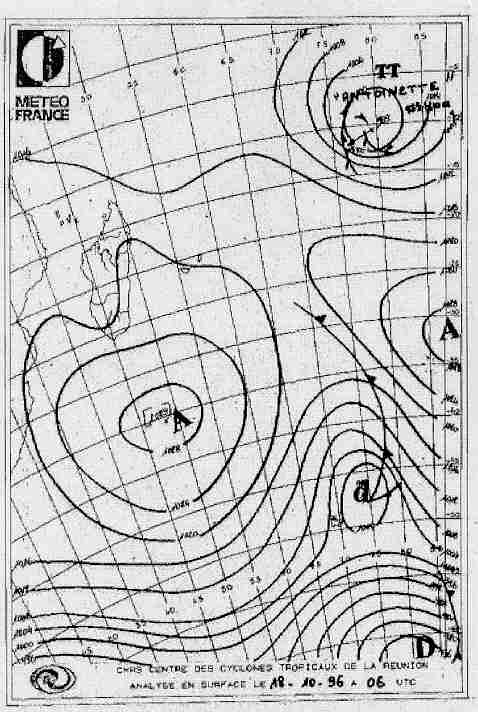
- The 1996/97 cyclonic season for the SW Indian Ocean was started with the tropical depression "Antoinette". Download the special map (42K) provided by "CMRS Centre des Cyclones Tropicaux de la Reunion", transmitted on Oct 18 at 1103 UTC from Saint Denis Meteo on 8176 kHz, and received by Mohammad Sultan, Mauritius.
- Here are the latest infos from Nikaoradio (ZKRT) send to me by Arnold Gibbons who is running this service:
The TX-times are 0630 and 1930 UTC.
Transmission Frequency Fc 12215.7 KHz +/- 400 Hz shift.
Hardware. AEA PK232 MBX TNC Software. AEA PKFAX.
Product. SW Pacific Surface Analysis (2 Hpa) 0000/1200 UTC. Eq - 35S 150E -120W.
Issued by the NWFC Nadi Fiji. Received via AFTN through courtesy Cook Islands Met Service.
Data is in Fleetcode format and computer decoded/printed for facsimile transmission.
In addition, the Fleetcode is retransmitted as an FEC digital (Amtor B mode)broadcast on 10128 KHz (mark freq) at 0530/1730 KHz.
This transmission is due to be transferred to alternative frequencies in the near future.
Tentively, the frequencies will be 12216 KHz(day) 6934 KHz (night).
- Bob McDavitt from MetService New Zealand send me the latest ZKLF schedule.
- Dave Davey (AUS) send me the latest Australian AXM/AXI schedule , or download the schedule in HTML format direct from Dave´s homepages.
- Mohammad Sultan (Mauritius) found a new frequency 11135.5 kHz from USN Pearl Harbour/USN San Francisco. We could identifying a map as provided by NPMOC Pearl Harbour, but don't know which of the two USN stations is using this frequency.
- Roland Liekens (Belgium) found a new frequency 14545 kHz in use by Beijing Meteo (BAF).
- Taipei Meteo also on 18560 kHz.
- The facsimile services from the South Shetland Islands, coming now from Centro Meteorologico Vcm. Marambio (former Centro Meteorologico Presidente Frei).
Frequencies: 2401 kHz 4807 kHz and 9951 kHz. Power 10 KW. Callsign LSB
Schedule: daily at 0025 UTC 0325 UTC 1225 UTC and 1525 UTC (120/576)
Source: UK Hydrographic Office (Admiralty list of Radio Signals) via Day Watson.
- Dirk Van de Wal (BEL) found a UNID station on 14572.3 kHz transmitting a weather map at 0820 UTC (120/576)
- Day Watson (UK) send me two pictures ( picture 1/44K and picture 2/48K ) received from the South American UNID Station (Buenos Aires ?) on 12673.9 kHz.
- Moscow Meteo 1 also on 5101.3 kHz
- Mohammad Sultan from Mauritius found a new station on 18002 kHz transmitting charts at 0715 and 0800 UTC from the far east area, provided by Hanoi Vietnam.
He also wrote me that Delhi Meteo is still on the air.
Download the pictures received by Mohammed Sultan, Mauritius:
A part from the "Hanoi" chart on 18002 kHz (93K)
Delhi Meteo (14841 kHz) with a INSAT IR Satellite rebroadcast (0600 UTC) (50K)
The first part from the Saint Denis Meteo facsimile-schedule (27K).
- PICTURE DX BULLETIN Release #4 September 1996 from ON4VT now available.
- Day Watson (UK) found on the former USN Exmouth (AUS) facsimile frequency 12673.9 kHz, facsimile transmissions from a South American station.
I have check some of the pictures from Day, and monitoring the frequency on my location also, it is a typical transmission as from Buenos Aires Meteo Argentina in the past, with black areas around the picture , but the signals are very weak here in Europe to identify the station definitively.
- Costas Kralis (SV1XV) reported that the test transmissions from Athens Radio on 8105 kHz coming from another site as the transmissions on the regular frequency 8530 kHz from the Coastal station.
They use a transmitter in the city of Athens, wich is at the same location with the Civil Aviation Service transmitters.
If the test is successfully, they are going to continue the 8105 kHz transmission in the future.
- Alec Reynolds the senior editor of the Admiralty List of Radio Signals (ALRS)
Volume 3, the maritime Weather Services volume, send me folowing notice:
ALRS Volume 3, due to the vast amount of new meteorological data that is constantly arriving
within our office, has now been split into two parts.
Part 1 covers Europe, Africa and Asia (excluding the Philippine Islands and Indonesia) and
Part 2 covers the Philippine Islands, Indonesia, Australasia, the Americas, Greenland and
Iceland.
You can see from this split that the volume now matches exactly the two parts of ALRS Volume 1
our Coast Radio Station Public Correspondence publication.
Another development is the inclusion of the station facsimile Map Area diagrams.
The user can now see exactly the area covered by each of the stations products.
This is a lengthly task and is being carried, if possible, for all new and amended station
entries as they come up.
- USN Keflavik was logged on 8968 kHz.
- Robert Margolis received Aug. 9 the rarely heard station, CZW on 14626 kHz (120/576) Time: 1607-1617. UTC
- UNID (Magadan Meteo, RUS ?) on 9354 kHz with a verry weak signal here in Germany, received daily at 1700-1830 + 1900 UTC 120/576, and 1930 UTC 60/576.
- Athens Radio (SVJ) is testing now a new frequency 8105.0 kHz // 8530 kHz.
- IPS Radio & Space Services Australia coming out with ASAPS for Windows from August 1996, a free demonstration copy of ASAPS for Windows will be avaiable in August.
- The German Weather Service DWD is now online, with a lot of informations and products.
- Warsaw Meteo (SOA211) Poland was received by Klaus Betke, Germany on 111.4 kHz (LSB) at:
0933 UTC with a surface prognosis 00Z+24H
1001 UTC with a 700 hPa prognosis 00Z+24H
1102 UTC with a 850 hPa prognosis 00Z+48H
1115 UTC with a surface prognosis 00Z+48H (I have received it at 1029 UTC) click here (7K)
1404 UTC with a surface prognosis 00Z+72H
1431 UTC with a surface prognosis 00Z+36H
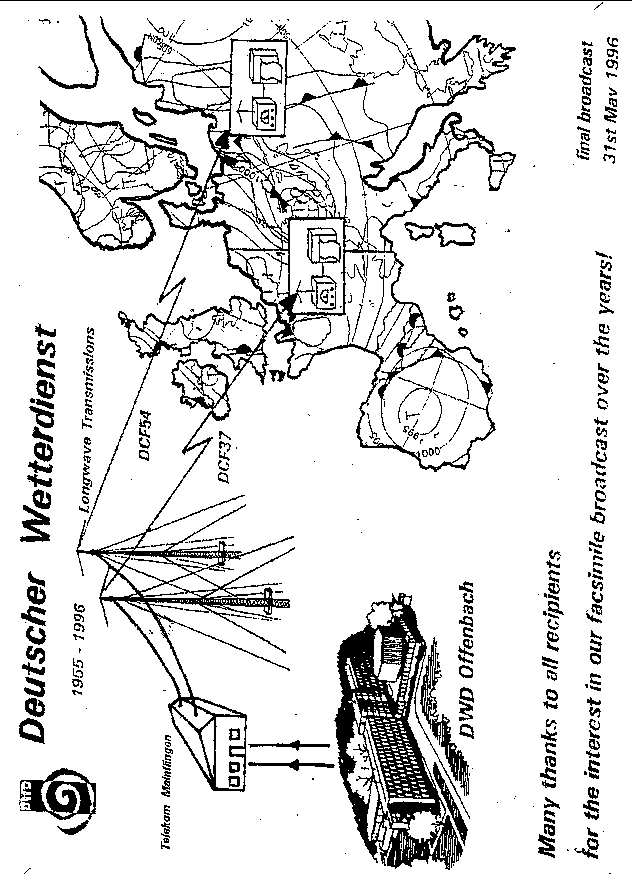
- Offenbach Meteo DCF 37 on 117.4 kHz and DCF 54 on 134.2 kHz discontinued facsimile transmissions on May 31th.
Download the FINAL "GOOD BY" PICTURE broadcast from Offenbach Meteo (DWD) as transmitted by DCF54 and DCF37 on Longwave May 31th 1996. Many thanks to all Operators from Offenbach and Mainflingen for the excellent Weatherfacsimile Service in the last 41 years via Longwave!!
Now it´s time to visit the best alternate, the web site " Georgs Wetter-Zentrale" with up-to-date charts and maps for Germany and Europe, or the German Weather Service DWD
- Here is the first Picture DX Bulletin from Danny ON4VT
- Due to network problems with the (funet.fi) server in Finland, a lot of people wrote me they have problems to download the JVFAX7.1 software package.
I have upload the JVFAX7.1 program now at the AOL-server (link from the software section), and I hope the JVFAX7.1 software-download works better now.
- Christian Bock give me the permission for uploading his WXSat program (see Software), a program to decode WX Satellite signals in the APT format. It use the sound card input, so there is no other external sampling hardware required. It is copyright by Christian H. Bock, Freiburg Germany, and only for amateurs, education and private use. There is only a German version.
- Added the latest AXM/AXI schedule from Australia, the schedule transmissions revised to 0015 and 1215 to allow a 30 minutes time block. The format now is much larger so we can reading the schedule much better under poor conditions. New on the schedule are the transmissions at 0130, 1315, 1330, 1345 and 1400 UTC. With thanks to Morrison Hoyle.
- Nairobi Meteo (5YE) transmitting now also maps orginated by Meteo France.
- Moscow Meteo recently reduced the facsimile frequencies. Here are the active frequencies from my own observations:
53.6 / 4560/ 5150/ 7670 kHz Moscow Meteo 1
10980 kHz Moscow Meteo 2
144.5/ 12165 kHz Moscow Meteo 3
- Roger City Radio (WLC) discontinued facsimile transmissions. (Source Roger City Radio via Jim Lawrence).
- I have received the UNID station (Murmansk?) on 8444 kHz (see the HF-FAX listings) at 2000 UTC on 8445.7 kHz (LSB) 120/288.
Klaus Betke from Germany received this station also at 1930 UTC with two SFC analysis.
- I have received the UNID station on 7845.1 kHz (see below) also at 2200 UTC
- Meteorological IR Satellite pictures are now available on the scheduled time slots for the NMF/NMC broadcasts from USCG Boston/San Francisco. (Source USCG notice to mariners).
- Praque Meteo (OLT21) discontinued facsimile transmissions on Mar. 31th (Source Klaus Betke, Germany).
- The AXM transmitter located in Canberra, using now 10 kW instead of 5 kW power.
- Nikaoradio (ZKRT) from Rarotonga, Cook Islands transmit daily a SURFACE ANALYSIS at 1905 UTC on 12215.5 kHz.
This service is running by Arnold Gibbons (agibbons@gatepoly.co.ck) as a individual operation, for the benefit of cruising yachties about the South Pacific.
The map is prepared by Fiji Met Service based on 12Z data, then coded in IAC Fleet code, and sent by MetService New Zealand using email to Rarotonga where Arnold´s PC converts it into a GIF map ready for transmission.
Austin Whitten a computer analyst and cruising sailor who has decided to stay a while at Rarotonga, has setup the email link and computer programs.
With thanks to Georg C. Salley (USA) for that tip, Bob McDavit from MetService Auckland, who give me all the infos about this station at Rarotonga, and Austin Whitten who send me a example map and other info´s.
- The UNID CIS (Tbilisi Meteo ?) station on 14914.1 kHz transmitting daily at 1350 UTC with 60/576. Here is a picture received on Saturday 17 Feb. at 1350 UTC a surface analysis from the mediterian sea/ black sea (11K).
- USCG San Francisco (NMC) using now two new transmit antennas for facsimile transmissions from Pt. Reyes CA.
- Murmansk Meteo is transmitting now on 7908.8 kHz (LSB).
- Bob Margolis, USA received 28 Jan a (CIS?) UNID station on 3959 kHz at 0209 UTC, mode 60/576.
- Two UNID´s logged here in Germany on 8459 kHz (with a Sat picture around 1730 UTC not USCG Kodiak!) and 7845.1 kHz (around 0640 UTC), both with 120/576.
- US Navy not discontinued facsimile broadcasts before 1997.
- The UNID station on 14626 kHz is confirmed by Robert Margolis as CZW, Maritim Air Group (MAG), Halifax, NS, Canada.
Robert has logged CZW on 14627 kHz at 0200 1420 1430 and 2030 UTC on three different occasions, having last monitored it on Aug. 22, 1995 at 1415 UTC. There is no regular schedule for these transmissions.The IIP Icepatrol planes sending wx charts to CZW. Other listed frequencies are 4618 and 6917 kHz.